 Quran
Quran
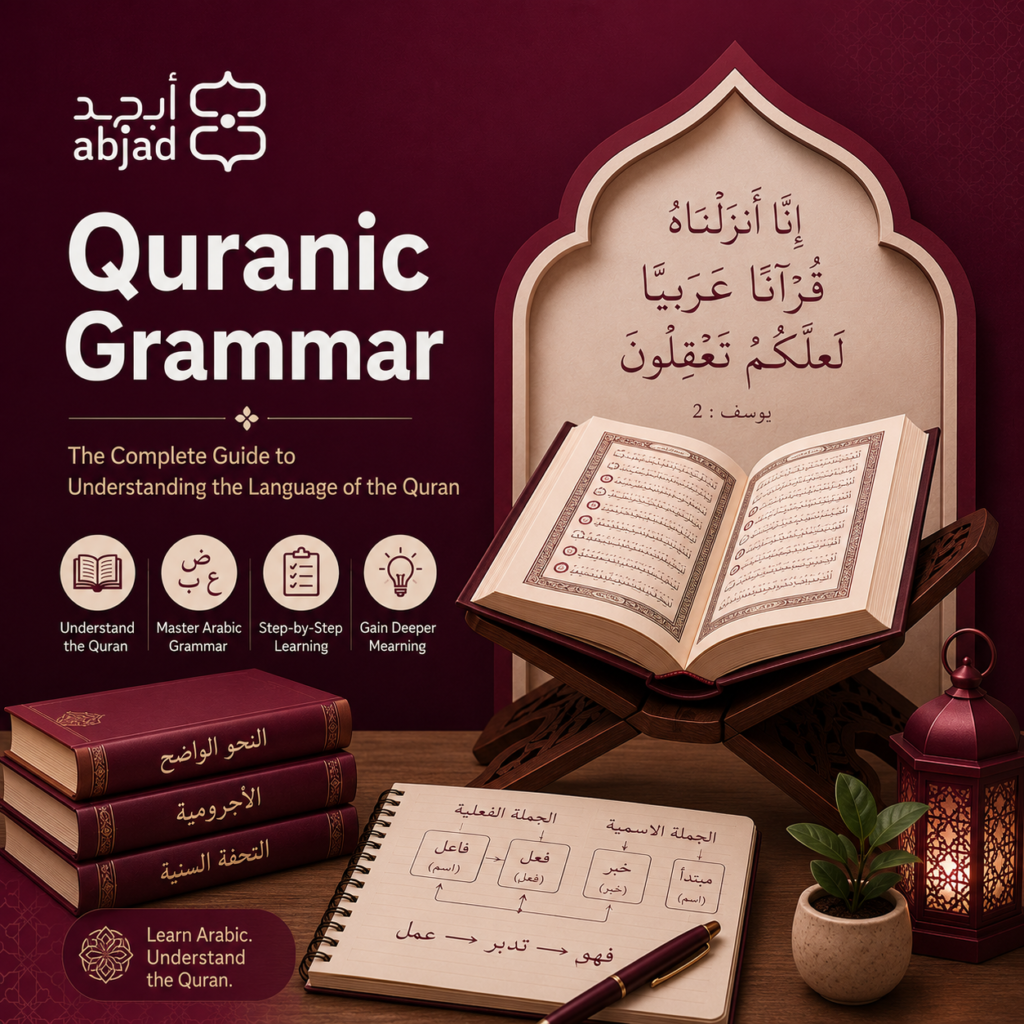
Have you ever recited a verse from the Quran and understood the words individually, yet missed the deeper meaning of the sentence? The difference between recognizing Quranic words and truly understanding Allah’s message lies in grammar.
Quranic Arabic grammar is the system that reveals how words connect, how meanings are built, and why every ending in the Quran carries significance. Through Nahw (syntax) and Sarf (morphology), learners move beyond translation and begin to understand the structure, precision, and beauty of the Quran’s original language.
This guide explains the essential Quranic grammar rules every learner should know, why they matter, and the step-by-step path to building a foundation for deeper Quranic understanding.
What Is Quranic Grammar?
Quranic grammar is the systematic study of the classical Arabic rules that structure every sentence, every word, and every ending in the Holy Quran.
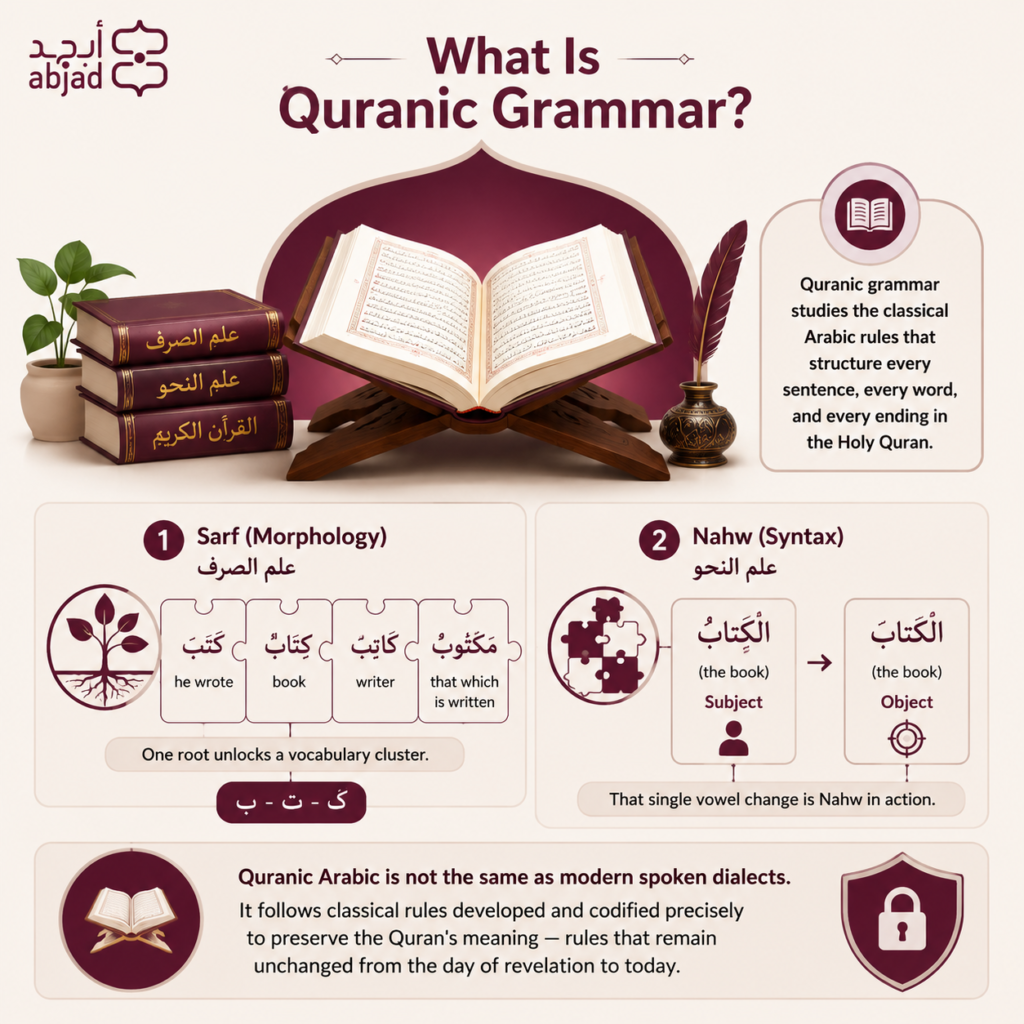
It rests on two interlocking sciences:
1. Sarf (Morphology — علم الصرف)
studies how words are formed and how they change. From a single three-letter root like ك-ت-ب, Sarf produces: كَتَبَ (he wrote), كِتَابٌ (book), كَاتِبٌ (writer), مَكْتُوبٌ (that which is written). One root unlocks a vocabulary cluster.
2. Nahw (Syntax — علم النحو)
studies how words combine into sentences and how their endings shift according to their grammatical role. الكِتَابُ (the book — subject) becomes الكِتَابَ (the book — object). That single vowel change is Nahw in action.
Quranic Arabic is not the same as modern spoken dialects. It follows classical rules developed and codified precisely to preserve the Quran’s meaning — rules that remain unchanged from the day of revelation to today.
Why Learning Quranic Arabic Grammar Matters?
The importance of understanding the Quran’s language is not a modern academic suggestion. It is grounded in divine command and prophetic instruction.
Allah says in the Quran:
إِنَّا أَنزَلۡنَـٰهُ قُرۡءَٰنًا عَرَبِيًّا لَّعَلَّكُمۡ تَعۡقِلُونَ
“Indeed, We have sent it down as an Arabic Quran so that you may reason [and understand].” — Surah Yusuf, 12:2
The verse links the Arabic nature of the Quran directly to the act of reasoning and understanding. Grammar is the door through which that understanding enters.
Umar ibn al-Khattab (رضي الله عنه) reported the Prophet ﷺ’s instruction on this matter. The Prophet ﷺ said:
تَعَلَّمُوا الْعَرَبِيَّةَ فَإِنَّهَا مِنْ دِينِكُمْ
“Learn Arabic, for it is part of your religion.”
This hadith establishes Arabic — and by extension Quranic grammar — not as an intellectual luxury but as a dimension of religious practice. The Quranic Arabic course is built directly around this principle, moving learners through grammar within the context of real Quranic verses from the first lesson.
Discover the Beauty of Quranic Arabic With a FREE Trial Today

Watch Our Classes in Action
Curious what a real session looks like? Take a peek inside our interactive classrooms and see how our expert instructors bring the Arabic language to life. Watch a sample lesson below!
Begin Your Arabic Journey in the UAE
Join Abjad Institute for a professional and immersive Arabic language experience tailored to your goals.
Book Your Free TrialRead more: How to Learn Quranic Arabic Free Online in the UAE?
The Core Quranic Arabic Grammar Rules Every Learner Must Know
Quranic Arabic grammar covers a rich body of rules, but a small set governs the majority of what you encounter in everyday recitation. Mastering these first gives learners the highest return on their study time.
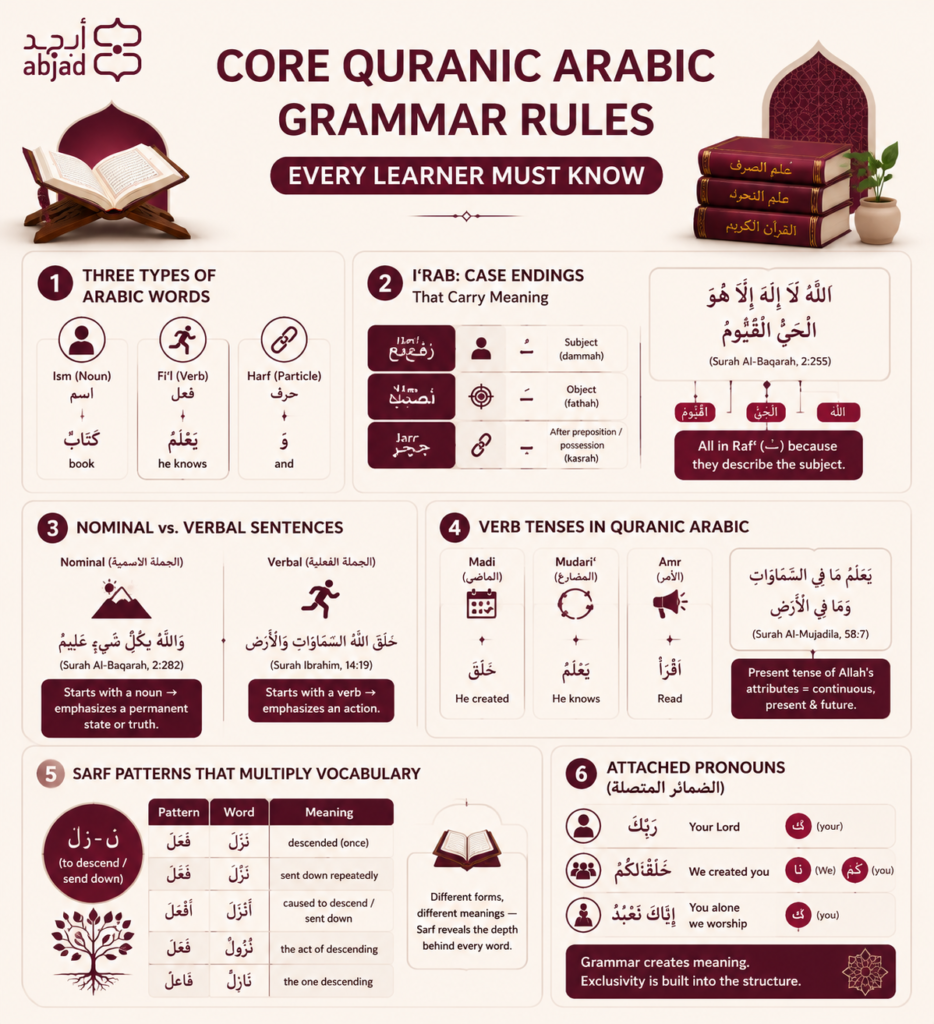
1. The Three Types of Arabic Words
Every word in the Quran belongs to one of three categories, and knowing which category a word belongs to determines everything about how it behaves grammatically.
- Ism (اسم — Noun): Includes names, places, concepts, pronouns, and adjectives, such as اللهُ، الرَّحِيمُ، كِتَابٌ.
- Fi‘l (فعل — Verb): Describes actions in the past, present, or command form, such as خَلَقَ (he created)، يَعْلَمُ (he knows)، اقْرَأْ (read).
- Harf (حرف — Particle): Connects words and carries meaning but cannot stand independently, such as فِي (in)، مِنْ (from)، وَ (and).
This classification is not just academic. A beginner who cannot identify whether رَحْمَةٌ is an ism will struggle to parse why its ending changes across different Quranic verses. Every advanced rule builds on this foundation.
2. I’rab: Case Endings That Carry Meaning
I’rab (الإعراب) is the system of grammatical case endings applied to nouns and how they signal each word’s role in the sentence. Arabic has three cases:
- Raf‘ (رفع): Nominative case, usually marking the subject, with dammah (ـُ).
- Nasb (نصب): Accusative case, often marking the object, with fathah (ـَ).
- Jarr (جر): Genitive case, used after prepositions or in possession structures, with kasrah (ـِ).
Here is why this matters practically. In Surah Al-Baqarah, 2:255 (Ayat al-Kursi):
اللَّهُ لَا إِلَٰهَ إِلَّا هُوَ الْحَيُّ الْقَيُّومُ
“Allah — there is no deity except Him, the Ever-Living, the Sustainer of existence.”
اللهُ carries a damma (ـُ) — raf’ — because it is the subject of a nominal sentence. الحَيُّ and القَيُّومُ both carry raf’ because they are attributes agreeing with the subject. A student who understands i’rab reads this sentence with grammatical precision, not just phonetic memory.
The critical practitioner note: many students memorize the label “raf'” before they understand why a word takes it. The correct teaching sequence is: identify the word’s role first, then name the case ending that follows. Role → Case, not Case → Role.
3. Nominal Sentences (الجملة الاسمية) vs. Verbal Sentences (الجملة الفعلية)
The Quran uses both sentence types deliberately, and each carries a distinct emphasis.
A nominal sentence begins with a noun and typically expresses a permanent state or ongoing truth. Consider:
وَاللَّهُ بِكُلِّ شَيۡءٍ عَلِيمٌ
“And Allah is Knowing of all things.” — Surah Al-Baqarah, 2:282
Starting with اللهُ (a noun) emphasizes the permanence of this attribute — Allah’s knowledge is not an event; it is a constant reality.
A verbal sentence begins with a verb and emphasizes an action. Consider:
خَلَقَ اللَّهُ السَّمَاوَاتِ وَالْأَرْضَ
“Allah created the heavens and the earth.” — Surah Ibrahim, 14:19
Here the verb خَلَقَ comes first, foregrounding the act of creation itself. The grammar is not decorative — it is the message.
4. Verb Tenses in Quranic Arabic
Arabic verbs carry three tenses that Quranic grammar uses with precision:
- Madi (الماضي): Completed actions, such as خَلَقَ (He created).
- Mudari‘ (المضارع): Present or ongoing actions, such as يَعْلَمُ (He knows).
- Amr (الأمر): Commands, such as اقْرَأْ (Read).
The present tense in the Quran is especially significant when used for Allah’s attributes. When Allah says:
يَعْلَمُ مَا فِي السَّمَاوَاتِ وَمَا فِي الْأَرْضِ
“He knows what is in the heavens and what is on the earth.” — Surah Al-Mujadila, 58:7
The mudari’ form يَعْلَمُ signals continuous, present, and future knowledge — not a knowledge that happened once and ended. Grammar carries theology.
5. Sarf Patterns That Multiply Your Quranic Vocabulary
Sarf (morphology) is the science of word formation. Every Arabic word descends from a root of typically three letters. The Quran uses the root ن-ز-ل (to descend/send down) in multiple derived forms — and Sarf reveals why each form was chosen:
| Pattern | Word | Meaning |
| فَعَلَ (basic verb) | نَزَلَ | descended (once) |
| فَعَّلَ (emphasis/repetition) | نَزَّلَ | sent down repeatedly |
| أَفْعَلَ (causative) | أَنْزَلَ | caused to descend / sent down |
| فَعْل (verbal noun) | نُزُولٌ | the act of descending |
| فَاعِل (active participle) | نَازِلٌ | the one descending |
When Allah uses أَنزَلْنَا in Surah Yusuf, 12:2 and نَزَّلَ in Surah Al-Furqan, 25:1, a student without Sarf sees two similar words. A student with Sarf understands that one emphasizes the act of sending while the other emphasizes gradual, repeated revelation — a distinction with real tafsir implications.
A learner who masters these five forms first will be able to analyze the vast majority of Quranic verbs they encounter — before spending time on the less common forms. If your schedule doesn’t allow fixed weekly sessions, Abjad Institute’s self-paced Arabic course lets you work through Sarf and Nahw at whatever pace fits your life, without losing the structure.
Begin Your Self-Paced Arabic Learning Journey With a FREE Trial Today

6. Attached Pronouns (الضمائر المتصلة)
The Quran frequently attaches pronouns directly to verbs and nouns, and recognizing them is essential for following who is being addressed or described.
Examples:
- رَبِّكَ — Your Lord (كَ = your)
- خَلَقْنَاكُمْ — We created you (نَا = We, كُمْ = you)
- إِيَّاكَ نَعْبُدُ — You alone we worship
That last example from Surah Al-Fatihah, 1:5 is one of the most discussed grammatical choices in all of Quranic tafsir. The object إِيَّاكَ is placed before the verb نَعْبُدُ — a deliberate inversion in Nahw that creates exclusive emphasis: You alone we worship, not others alongside You. This is theological exclusivity encoded in grammar.
Read more: What Is Quranic Arabic?
How to Learn Quranic Arabic Grammar Step by Step?
Learning Quranic Arabic grammar is most effective when the study sequence follows the natural development of the language. Each stage builds on the previous one, allowing learners to understand Quranic verses gradually instead of memorizing isolated rules.
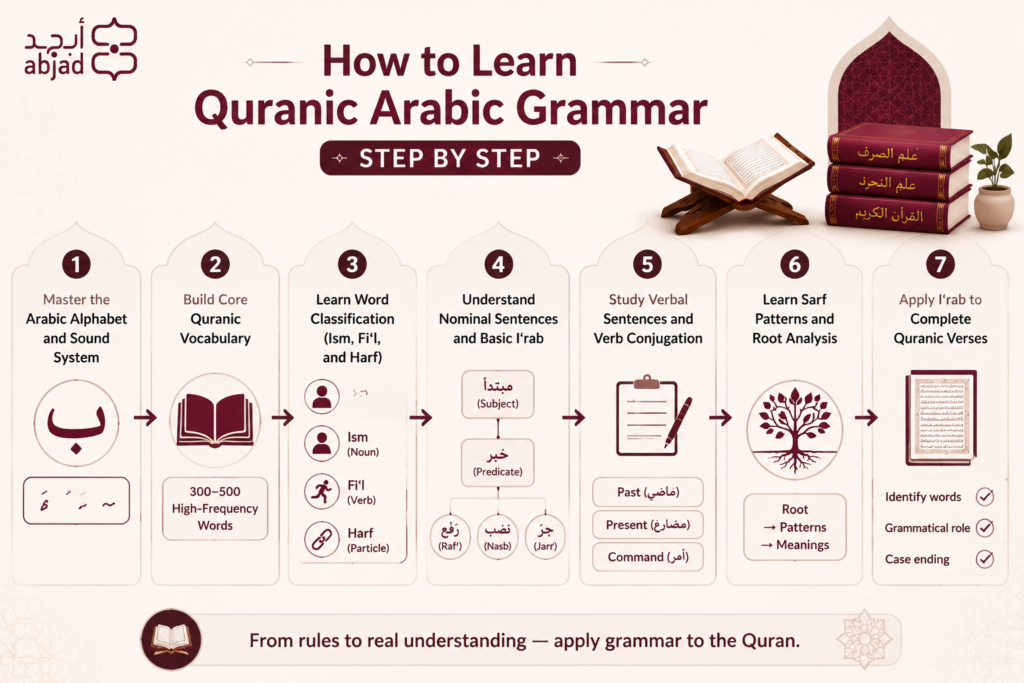
1. Master the Arabic Alphabet and Sound System
Before studying grammar, learners need a strong foundation in Arabic letters, pronunciation, and vowel markings. Correct reading of letters and harakat helps students recognize word endings and avoid mistakes when applying grammar rules.
2. Build Core Quranic Vocabulary
Learning the most frequent Quranic words before advanced grammar allows students to apply rules to familiar examples. Focusing on 300–500 high-frequency Quranic words gives learners a strong vocabulary base and makes grammar concepts easier to understand.
3. Learn Word Classification (Ism, Fi‘l, and Harf)
The first grammar skill is identifying the three types of Arabic words:
- Ism (Noun)
- Fi‘l (Verb)
- Harf (Particle)
This classification is the foundation of Quranic grammar because every sentence analysis begins by understanding the role of each word.
4. Understand Nominal Sentences and Basic I‘rab
Learners should begin with nominal sentences (الجملة الاسمية) and understand the relationship between mubtada’ (subject) and khabar (predicate). From there, they can gradually learn I‘rab and how case endings such as raf‘, nasb, and jarr reveal meaning.
5. Study Verbal Sentences and Verb Conjugation
The next step is learning verbal sentences (الجملة الفعلية) and how Arabic verbs change according to tense, person, gender, and number. Understanding past, present, and command forms helps learners recognize who performed an action and when it occurred.
6. Learn Sarf Patterns and Root Analysis
Sarf (Arabic morphology) teaches learners how words are formed from their roots. Starting with basic patterns such as Form I (فَعَلَ) and Form II (فَعَّلَ) helps students recognize connections between Quranic words and expand their vocabulary efficiently.
7. Apply I‘rab to Complete Quranic Verses
The final stage is applying grammar directly to Quranic text. Learners analyze complete verses by identifying each word’s type, grammatical role, and case ending. This practical application transforms grammar from memorized rules into real Quranic understanding.
This is where grammar becomes Quranic understanding rather than academic exercise. Start with short surahs and build toward longer passages gradually. Many learners at this stage find that working on Arabic script precision in parallel — through a dedicated Arabic writing course — sharpens their ability to spot case endings and root patterns on the page, which makes verse analysis noticeably faster.
Start Your Arabic Writing Journey With a FREE Trial Today
Inside Our Live Classes
Don’t just take our word for it—see for yourself! Click below to watch short clips from our live classes and meet the instructors who will guide your learning journey.
Begin Your Arabic Journey in the UAE
Join Abjad Institute for a professional and immersive Arabic language experience tailored to your goals.
Book Your Free TrialUnlock the Meaning of the Quran with Abjad Institute
Whether your goal is to understand the Quran directly, strengthen your Arabic foundation, or master the grammar behind Quranic verses, learning with qualified teachers makes the journey clearer and more effective.
At Abjad Institute, our structured Quranic Arabic programs guide learners step by step through the essential grammar skills needed for deeper Quran understanding.
Our programs include:
- Quranic Arabic Grammar (Nahw and Sarf)
- Quranic vocabulary and root analysis
- Arabic reading and pronunciation foundations
- Understanding Quranic sentence structures
- Tajweed and correct Quran recitation
- Interactive online classes
- Personalized instruction for children and adults
Book your free trial session today and take the first step toward understanding the Quran through its original language.

Discover Our Arabic Courses
- Arabic Course for Kids
- Arabic Conversation for Kids
- Arabic Qaida for Kids
- Beginner Arabic for Kids
- Arabic Grammar for Kids
- Teen Arabic Summer Course
- Arabic Kids Camps
- UAE Kindergarten Arabic Classes
- Modern Standard Arabic Course
- Fusha Arabic Course
- Classical Arabic Course
- Emirati Arabic Course
- Gulf Arabic Course
- Learn Saudi Arabic
- Business Arabic Course UAE
- Arabic Language Classes for Professionals in UAE
- Quranic Arabic Course
Begin Your Arabic Journey in the UAE
Join Abjad Institute for a professional and immersive Arabic language experience tailored to your goals.
Book Your Free TrialConclusion
Quranic grammar built on the twin sciences of Nahw (syntax) and Sarf (morphology) is the tool that transforms the Quran from a text you recite into a message you comprehend. The core rules covered in this guide word classification, i’rab, nominal and verbal sentences, verb tenses, Sarf patterns, and attached pronouns form the foundation every learner needs before advancing further.
The goal is not to become a grammarian. The goal is to sit with a verse of the Quran and understand, directly and without a translation in between, what Allah is saying to you. That goal is reachable, and it begins with the first rule.
Frequently Asked Questions About Quranic Grammar
Learning Quranic grammar raises many questions for beginners, especially about Nahw, Sarf, I‘rab, study timelines, and the best way to start. These answers address the most common concerns learners have when building a foundation for understanding the Quran’s language.
What is the difference between Quranic Arabic grammar and modern Arabic grammar?
Quranic Arabic grammar follows classical rules codified to preserve the exact linguistic form of the Quran. Modern Arabic dialects have dropped many case endings and simplified sentence structures. A student who learns only spoken Arabic will understand everyday conversation but will not be able to analyze Quranic sentences accurately.
Do I need to learn both Nahw and Sarf to understand the Quran?
Yes. Nahw tells you how words function within a sentence; Sarf tells you how those words are formed and what their root reveals about their meaning. Studying one without the other leaves a significant gap — you can identify a word’s role without understanding its deeper meaning, or understand its formation without knowing its function.
How long does it take to learn Quranic Arabic grammar?
Most students build a solid foundational understanding of Quranic grammar within 6 to 12 months of consistent study — typically 4 to 5 hours per week with a qualified instructor. The variable is not intelligence; it is consistency and the quality of instruction.
Can a complete beginner start learning Quranic grammar?
Yes, provided the sequence is correct. A beginner should start with the Arabic alphabet and high-frequency Quranic vocabulary before touching grammar rules. Jumping to i’rab without these foundations is the most common reason learners stall early.
Is it necessary to memorize all Sarf patterns to understand the Quran?
Not all ten forms carry equal frequency in the Quran. Forms I, II, IV, V, and X appear most often. A learner who masters these five forms first will be able to analyze the vast majority of Quranic verbs they encounter before moving to the less common forms.
What is I’rab and why does it matter so much in Quranic grammar?
I’rab is the system of case endings that shows each word’s grammatical role in a sentence. It matters because a change in a single short vowel can shift who is doing an action, who is receiving it, or how two words relate to each other — changes that affect the meaning of the verse directly.





Leave a Reply