 Learn Arabic
Pick up any Arabic text and you will encounter verbs that end abruptly with no vowel, or that seem to have lost a final letter entirely.
This is not a printing error. It is jazm in Arabic, one of the language’s most logical and consistent grammatical mechanisms, and once you grasp it, reading Arabic shifts from guesswork to genuine understanding.
Jazm (الجزم) is the fourth grammatical state of the Arabic verb. It belongs exclusively to the present-tense form (the muḍāriʿ) and is triggered by a specific set of particles called jawāzim.
When jazm enters a verb, the verb’s final vowel disappears, a weak letter is deleted, or the verb’s final nūn is dropped.
These changes are not decorative; they carry meaning. A verb in jazm signals negation in the past, a prohibition, a command directed at a third party, or the grammatical linkage inside a conditional sentence.
For residents in the UAE studying Arabic jazm is one of the milestones where grammatical fluency becomes visible and practical.
What You’ll Learn in This Article:
- The precise meaning of jazm in Arabic both lexically and as a grammatical term.
- Which particles govern a single verb, and which govern two verbs simultaneously.
- The three grammatical signs that mark a verb as majzūm (in the state of jazm).
- How jazm appears throughout the Quran with real verse examples.
- The most common errors UAE learners make with this rule, and how to correct them.
Start Your Arabic Course for Beginners UAE Today

Understanding Jazm In Arabic Means You Read Verbs
Arabic grammar is built on the principle of iʿrāb: changes at the end of words that signal their grammatical role in a sentence.
Nouns shift their endings to show whether they are subjects, objects, or possessors. The muḍāriʿ verb does the same — and jazm in Arabic is the grammatical state that marks it as negated, prohibited, commanded, or conditional.
Grasping jazm gives you interpretive control over one of the most active parts of the Arabic verb system. Without it, reading connected Arabic text means constant ambiguity about whether a verb is in its default raised state or has been shifted by a particle into a different meaning.
A. What Does Jazm Mean Linguistically And Grammatically?
Jazm (جزم) derives from the Arabic root meaning “to cut” or “to sever decisively.” Lexically, jazama al-shayʾ means to cut something with finality — no reversal, no ambiguity. Classical Arabic dictionaries define jazm as a decisive act.
The grammatical use of the term is metaphorically precise: when jazm enters a verb, it “cuts” the final vowel away from the word’s ending, leaving silence in its place.
Grammatically, jazm is defined as a change (taghyīr iʿrābī) that occurs at the end of the muḍāriʿ verb when a jazm-triggering particle precedes it.
The verb’s default final ḍamma — the vowel that signals its baseline state — is replaced by sukūn, or in irregular cases, a final letter is removed entirely.
The result is a verb that means something different from its unmarked form, with the change readable directly off the page.
Join the Best Arabic from Scratch Course in the UAE with the first session free

B. Why Does Jazm Apply Exclusively To The Muḍāriʿ Verb?
Jazm does not touch nouns, past-tense verbs, or imperative verbs. Classical grammarians explain this restriction by pointing to the muḍāriʿ verb’s structural resemblance to the Arabic noun: like nouns, it accepts inflectional endings that change with grammatical context.
Because the muḍāriʿ is flexible in this way, it can receive all four grammatical states — rafʿ, naṣb, jarr-equivalent, and jazm — while other verb types are grammatically fixed (mabnī).
Nouns that end in sukūn — such as مَنْ, كَمْ, or الَّذِي — carry what grammarians call sukūn al-bināʾ: a fixed, built-in sukūn that has nothing to do with iʿrāb. Learners who confuse this with the sukūn of jazm make errors in parsing that compound over time.
The distinction is structural: the verb’s sukūn of jazm replaces a vowel that was there before; the noun’s sukūn of bināʾ was never a vowel to begin with.
C. Where Does Jazm Sit Within Arabic’s Four Grammatical States?
Arabic iʿrāb recognizes four states: rafʿ (nominative), naṣb (accusative), jarr (genitive), and jazm. The first three apply to both nouns and verbs in their respective domains; the fourth belongs only to the muḍāriʿ.
This means jazm is the verb’s unique grammatical territory — the marker that separates it from all other word types and signals its specific function in the sentence.
For anyone working on how to read Arabic script in the UAE, recognizing the sukūn of jazm in unvoweled text is one of the first practical grammar skills to develop. Standard Arabic print — newspapers, websites, official documents — omits most vowel marks.
The reader supplies the correct vowel from grammatical knowledge. Knowing jazm means supplying sukūn correctly, rather than guessing.
Unlock the Beauty of Arabic at The Arabic Learning Academy with a FREE Trial

The Conditionals That Trigger Jazm
Jazm does not occur spontaneously. A grammatical particle (jāzim) must precede the verb to trigger the change.
Arabic grammarians divide these particles into two clear categories: those that govern a single muḍāriʿ verb, and those that govern two simultaneously. Getting comfortable with both categories is the foundation of working with jazm in real Arabic texts.
A. Four Particles That Jazzim A Single Verb
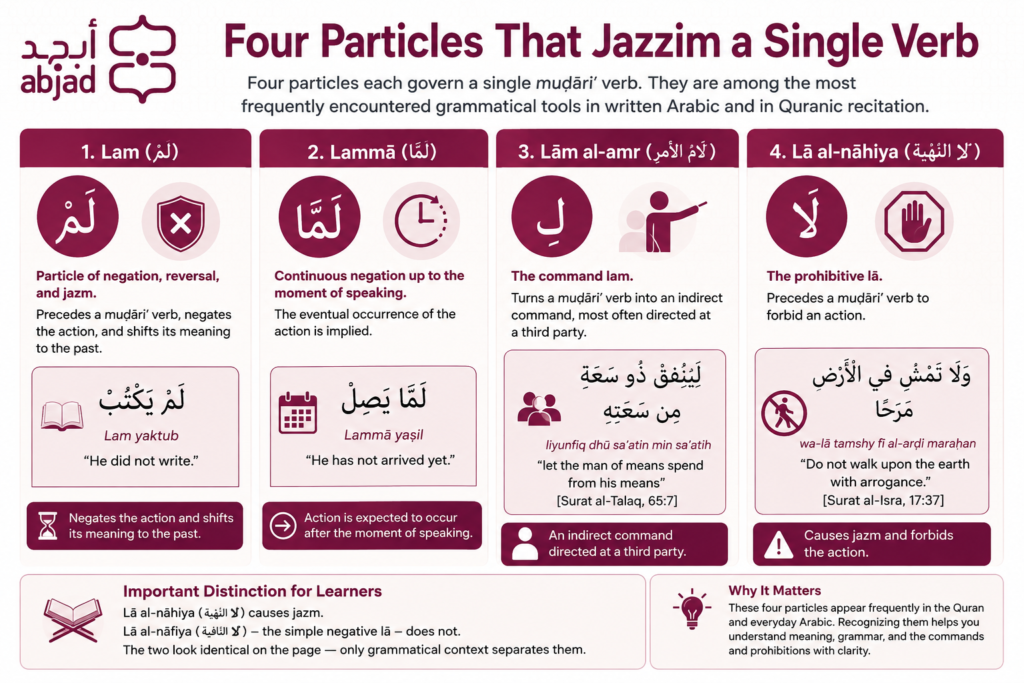
Four particles each govern a single muḍāriʿ verb. They are among the most frequently encountered grammatical tools in written Arabic and in Quranic recitation.
Lam (لَمْ)
Lam (لَمْ) is a particle of negation, reversal, and jazm. It precedes a muḍāriʿ verb, negates the action, and shifts its meaning to the past. Lam yaktub (لَمْ يَكْتُبْ) — “he did not write” — uses a present-tense verb form but a past-tense meaning.
Lammā (لَمَّا)
Lammā (لَمَّا) works similarly but with two critical differences: the negation is continuous up to the moment of speaking, and the eventual occurrence of the action is implied. Lammā yaṣil (لَمَّا يَصِلْ) means “he has not arrived yet” — with the unspoken sense that he is expected.
Lām al-amr (لامُ الأمرِ)
Lām al-amr (لامُ الأمرِ) is the command lam — a prefix that turns a muḍāriʿ verb into an indirect command, most often directed at a third party. The Quran uses it throughout: liyunfiq dhū saʿatin min saʿatih
(لِيُنفِقْ ذُو سَعَةٍ مِّن سَعَتِهِ) — “let the man of means spend from his means” (Surat al-Talaq, 65:7).
Lā al-nāhiya (لا النَّاهية)
Lā al-nāhiya (لا النَّاهية) is the prohibitive lā. It precedes a muḍāriʿ verb to forbid an action: wa-lā tamshy fī al-arḍi maraḥan
(وَلَا تَمْشِ فِي الأَرْضِ مَرَحًا) — “do not walk upon the earth with arrogance” (Surat al-Isra, 17:37).
The critical distinction for learners: lā al-nāhiya causes jazm; lā al-nāfiya (the simple negative lā) does not. The two look identical on the page — only grammatical context separates them.
B. Conditional Particles That Jazzim Two Verbs At Once
The conditional family (adawāt al-shart al-jāzima) governs two muḍāriʿ verbs simultaneously. The first verb (fiʿl al-shart) states the condition; the second (jawāb al-shart) states the result. Both enter jazm.
The principal conditional particle is in (إنْ): in tadrus tanjah (إنْ تَدْرُسْ تَنْجَحْ) — “if you study, you will succeed.”
Beyond in, the family includes man (مَنْ) for rational beings, mā (مَا) for non-rational things, mahmā (مَهْمَا) similarly, matā (مَتَى) and ayyāna (أيَّانَ) for time, and ayna (أيْنَ), annā (أنَّى), and ḥaythumā (حَيْثُمَا) for place.
A nuance that separates thorough understanding from surface knowledge: when a conditional particle governs a verb whose weak final letter (alif, wāw, or yāʾ) is followed by a group suffix, that letter disappears due to the meeting of two silent letters (iltiqāʾ al-sākinayn) — not because of jazm itself.
In those cases, jazm’s sign is nūn deletion, not weak-letter deletion. Getting this right prevents miscounting the signs of jazm and misreading Quranic verb forms.
Read also: The Shadda In Arabic Small Mark That Doubles The Impact
C. Jazm Without A Visible Particle, The Case Of Jawāb Al-Ṭalab
A muḍāriʿ verb can enter jazm with no explicit jāzim particle in sight, if it follows a request — a command, a prohibition, a question, a wish, or an offer — and carries a conditional implication. Classical grammarians call this mechanism jawāb al-ṭalab.
The sentence zurni azurk (زُرْنِي أَزُرْكَ) — “visit me and I will visit you” — contains no conditional particle. Yet azurk is majzūm: the underlying meaning is “if you visit me, I will visit you”.
The Quran uses this construction:
qul li-ʿibādī alladhīna āmanū yuqīmū al-ṣalāh “قُل لِعِبَادِيَ الَّذِينَ آمَنُوا يُقِيمُوا الصَّلَاةَ” (Surat Ibrahim, 14:31)
where yuqīmū is majzūm as a result of the implied condition embedded in the command. This mechanism separates advanced readers from those still working at the surface level of the grammar.
Begin Your Kid’s Path of Speaking Arabic

Three Signs That Reveal A Verb Is In Jazm
When jazm enters a verb, the result depends on the verb’s ending. There are exactly three outcomes, and every majzūm verb in Arabic falls into one of them.
Knowing all three lets you identify jazm in any text — including unvoweled Arabic, where grammatical knowledge must supply what the diacritical marks do not show.
A. Sukūn — The Signature Mark
When a muḍāriʿ verb ends in a sound consonant and carries no attached group suffix, jazm marks the verb with sukūn on its final letter. The ḍamma that was there in the raised state disappears; silence takes its place.
Lam yaktub (لَمْ يَكْتُبْ) — the bāʾ rests with sukūn. Lā tafraḥ (لَا تَفْرَحْ) — the ḥāʾ rests with sukūn.
The Quran: wa-in lam tafʿal famā ballaghta risālatah (وَإِن لَّمْ تَفْعَلْ فَمَا بَلَّغْتَ رِسَالَتَهُ) — “and if you do not do it, then you have not delivered His message” (Surat al-Maida, 5:67). The verb tafʿal wears its jazm visibly in the sukūn on the lam.
Watch Our Classes in Action
Curious what a real session looks like? Take a peek inside our interactive classrooms and see how our expert instructors bring the Arabic language to life. Watch a sample lesson below!
Begin Your Arabic Journey in the UAE
Join Abjad Institute for a professional and immersive Arabic language experience tailored to your goals.
Book Your Free TrialB. Deletion Of The Weak Letter
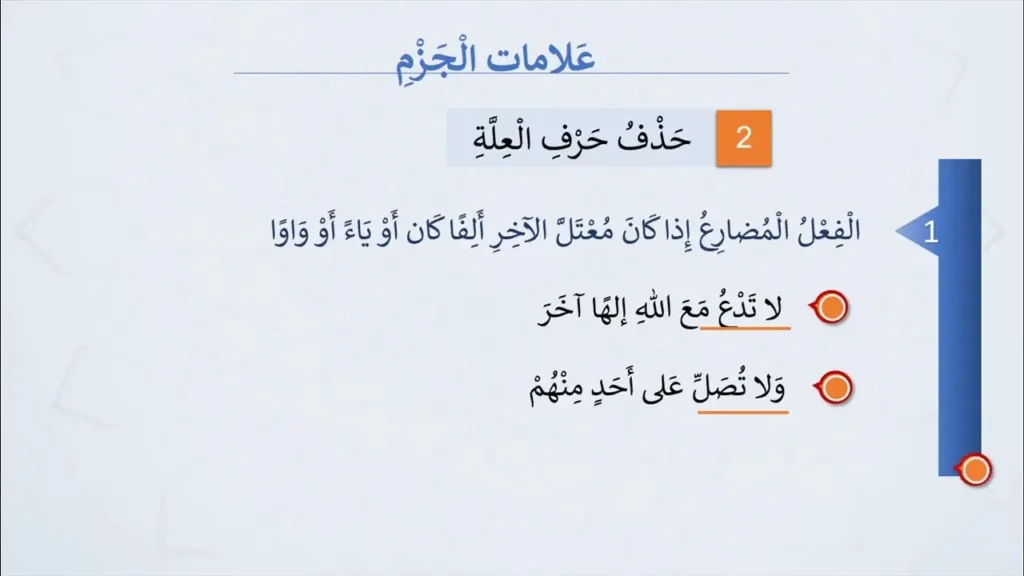
When the muḍāriʿ verb ends in a weak letter — alif, wāw, or yāʾ — jazm is signaled not by sukūn but by the deletion of that final letter.
The consonant before it keeps a residual vowel that signals which letter was removed: fatḥa for alif, ḍamma for wāw, kasra for yāʾ.
Three Quranic examples make each case concrete:
- Alif deleted: wa-lā tansa naṣībaka min al-dunyā “وَلَا تَنسَ نَصِيبَكَ مِنَ الدُّنْيَا”, “do not forget your share of this world” (Surat al-Qasas, 28:77). The original verb is tansā; the alif is gone under the prohibitive lā.
- Wāw deleted: wa-lā tadʿu maʿa Allāhi ilāhan ākhara “وَلَا تَدْعُ مَعَ اللَّهِ إِلَهًا آخَرَ”, “do not call upon another god alongside Allah” (Surat al-Qasas, 28:88). The original verb is tadʿū; the wāw is gone.
- Yāʾ deleted: wa-lā tamshy fī al-arḍi maraḥan “do not walk on earth with arrogance” (Surat al-Isra, 17:37). The original verb is tamshī; the yāʾ is gone.
C. Deletion Of The Nūn In The Five Verbs
The five verb forms (al-afʿāl al-khamsa) — the muḍāriʿ patterns that end in nūn in their default raised state — lose that nūn under jazm.
| Default Form (Marfūʿ) | Jazzimed Form | English Meaning |
| يَفْعَلُونَ | لَمْ يَفْعَلُوا | they (m. pl.) did not do |
| تَفْعَلُونَ | لَمْ تَفْعَلُوا | you (m. pl.) did not do |
| يَفْعَلَانِ | لَمْ يَفْعَلَا | they (dual) did not do |
| تَفْعَلَانِ | لَمْ تَفْعَلَا | you (dual) did not do |
| تَفْعَلِينَ | لَمْ تَفْعَلِي | you (f. sg.) did not do |
Quranic example: in yurīdā iṣlāḥan yuwaffiq Allāhu baynahumā “إِنْ يُرِيدَا إِصْلَاحًا يُوَفِّقِ اللَّهُ بَيْنَهُمَا” (Surat al-Nisaʾ, 4:35). The verb yurīdā (they two intend) has lost its nūn; yuwaffiq has received sukūn.
Both are majzūm — one through nūn deletion, the other through sukūn — demonstrating both mechanisms in a single verse.

Jazm In The Quran Where The Rule Meets The Page Every Day
For the majority of Arabic learners in the UAE jazm is not an academic curiosity. It is the mechanism behind the meaning of hundreds of Quranic verses, active in prohibitions, past negations, commands, and conditional constructions throughout the text.
Why learn Quranic Arabic is a question that often gets answered with references to spiritual connection and recitation but the answer also includes this: knowing Quranic Arabic means reading the grammatical signals that carry the Quran’s precise meanings.
A verb in jazm under lā al-nāhiya is a prohibition. A verb in jazm under lam is a past negation. A pair of verbs in jazm under in are the two halves of a conditional statement.
For anyone committed to how to read Arabic Quran in the UAE with understanding rather than recitation alone, studying jazm transforms how individual verses read.
The change from lam yara (لَمْ يَرَ — he did not see) to yarā (يَرَى — he sees) is not a minor spelling difference; it is the difference between a negated past and an affirmed present.
Understanding benefits of learning Quranic Arabic extends well beyond vocabulary — it includes grammatical fluency in precisely these mechanisms.
That fluency starts with the Quranic Arabic alphabet and its diacritical marks, which carry the jazm signs visibly in fully-voweled Quranic text and guide the ear and eye together through recitation.
Explore Our Quranic Arabic Course in the UAE to master Arabic Languag

Where UAE Learners Get Tripped Up by Jazm and the Fixes That Work
Arabic learners in the UAE arrive with very different starting points. Some are dialect speakers who grew up hearing Arabic but never studied its classical grammar formally.
Jazm creates predictable difficulties for each group, and the difficulties cluster around the same three errors.
Arabic writing practice in the UAE through structured exercises, verb tables, and Quranic sentence analysis builds the automatic recognition that makes jazm visible in any text, not just textbook examples.
Read also: The Difference Between Sukoon And Jazm- A Simple Guide
Confusing Sukūn Of Bināʾ With Sukūn Of Jazm
Words like man (مَنْ), lam (لَمْ), and bal (بَلْ) end in sukūn by default — their sukūn is a property of their grammatical construction as particles. The sukūn of jazm on a muḍāriʿ verb is entirely different: it replaces a ḍamma that was there before.
Applying Jazm To The Wrong Word Type
Seeing lam before a sentence and placing the jazm effect on a noun or a past verb is a common beginner error. The jāzim particle only affects the immediately following muḍāriʿ verb — nothing else.
Interchanging Lam And Lammā
Both negate and jazzim the muḍāriʿ, and both shift its meaning to the past. The functional difference, lam’s open temporal scope versus lammā’s continuous-to-present negation with expectation, matters in formal writing and Quranic interpretation.
Inside Our Live Classes
Don’t just take our word for it—see for yourself! Click below to watch short clips from our live classes and meet the instructors who will guide your learning journey.
Begin Your Arabic Journey in the UAE
Join Abjad Institute for a professional and immersive Arabic language experience tailored to your goals.
Book Your Free TrialAbjad Institute Where Uae Residents Learn Arabic That Sticks
Abjad Institute is one of the UAE’s most trusted Arabic language academies, offering structured, expert-guided courses for learners across all levels and age groups.
From complete beginners to advanced grammar students, from young children to working professionals, Abjad‘s programs are designed around genuine Arabic fluency in the Quran, in Modern Standard Arabic, in conversation, and in writing.
Whether you are in Dubai, Abu Dhabi, Sharjah, or anywhere across the Emirates, Abjad‘s qualified instructors teach Arabic systematically, building the grammatical awareness that makes rules like jazm feel logical rather than arbitrary.
Discover Our Arabic Courses:
- Arabic Classes for Beginners
- Arabic Course for Kids
- Arabic Conversation for Kids
- Arabic Qaida for Kids
- Beginner Arabic for Kids
- Arabic Grammar for Kids
- Teen Arabic Summer Course
- Arabic Kids Camps
- UAE Kindergarten Arabic Classes
- Modern Standard Arabic Course
- Fusha Arabic Course
- Classical Arabic Course
- Emirati Arabic Course
- Gulf Arabic Course
- Learn Saudi Arabic
- Business Arabic Course UAE
- Arabic Language Classes for Professionals in UAE
Start your Arabic course at Abjad Institute today with a Free Trial and begin reading the Arabic that actually surrounds you in the UAE

Conclusion
Jazm in Arabic is precise, consistent, and learnable. It marks the muḍāriʿ verb in four distinct grammatical situations: past negation (through lam and lammā), prohibition (through lā al-nāhiya), command directed at a third party (through lām al-amr), and conditional relationships (through the conditional particle family, or through the jawāb al-ṭalab mechanism without any visible particle).
Each situation produces one of three visible signs on the verb: sukūn, deletion of a weak final letter, or deletion of the final nūn.
For UAE learners, this is not optional grammar. Jazm appears in the Quran on nearly every page, in Standard Arabic used in government, media, and formal correspondence, and in school curricula from primary level onward.
Learn the particle families, recognize the three signs, practice with Quranic text, and work with a teacher who can anchor the rule in examples you actually encounter.
Read also: Sukoon In Arabic – Meaning, Pronunciation and Grammatical Role
Frequently Asked Questions
What is jazm in Arabic grammar?
Jazm is the fourth grammatical state of the muḍāriʿ (present/imperfect) Arabic verb. It is triggered by specific particles — including lam, lammā, lā al-nāhiya, lām al-amr, and the conditional particle family — and marks the verb with one of three signs: sukūn, deletion of a weak final letter, or deletion of the final nūn. Jazm does not apply to nouns, past-tense verbs, or imperative verbs.
What is the difference between lam and lammā in jazm?
Both lam and lammā negate a muḍāriʿ verb and shift its meaning to the past. The difference lies in scope and implication. Lam negates an action with no suggestion of future occurrence — lam yaktub means simply “he did not write.” Lammā negates continuously up to the present moment and implies the action is expected — lammā yaktub means “he has not yet written” (and is still expected to).
Does jazm ever apply to Arabic nouns?
No. Jazm applies exclusively to the muḍāriʿ verb. Some nouns end in sukūn by default — such as مَنْ, كَمْ, and الَّذِي — but this is sukūn al-bināʾ, the sukūn of grammatical construction, entirely different from the sukūn of jazm. The verb’s sukūn of jazm replaces a vowel that was there before; the noun’s sukūn of bināʾ was never a vowel in the first place.
How many categories of jazm particles are there?
There are two main categories. The first governs a single muḍāriʿ verb and includes four particles: lam, lammā, lā al-nāhiya, and lām al-amr. The second governs two muḍāriʿ verbs simultaneously and includes the conditional particle family: in, man, mā, mahmā, matā, ayyāna, ayna, annā, ḥaythumā, kayfamā, ayy, and idhmā.
How does jazm appear throughout the Quran?
Jazm is pervasive in Quranic Arabic. It appears in prohibitions (lā al-nāhiya), past negations (lam and lammā), commands to third parties (lām al-amr), and conditional sentences (in and its companion particles).
Quranic verbs such as lam tara (you did not see), wa-lā tansa (do not forget), wa-lā tadʿu (do not call), and in yurīdā (if the two intend) are all examples of jazm through different mechanisms — alif deletion, alif deletion, wāw deletion, and nūn deletion respectively.
How can I get better at recognizing jazm in Arabic texts?
Read voweled Arabic text — starting with short Quranic passages with full diacritical marks — and identify the jāzim particle first, then locate the governed verb, then check its ending for the appropriate sign. Work verb tables for all three signs across different verb types. And when questions come up, bring them to a qualified teacher rather than guessing in isolation.
Related Articles
Learn Arabic






Leave a Reply