 Quran
Quran
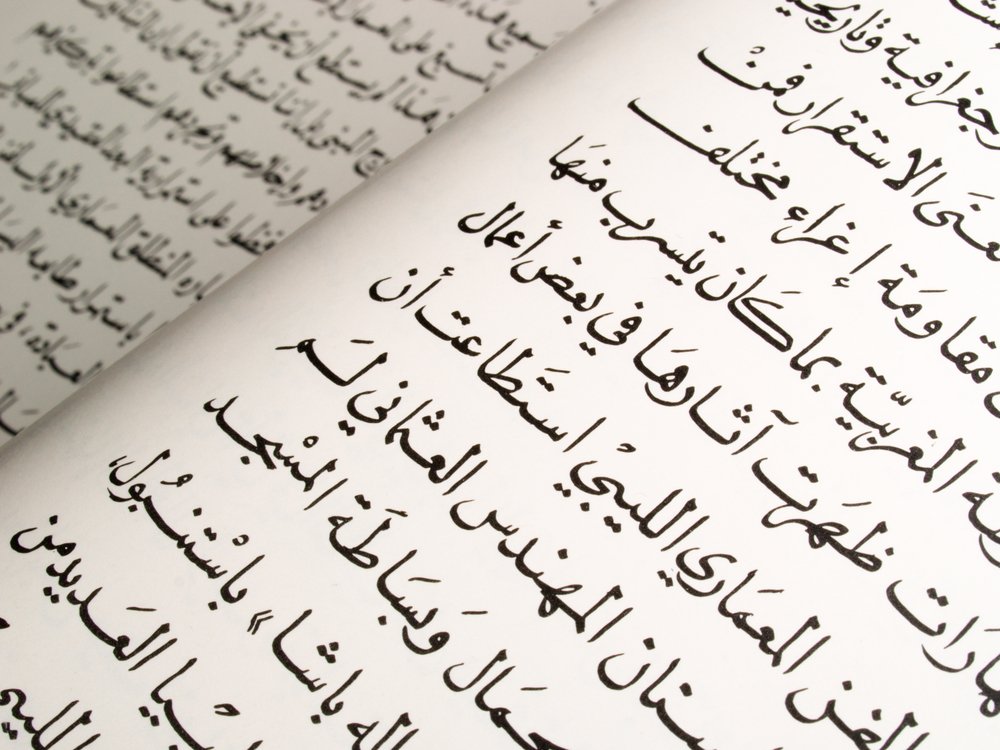
Most Arabic text you encounter every day — on road signs across Dubai, in local newspapers, on restaurant menus, in WhatsApp messages from Emirati colleagues — carries no vowel marks at all. No fatha, no kasra, no damma. Just bare letters. For anyone learning Arabic in the UAE, this gap between the classroom and real life can feel like hitting a wall.
The good news: reading Arabic without harakat is a learnable skill, not a talent. It follows a clear progression, and with the right framework, most learners make noticeable progress within weeks.
This means the goal of learning how to read without harakat in the UAE is not to “remove” something from your reading. It’s to build the knowledge base that native speakers already carry — so your brain fills in the vowels without being told.
The steps below apply universally, but learners in the UAE have a genuine advantage: Arabic is everywhere here. Road signs, government services, menus, and daily conversation give you constant low-pressure exposure that learners in non-Arabic environments simply don’t have. Use it.
1. Master The Arabic Alphabet In All Four Forms To Know How to Read Arabic Without Harakat In The UAE
Every Arabic letter appears in four shapes depending on its position in a word: initial, medial, final, and isolated. Before you can read anything without harakat, you need instant recognition of all four forms of all 28 letters — without needing a vowel mark to identify them.
Practise on unvowelled letter cards. When you can read a page of bare letters without slowing down, you are ready to move forward. The Arabic alphabet course at Abjad Institute is structured around exactly this kind of pattern recognition.
2. Build A High-Frequency Vocabulary Bank Of Arabic Language
The single biggest factor in reading without harakat is vocabulary size. When you recognise a word instantly, you do not need vowels to pronounce it — you already know it. Aim to build active recognition of the 500–1,000 most common Arabic words as early as possible.
Start with word families built around roots. The root د-ر-س (d-r-s), for example, generates: دَرَسَ (he studied), دَرْس (lesson), مَدْرَسَة (school), دِرَاسَة (study). Learn the root once, and you can read all its derivatives without marks.
Master Fusha Arabic Step by Step With a FREE Trial Today

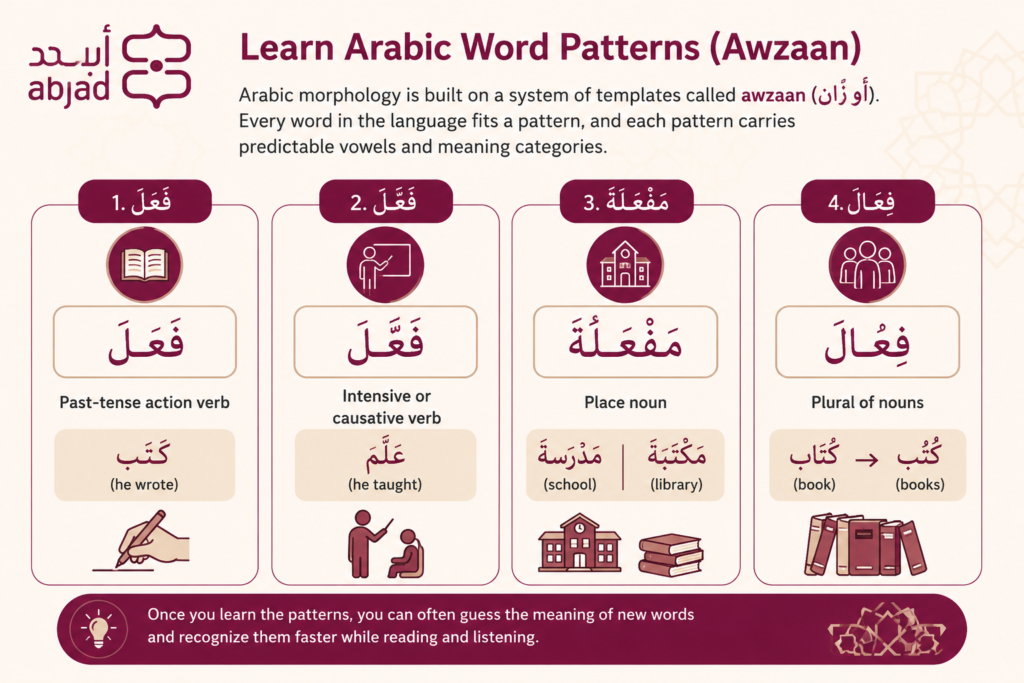
3. Learn Arabic Word Patterns (Awzaan)
Arabic morphology is built on a system of templates called awzaan (أَوْزَان). Every word in the language fits a pattern, and each pattern carries predictable vowels and meaning categories.
For example:
- فَعَلَ → past-tense action verb (كَتَبَ — he wrote)
- فَعَّلَ → intensive or causative verb (عَلَّمَ — he taught)
- مَفْعَلَة → place noun (مَدْرَسَة — school, مَكْتَبَة — library)
- فِعَال → plural of nouns (كِتَاب → كُتُب)
Once you recognise a pattern, you can pronounce an unfamiliar word correctly even without a single vowel mark. This is one of the most underused techniques in Arabic pedagogy — and one of the most powerful.
4. Study Core Arabic Grammar (Nahw)
Arabic grammar tells you what function each word performs in a sentence, and that function determines its vowels. This is the foundational mechanism behind reading unvowelled text:
- The subject (فاعل) of a verb takes a damma (ُ) on its final letter
- The object (مفعول به) takes a fatha (َ)
- Words after prepositions take a kasra (ِ)
So in the sentence الطالبُ قرأ الكتابَ (The student read the book), you know immediately that الطالب is the subject and الكتاب is the object — even without marks — because of word order and grammatical role. Once grammatical patterns become automatic, you stop guessing and start knowing.
An Arabic Grammar Course focused on irab (إعراب — case endings) will accelerate this significantly.
5. Use Context As Your Primary Reading Tool
Context is the most powerful reading aid available to you — more powerful than any rule. Before you try to decode an individual word, read the full sentence or paragraph. The surrounding words almost always narrow the possibilities to one.
Consider the sentence: ذهب الولد إلى المدرسة (The boy went to school). Even if you did not know the word مدرسة, the phrase إلى (to) signals a destination noun, and the context of a boy going somewhere strongly suggests an institution. Context + pattern = pronunciation, without a single vowel mark.
This is exactly the technique native readers use without being aware of it. It becomes automatic with practice.
Read also: Quranic Grammar: The Complete Guide to Understanding the Language of the Quran
Watch Our Classes in Action
Curious what a real session looks like? Take a peek inside our interactive classrooms and see how our expert instructors bring the Arabic language to life. Watch a sample lesson below!
Begin Your Arabic Journey in the UAE
Join Abjad Institute for a professional and immersive Arabic language experience tailored to your goals.
Book Your Free Trial6. Transit From Vowelled To Unvowelled Arabic Texts Gradually
The most common mistake learners make is jumping from fully vowelled beginner texts directly to a newspaper — and feeling defeated when they can’t read it. The transition should be gradual and deliberate.
A proven sequence:
- Read a vowelled passage until you know it well
- Cover the harakat and attempt to read from memory + knowledge
- Move to short, simple unvowelled passages on familiar topics
- Progress to news headlines, then full articles
- Finally, tackle longer prose and formal writing
Children’s Arabic stories, simple Quranic verses you have already memorised, and social media captions are ideal transition materials. If you are also working on how to read Quranic Arabic, note that the Quran is fully vowelled — which makes it excellent for reinforcing pattern recognition before moving to unvowelled text.
Master Arabic Step by Step from Scratch with a FREE Trial Class in the UAE

7. Improve Your Arabic By Reading Aloud Every Day
Reading aloud every day is one of the fastest ways to improve Arabic reading fluency. Unlike silent reading, it requires you to pronounce every word, helping you build confidence while reinforcing correct pronunciation and word recognition.
Reading aloud also engages different cognitive processes. To know how to read Arabic without tashkeel, you must choose the correct pronunciation in real time instead of skipping unfamiliar words. This strengthens your decoding skills and gradually makes reading more accurate and natural.
To measure your progress, record yourself reading occasionally and compare your pronunciation with that of a native speaker. The differences you notice become clear learning targets, helping you refine your pronunciation and improve with each practice session.
Read also: How To Read Arabic Script In The UAE
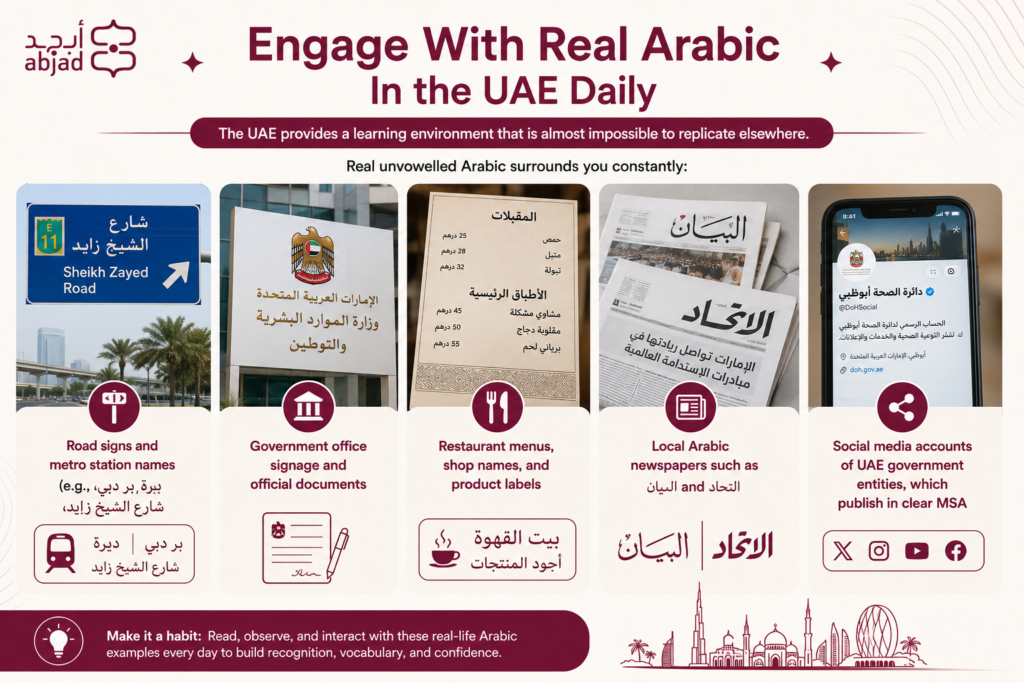
8. Engage With Real Arabic In the UAE Daily
The UAE provides a learning environment that is almost impossible to replicate elsewhere. Real unvowelled Arabic surrounds you constantly:
- Road signs and metro station names (e.g., بر دبي, ديرة, شارع الشيخ زايد)
- Government office signage and official documents
- Restaurant menus, shop names, and product labels
- Local Arabic newspapers such as البيان and الاتحاد
- Social media accounts of UAE government entities, which publish in clear MSA
Make a daily habit of reading any Arabic text you encounter in the UAE — without looking up harakat. Even five minutes of this practice compounds significantly over weeks.
Understanding how to read Arabic in the UAE context also means becoming familiar with the specific vocabulary of daily Emirati life: governmental, commercial, and cultural terms that appear constantly but rarely feature in standard textbooks.
9. Use Arabic Numerals and Calendar Systems
One practical dimension of Arabic literacy in the UAE that many learners overlook is the numeral system. The UAE uses both Eastern Arabic numerals (٠١٢٣٤٥٦٧٨٩) and Western Arabic numerals (0–9), often interchangeably. Government documents and some official signage use Eastern numerals exclusively.
Alongside this, knowing how to read Arabic dates — both Hijri and Gregorian as written in Arabic — is essential for reading official UAE documents, visa papers, tenancy contracts, and public announcements. Date formats in Arabic do not require harakat, but they do require familiarity with the Arabic names of months and the numerical conventions used in UAE bureaucracy.
10. Practise Writing Alongside Arabic Reading
Reading and writing Arabic reinforce each other in ways that most learners underestimate. When you write a word by hand — including its root letters, without harakat — your brain encodes both its visual pattern and its morphological structure simultaneously. That dual encoding makes the word faster to recognise the next time you see it in print.
Start a daily Arabic writing habit, even if it is just copying passages from a newspaper or writing short sentences about your day. Learn to write Arabic course at Abjad Institute covers the mechanics of Arabic script and word formation in a way that directly supports reading fluency. And if you are building from the very beginning, the learn arabic from scratch course provides the structured foundation that makes these steps easier to sequence correctly.
Enroll in our one of our courses to enjoy the learning journey with our dedicated teachers
Read also: How To Read Arabic For Beginners In The UAE? A Step-By-Step Guide
How to Practise Reading Arabic Without Harakat for Free
You do not need to spend money to begin this journey, particularly in the UAE.
Free resources available to you:
- YouTube channels dedicated to unvowelled Arabic reading — search for courses specifically focused on القراءة بدون تشكيل
- UAE newspaper websites — Al Bayan (البيان) and Al Ittihad (الاتحاد) publish daily content in clear Modern Standard Arabic, all unvowelled
- Government of Dubai and UAE Federal portals — official announcements are excellent practice material with practical vocabulary
- Arabic social media accounts — Instagram and X (Twitter) accounts of UAE institutions publish short, grammatically clean Arabic
- The Quran app (with the vowelled text hidden) — for those also studying Quranic Arabic, toggling off tashkeel on a digital Quran and testing yourself against memory is a powerful free technique
- Flashcard apps such as Anki, loaded with Arabic root families and word patterns
The critical point: The sources of how to read Arabic without harakat free practice works when it is consistent. Twenty minutes of daily unvowelled reading will outperform two hours once a week, every time.
Inside Our Live Classes
Don’t just take our word for it—see for yourself! Click below to watch short clips from our live classes and meet the instructors who will guide your learning journey.
Start Learning Arabic At Abjad Institute In The UAE
Abjad Institute is one of the UAE’s dedicated Arabic language institutions, offering structured courses for adults and beginners who want to move from classroom Arabic to genuine reading fluency.
If you are at the stage where you can read vowelled Arabic but struggle with real-world unvowelled text — the gap that most learners hit — Abjad’s courses are built to close exactly that gap. The curriculum progresses from alphabet recognition through grammar, morphology, and reading comprehension, giving you the tools that make unvowelled text readable rather than intimidating.
Courses available for learners in the UAE:
- Arabic Course in the UAE
- Arabic Intensive Course
- Arabic Conversation for Kids
- Beginner Arabic for Kids
- Arabic Kids Camps
- Modern Standard Arabic Course
- Fusha Arabic Course
- Classical Arabic Course
- Emirati Arabic Course
- Business Arabic Course UAE
- Arabic Language Classes for Professionals in UAE
- Quranic Arabic Course
Start your Arabic course at Abjad Institute today with a Free Trial and begin reading the Arabic that actually surrounds you in the UAE — without waiting for harakat that will never appear.
Begin Your Arabic Journey in the UAE
Join Abjad Institute for a professional and immersive Arabic language experience tailored to your goals.
Book Your Free Trial
Conclusion
Reading Arabic without harakat is ultimately about building three things: vocabulary recognition, grammatical instinct, and pattern familiarity. None of these come from memorising rules — they come from consistent, structured exposure.
The 10 steps in this guide form a complete progression from letter recognition to confident real-world reading. Work through them in sequence, use the UAE’s Arabic-rich environment as a daily practice resource, and prioritise writing alongside reading to accelerate retention.
For learners who want a structured pathway rather than self-directed practice, Abjad Institute offers courses in the UAE that are specifically designed to build the grammar knowledge and reading skills that make unvowelled Arabic accessible — from a complete beginner level through to advanced reading competence.
Read also: How To Read Arabic Letters In The UAE? A Step-By-Step Guide For Beginners
Frequently Asked Questions
How long does it take to read Arabic without harakat fluently?
Most learners with consistent daily practice — 20 to 30 minutes per day — begin reading simple unvowelled texts with reasonable accuracy within three to six months. Full fluency with complex material typically takes one to two years, depending on starting level and how much Arabic surrounds you day-to-day.
Can beginners learn to read Arabic without harakat, or is it only for advanced learners?
Beginners should start with vowelled texts — that is the correct sequence. However, you should begin transitioning to short unvowelled passages much earlier than most learners expect, typically after mastering the alphabet and around 300 to 500 high-frequency words. Staying on vowelled text too long can actually slow your progress.
Is reading Arabic without a tashkeel the same as reading Modern Standard Arabic?
Yes, essentially. Modern Standard Arabic (MSA) — the formal written variety used across media, education, and official communication in the UAE and the wider Arab world — is written without tashkeel in almost all contexts. Learning to read unvowelled text means learning to read MSA as it actually appears in the real world.
Does knowing how to write in Arabic help with reading without harakat?
Significantly. Writing forces you to internalise word structure at the letter level, which reinforces the visual pattern recognition that unvowelled reading depends on. If you want to build reading fluency faster, add writing practice to your routine. Understanding how to write in Arabic in the UAE context — including formal script conventions — also prepares you for real documents and official communication.
What is the most common mistake learners make when trying to read without harakat?
Trying to decode each word in isolation rather than reading at the sentence level. Native readers process words in context, not one by one. If you stop at every unfamiliar word and try to guess its vowels from the letters alone, you will always struggle. Train yourself to read forward, gather context, and return to ambiguous words after the sentence is complete.
Is it worth learning to read Arabic if I only live in the UAE temporarily?
Absolutely. Arabic literacy in the UAE is practically useful from day one — for reading contracts, government documents, road signs, and understanding the cultural context around you. Even basic unvowelled reading skills, built over a few months of structured study, make daily life significantly more navigable and open doors to professional opportunities that remain closed to those who rely on translation.






Leave a Reply