 Learn Arabic
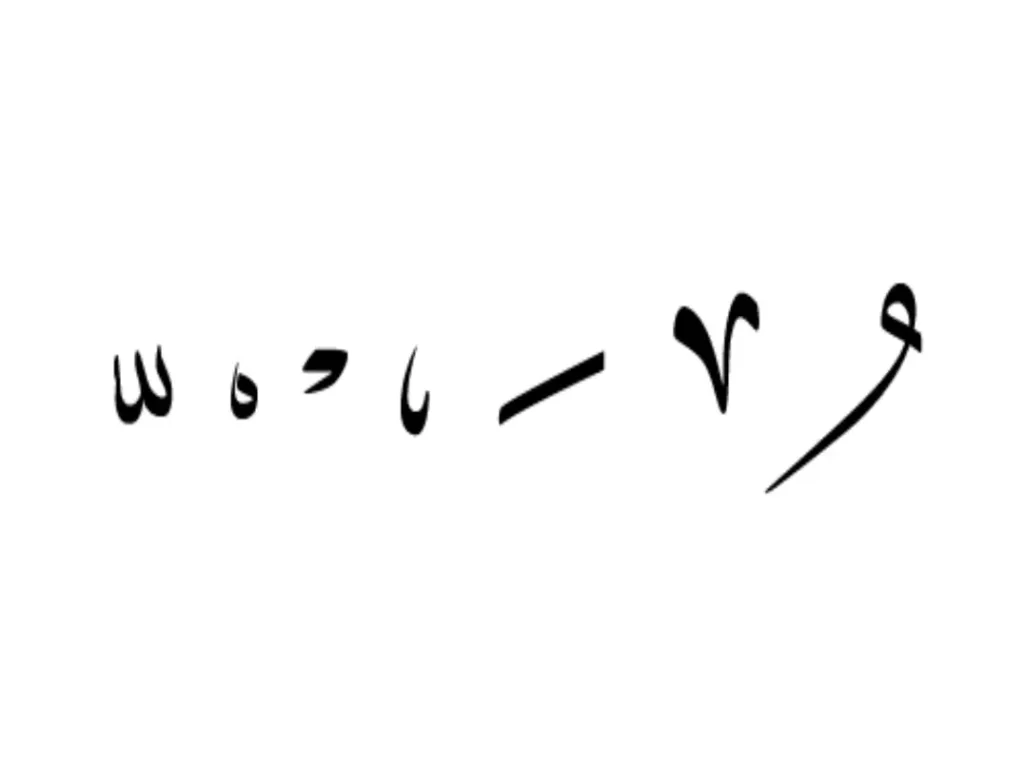
Pick up any Quran, children’s Arabic reader, or beginner textbook in the UAE and you will notice the small marks crowded above and below every letter. These are the harakat — the diacritical signs that give Arabic its vowel sounds and grammatical signals.
And the question of how many harakat in Arabic has more than one correct answer, depending on which layer of the system you are counting.
Most learners expect a single number and discover a layered system instead. Three short vowels form the phonetic foundation. A fourth mark signals silence. A fifth doubles any consonant.
Three more encode the grammatical case of indefinite nouns. Together, that is eight marks — a complete, interlocking system designed over twelve centuries ago and unchanged since.
For residents and expats in the UAE, knowing these marks in full is the difference between reading Arabic carefully and reading it confidently.
The ambiguity in Arabic does not come from the marks themselves — it comes from their absence, which is standard in most everyday written Arabic. Here are the eight marks, in the order most programs introduce them.
Read also: How To Read Arabic Without Harakat In The UAE? — A Complete Guide
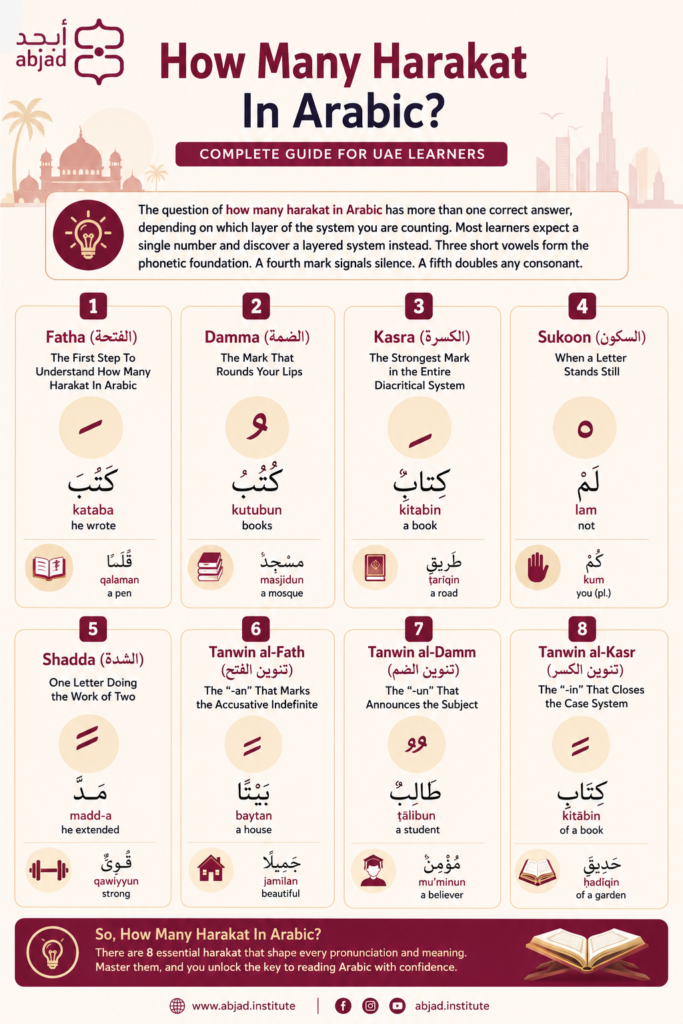
1. Fatha (الفتحة): The Short “A” Vowel in Arabic
The fatha is a short diagonal stroke placed above the letter. It produces the short “a” sound — close to the “a” in cat.
The name comes from the Arabic root meaning “to open,” describing the open mouth position the sound requires. It is the most frequently occurring diacritic in the language.
بَ = ba. كَتَبَ (kataba) = “he wrote.”
2. Damma (الضمة): The Short “U” Vowel in Arabic
The damma looks like a miniature waw (و) placed above the letter. It produces a short “u” sound. The name references the rounded shape of the lips during pronunciation.
Grammatically, when a damma sits on a noun’s final letter, it signals the nominative case — that noun is the subject of the sentence.
بُ = bu. كُتُب (kutub) = “books” (plural).
Begin Your Classical Arabic Path Today
3. Kasra (الكسرة): The Short “I” Vowel and Strongest Harakah
The kasra is a short diagonal stroke placed below the letter. It produces a short “i” sound. The name means “to break,” referencing the slight jaw drop during pronunciation.
What distinguishes the kasra is its rank: when Arabic spelling rules determine how a hamza is written inside a word, the kasra overrides the damma, fatha, and sukoon — every single time, without exception.
بِ = bi. بِسْمِ (bismi) = “in the name of.”
4. Sukoon (السكون): How Arabic Marks a Letter Without a Vowel
The sukoon is a small circle placed above the letter. It signals no vowel — the letter is a clean consonant, blended directly into the next sound.
The Arabic word sukoon means tranquility or stillness, which captures the function perfectly: the letter simply rests.
بَيْت (bayt) = “house.” The sukoon on the ya creates the consonant cluster English spells as “ay.”
5. Shadda (الشدة): How One Arabic Letter Becomes Doubled
The shadda resembles a small “w” shape placed above the letter. It signals gemination — the consonant is doubled, pronounced for twice its standard duration.
The first of the doubled letters carries an implicit sukoon; the second carries whatever diacritic follows. This is why shadda and a written sukoon never appear together: the silence is already embedded in the mark.
مُدَرِّس (mudarris) = “teacher.” The ra is held for a full double beat.
Begin Your Kid’s Path of Speaking Arabic with Abjad Institute

6. Tanwin Al-Fath (تنوين الفتح): The “An” Ending for Accusative Nouns
Tanwin is written as a doubled version of a short vowel mark, placed on the final letter of a word. Tanwin al-fath uses two fatha marks (ً) and adds a nasal “-n” sound, producing the ending “-an.” It marks an indefinite noun in the accusative case — the direct object.
A precise spelling note: tanwin al-fath almost always adds an extra alif at the word’s end, except after ta marbuta (ة), hamza preceded by alif (اء), or alif maqsura (ى).
كِتَابًا (kitāban) = “a book” as a direct object.
Read also: Arabic Worksheets For Kids
7. Tanwin Al-Damm (تنوين الضم): The “Un” Ending for Nominative Nouns
Two damma marks (ٌ) on the final letter, producing the ending “-un.” It marks an indefinite noun in the nominative case — the word is performing the action.
When Arabic grammar teachers explain this in UAE classrooms, they often say that ٌ at a word’s end is the letter raising its hand: “I am the one doing this.”
كِتَابٌ (kitābun) = “a book” as a subject.
8. Tanwin Al-Kasr (تنوين الكسر): The “In” Ending for Genitive Nouns
Two kasra marks (ٍ) placed below the final letter, producing the ending “-in.” It marks an indefinite noun in the genitive case — typically after a preposition or as the second element in an idafa (possessive) construction.
The three tanwin forms together complete Arabic’s full indefinite noun-case system, doing in three marks what English achieves through word order and of-phrases.
كِتَابٍ (kitābin) = “a book” in possessive or prepositional context.
Read also: The Meaning Of Tanween In Arabic Language
Watch Our Classes in Action
Curious what a real session looks like? Take a peek inside our interactive classrooms and see how our expert instructors bring the Arabic language to life. Watch a sample lesson below!
Begin Your Arabic Journey in the UAE
Join Abjad Institute for a professional and immersive Arabic language experience tailored to your goals.
Book Your Free TrialHow Harakat Can Change the Meaning of Arabic Words
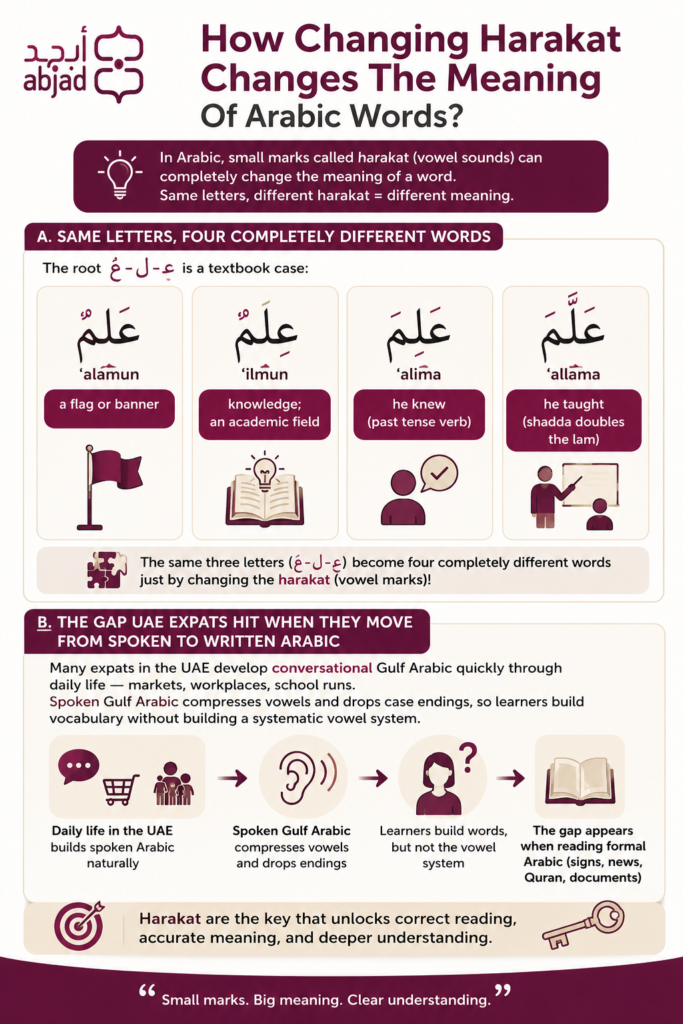
The language is built on a root-and-pattern system: three or four consonants generate entire families of related words, and the harakat are often the only visible signal of which member of that family you are reading.
Remove the marks, and a single string of letters can represent several completely different words.
A. How the Same Arabic Letters Create Different Words With Harakat
The root ع-ل-م is a textbook case:
- عَلَمٌ (ʿalamun) — a flag or banner
- عِلْمٌ (ʿilmun) — knowledge; an academic field
- عَلِمَ (ʿalima) — he knew (past tense verb)
- عَلَّمَ (ʿallama) — he taught (the shadda on the lam doubles it, shifting the verb into a different class entirely)
Without harakat, all four are written identically: علم. A native reader reconstructs the correct meaning from context and vocabulary depth. A learner without those resources reads ambiguity.
This is precisely why anyone working on how to read Arabic books in their original unvoweled form needs a strong diacritical foundation first — the marks train the intuition that later works without them.
B. Why Spoken Arabic Learners Struggle With Written Harakat
Many expats in the UAE develop conversational Gulf Arabic quickly through daily life — markets, workplaces, school runs. Spoken Gulf Arabic compresses vowels and drops case endings, so learners build vocabulary without building a systematic vowel system.
When they later try to read formal Arabic, official notices in Abu Dhabi, newspaper columns, the Quran, the gap appears sharply and unexpectedly.
The path through it is straightforward but requires patience: fully diacritized texts first, then a gradual reduction in marks as pattern recognition develops.
Learners working on how to write in Arabic in the UAE for professional purposes often find that writing harakat by hand is one of the fastest routes to internalizing the patterns.
Abjad Institute‘s Arabic programs in the UAE are designed exactly for this starting point: learners who have conversational fragments but need a systematic foundation they can read and write from, not just hear.
Write Arabic with Confidence Today at Abjad Institute
Read also: Arabic Harakat – 9 Essential Marks for Reading and Pronunciation
How Abu Al-Aswad and Al-Khalil Developed the Arabic Harakat System
As Islam spread rapidly in the 7th and 8th centuries CE, non-Arab converts began reciting the Quran with phonetic errors, a concern serious enough to demand a systematic solution.
Abu al-Aswad al-Du’ali created the first diacritical system at the request of the governor of Basra. He used red ink and dots: a dot above the letter for fatha, a dot below for kasra, a dot beside the letter for damma, and two dots for tanwin.
The system worked phonetically but created visual confusion with the existing dot-based marks that distinguished similar-looking consonants — ب، ت، ث، ج, and others — from each other.
Al-Khalil ibn Ahmad al-Farahidi the 8th-century scholar who also invented the science of Arabic prosody, resolved the confusion by replacing vowel dots with stroke-based marks.
Fatha became a small diagonal stroke above the letter; kasra a stroke below; damma a miniature waw above; sukoon a small circle. The system Al-Khalil codified has remained unchanged for over twelve hundred years.

Inside Our Live Classes
Don’t just take our word for it—see for yourself! Click below to watch short clips from our live classes and meet the instructors who will guide your learning journey.
Read also: The Meaning Of The Nominal Sentence In Arabic
Build A Real Arabic Foundation With Abjad Institute In The UAE
Abjad Institute is a UAE-based Arabic language center built for the specific needs of residents in the Emirates expats who want to move beyond basic phrases, nationals pursuing formal Arabic mastery, children who need a structured start, and professionals using Arabic in high-stakes environments.
From the first harakat to advanced reading, every Abjad course is designed by educators who understand what Arabic looks and sounds like when you encounter it daily in a country where it is the official language.
Whether your goal is Quranic recitation, Modern Standard Arabic, conversational Gulf dialect, or laying your child’s foundation from the alphabet up, Abjad structures each program for where UAE learners actually are — not where a generic syllabus assumes they should be.
Book your free trial today and see how far one session takes you.

Discover Our Arabic Courses:
- Arabic Classes for Beginners
- Arabic Course for Kids
- Arabic Conversation for Kids
- Arabic Qaida for Kids
- Beginner Arabic for Kids
- Arabic Grammar for Kids
- Teen Arabic Summer Course
- Arabic Kids Camps
- UAE Kindergarten Arabic Classes
- Modern Standard Arabic Course
- Fusha Arabic Course
- Emirati Arabic Course
- Gulf Arabic Course
- Learn Saudi Arabic
- Business Arabic Course UAE
- Arabic Language Classes for Professionals in UAE
Begin Your Arabic Journey in the UAE
Join Abjad Institute for a professional and immersive Arabic language experience tailored to your goals.
Book Your Free TrialConclusion
The question of how many harakat Arabic has opened a window into how the language is built at its core. Three marks carry its short vowels. One signals the absence of any vowel. One doubles consonants. Three encode indefinite noun cases across the full grammatical system.
Eight marks in total, each precise, each necessary, and together forming a system that was designed to eliminate ambiguity in a language where one diacritic can change a word’s meaning entirely.
For UAE learners, harakat are not a beginner’s training aid to be discarded once a few words look familiar.
They are the architecture of Arabic’s vowel system. Reading fluency that holds up under formal documents, official correspondence, Quranic recitation, and unvoweled newspapers depends on internalizing these marks correctly from the beginning.
Understanding how to read Arabic in the UAE at a practical or professional level always starts here: with eight small marks and the complete system they represent.
Frequently Asked Questions
How many harakat are in Arabic?
Arabic has three core short vowels — fatha (a), damma (u), and kasra (i) — plus sukoon, which marks the absence of a vowel. The full diacritical system adds shadda (the doubling mark) and the three tanwin forms, bringing the total to eight marks. The most common answers — three, four, or eight — are all technically correct depending on which part of the system is being counted.
Which harakat is the strongest in Arabic?
The kasra is the strongest, followed by damma, fatha, and sukoon in descending order. This ranking governs how the hamza is written in the middle of a word: whichever diacritic in the surrounding context holds the highest rank determines the hamza’s written form. Because the kasra wins every time, the hamza on ya (ئ) appears more frequently than other hamza-seat combinations in Arabic text.
Why does the Quran always include full harakat?
Quranic harakat were standardized to prevent lahn, pronunciation errors, as non-Arabic speakers recited the sacred text during Islam’s early expansion. Every letter is fully marked, and the rules of Tajweed depend on reading those marks with precision.
Can a beginner in the UAE start reading Arabic without harakat?
Some learners attempt this in spoken contexts and make early conversational progress. But reading formal Arabic without a harakat foundation creates systematic errors that are difficult to correct later. For those asking how long does it take to learn to read Arabic, starting with harakat typically shortens the overall timeline rather than lengthening it.
Do children in the UAE learn harakat the same way as adults?
The marks themselves are identical, but the teaching approach differs. Children learn through repetition, visual association, and pattern matching — they recognize what a Fatha looks like before they can articulate a rule. Adults benefit from understanding the grammar and phonetic logic alongside the shape.
What is the most effective way to practice harakat?
Read diacritized texts aloud as often as possible, starting with children’s Arabic books or the Quran. Writing words by hand with full harakat is particularly effective — producing the marks actively engages memory in a way that reading passively does not. Learners who build this into a consistent daily habit, even for fifteen to twenty minutes, find the marks become automatic within a few months.
Related Articles
Learn Arabic





Leave a Reply