 Learn Arabic
Arabic is not just a language in the UAE — it is a professional asset, a cultural bridge, and for many residents, a daily spiritual encounter. The fastest way into it is through the most common Arabic verbs.
These words appear in almost every sentence you will hear in a Dubai boardroom, a Sharjah souk, or a neighbourhood mosque. Before grammar tables, before alphabet drills — these verbs are where real fluency begins.
Research into Arabic vocabulary frequency consistently shows that a small set of core verbs accounts for a disproportionately large share of all everyday speech.
If you know these verbs in both past and present tense, with their English meanings, you can understand and construct far more Arabic than most beginners expect.
This article presents the top 10 most common Arabic verbs, each with its English meaning, conjugation, and UAE-relevant context. Every entry stands on its own — read one today, another tomorrow, and work through the list at your own pace.
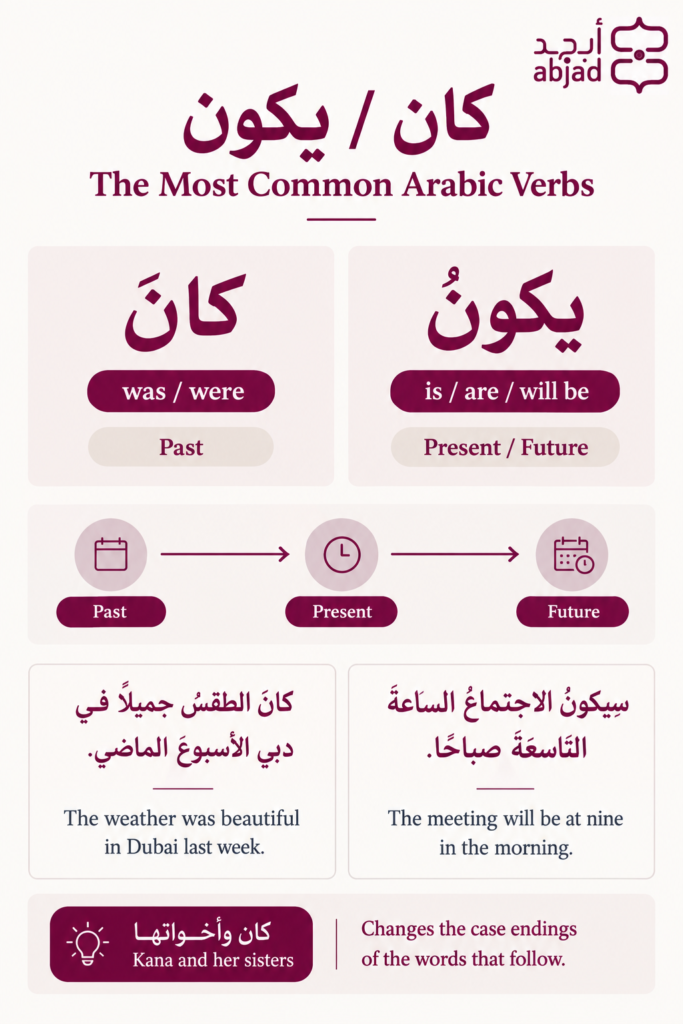
1. كان / يكون The Most Common Arabic Verbs
كان (kaana) means “was/were” in the past, while يكون (yakuunu) covers “is/are/will be.” It is the foundational verb of Arabic grammar — without it, you cannot form descriptive past-tense sentences or conditional structures.
Past: كانَ الطقسُ جميلاً في دبي الأسبوعَ الماضي. (The weather was beautiful in Dubai last week.) Present/Future: سيكونُ الاجتماعُ الساعةَ التاسعةَ صباحاً. (The meeting will be at nine in the morning.)
What makes كان uniquely important is its grammatical category: it belongs to كان وأخواتها — Kana and her sisters — a group of verbs that change the case endings of the words that follow them.
2. قال / يقول Say It Right And Arabic Conversations Fall Into Place
قال (qaala) is “said” and يقول (yaquulu) is “says” or “is saying.” On every Arabic verbs list compiled from frequency data, قال ranks in the top five, a reflection of how much human communication involves it.
There are two features worth knowing from the start. First, قال is a hollow verb, the middle root letter is a vowel, so its pattern shifts noticeably between past and present forms.
Second, the command form قُلْ (qul, “say!”) appears repeatedly in the Quran, making it instantly recognizable to anyone with any background in Islamic study.
This is one reason why the benefits of learning Quranic Arabic extend well beyond religious contexts: familiarity with Quranic high-frequency verbs transfers directly into everyday Arabic comprehension.
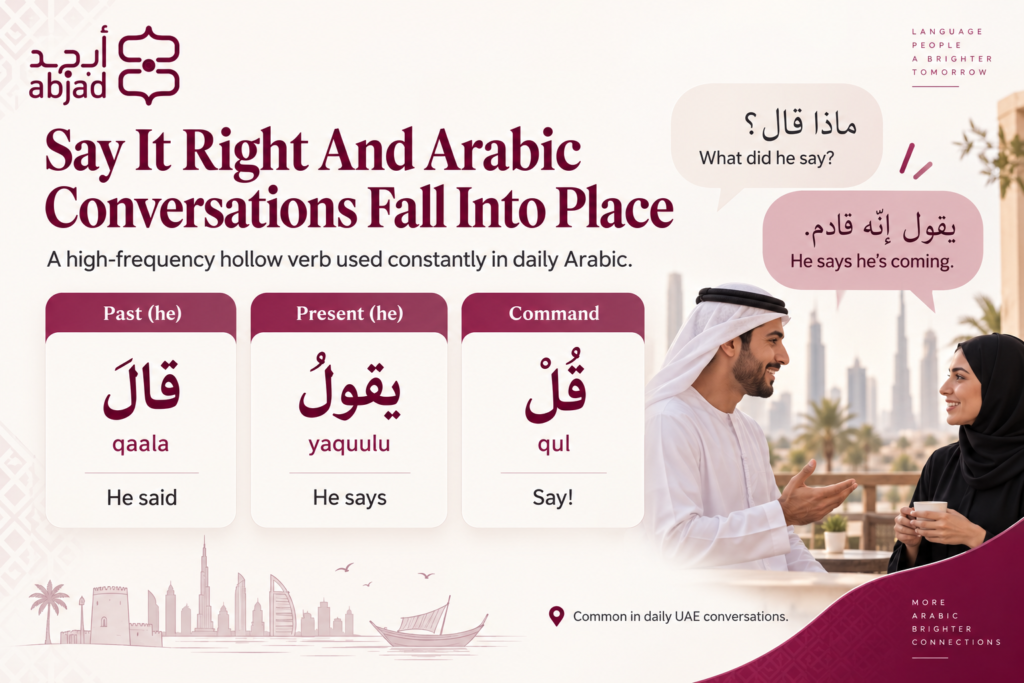
A. Past, Present, And Command: A Pattern Worth Memorizing
Learning these three basic forms together helps you recognize common verb patterns and understand Quranic Arabic more easily.
| Form | Arabic | Transliteration | Meaning |
| Past (he) | قالَ | qaala | He said |
| Present (he) | يقولُ | yaquulu | He says |
| Command | قُلْ | qul | Say! |
B. How Emiratis Actually Use قال In Daily Speech?
In UAE social and professional settings, قال opens nearly every story and piece of reported speech. قال لي مديري… (“My manager told me…”) is as common in a Dubai office as “my boss said…” is in any English-speaking workplace.
The verb also appears in proverbs, advice, and family conversation — making it one of the fastest verbs to recognize once you begin hearing Arabic around you daily.
Master the Language of the Quran with the first free session of our Quranic Arabic course

3. ذهب / يذهب A Verb That Gets You Moving Around The UAE
ذهب (dahaba) means “went” and يذهب (yadhabu) means “goes” or “is going.” It is a clean, regular verb — ideal for beginners because it follows the standard pattern with no irregularities.
Past: ذهبتُ إلى أبوظبي أمس بالمترو. (I went to Abu Dhabi yesterday by metro.) Present: أذهبُ إلى العمل كلَّ يوم بالسيارة. (I go to work every day by car.)
In the UAE, where residents travel constantly between Emirates and rely on a busy transport network, ذهب comes up in every logistics conversation. It is also the kind of verb that rewards immediate use.
The moment you form your first original sentence with it in a real context, the word sticks in a way vocabulary lists alone cannot achieve. Many learners wonder how long does it take to learn to read Arabic.
And part of the honest answer is: faster when you begin applying high-frequency verbs like ذهب in authentic sentences from day one rather than waiting until grammar feels complete.
Start learning Arabic alphabet now with first session free
4. عمل / يعمل The Verb That Opens Dubai’s Professional Doors
عمل (ʿamala) means “worked” and يعمل (yaʿmalu) means “works.” In the UAE’s professional landscape where Arabic-speaking clients, colleagues, and counterparts appear across every industry this verb earns its place near the top of any most common Arabic verbs in English reference list.
Past: عملتُ في شركة إماراتية لمدة ثلاث سنوات. (I worked at an Emirati company for three years.) Present: يعملُ زميلي في قطاع الخدمات المالية. (My colleague works in the financial services sector.)
A practitioner note worth holding on to: in UAE workplaces, the preposition after عمل determines the meaning. عمل في = works at a place. عمل على = worked on a project. عمل لحساب = works for a person or company.
Learning these collocations alongside the core verb instantly makes your Arabic sound contextual rather than translated from English word by word.
Learn Basic Arabic Conversation at Abjad Institute in the UAE Today

5. رأى / يرى Seeing In Arabic Means Both Looking And Thinking
رأى (raʾa) is one of the most semantically rich entries on any Arabic verbs list. It means “saw” in the past, and يرى (yara) means “sees” — but both extend beyond physical sight to mean “believes,” “thinks,” or “holds the opinion that,” depending on context.
Physical sight: رأيتُ برجَ خليفة لأوَّل مرة وأنا أسلكُ طريقَ الشيخ زايد. (I saw the Burj Khalifa for the first time while driving along Sheikh Zayed Road.)
Opinion/belief: أرى أنَّ هذا القرار يخدمُ مصالحَ الشركة على المدى البعيد. (I believe this decision serves the company’s long-term interests.)
Learners who work through structured Arabic programmes in the UAE, like those at Abjad Institute, encounter exactly this kind of dual-function verb early.

A. Seeing With Your Eyes Vs. Seeing With Your Mind
The root ر-أ-ي generates two distinct semantic fields: visual perception and intellectual opinion.
Arabic does what English also does “I see what you mean” but makes the pattern more systematic and grammatically reliable.
Recognizing this duality early prevents the confusion that stops many intermediate learners when they encounter رأى in a context that has nothing to do with looking.
Read also: The Meaning Of The Verbal Sentence In Arabic
B.
رأى In Formal And Informal UAE Contexts
In formal Arabic, رأى is the standard verb for expressing considered positions. In casual Emirati spoken Arabic, you will often hear شاف / يشوف (shāf/yishūf) for the physical act of seeing, while رأى / يرى tends to be retained for opinions and viewpoints.
This code-switch — between Modern Standard Arabic and dialect — is part of what makes Arabic in the UAE a layered, living language, and part of why learning both registers matters for anyone building genuine fluency here.
Start your First Free Session Today

6. أخذ / يأخذ Take It From The Experts: This Verb Is Everywhere
أخذ (axada) means “took” and يأخذ (yaʾxudu) means “takes.” It is a staple of both Modern Standard Arabic and Gulf dialect, and it builds into dozens of practical compound expressions that surface constantly in UAE daily life.
Past: أخذتُ وقتي في قراءةِ بنود العقد بعناية. (I took my time reading through the contract terms carefully.) Present: يأخذُ هذا المشروعُ جُلَّ الجهد والموارد المتاحة. (This project takes most of the available effort and resources.)
Common expressions built on أخذ in UAE Arabic:
- أخذ بعين الاعتبار = to take into consideration
- أخذ إجازة = to take time off
- أخذ موافقة = to obtain approval
This verb is a clear example of why the 100 most common Arabic verbs yield returns beyond single definitions. Each core verb is a hub of compound phrases and the collocations are where conversational Arabic actually lives.
Watch Our Classes in Action
Curious what a real session looks like? Take a peek inside our interactive classrooms and see how our expert instructors bring the Arabic language to life. Watch a sample lesson below!
Begin Your Arabic Journey in the UAE
Join Abjad Institute for a professional and immersive Arabic language experience tailored to your goals.
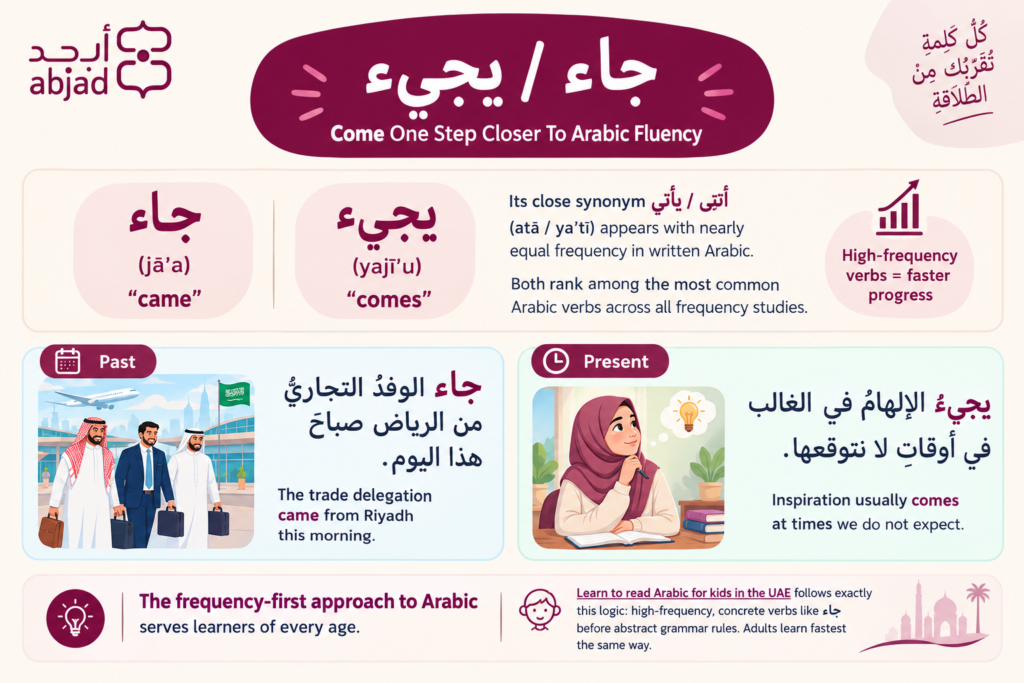
Book Your Free Trial7. جاء / يجيء Come One Step Closer To Arabic Fluency
جاء (jāʾa) means “came” and يجيء (yajīʾu) means “comes.” Its close synonym أتى / يأتي (atā / yaʾtī) appears with nearly equal frequency in written Arabic. Both rank among the most common Arabic verbs across all frequency studies.
Past: جاء الوفدُ التجاريُّ من الرياض صباحَ هذا اليوم. (The trade delegation came from Riyadh this morning.) Present: يجيءُ الإلهامُ في الغالب في أوقاتٍ لا نتوقعها. (Inspiration usually comes at times we do not expect.)
The frequency-first approach to Arabic serves learners of every age. Learn to read Arabic for kids in the UAE follows exactly this logic: high-frequency, concrete verbs like جاء before abstract grammar rules. Adults learn fastest the same way.
8. فهم / يفهم The Verb That Signals Real Progress In Arabic
فهم (fahima) means “understood” and يفهم (yafhamu) means “understands.” It is a verb every Arabic learner uses daily, and one you will hear Emirati teachers and colleagues reach for constantly when checking whether a point has registered.
Past: فهمتُ الفرقَ بين المضارع والماضي بعد أسبوعٍ من الممارسة. (I understood the difference between present and past tense after a week of practice.) Present: هل تفهمُ ما أقصده تحديداً؟ (Do you understand exactly what I mean?)
فهم opens into one of Arabic’s most productive roots — ف-ه-م: مفهوم (concept/understood), تفاهم (mutual understanding), مفهومٌ جيداً (well understood).
For UAE residents who prefer to begin independently, how to learn to read Arabic online for free is an increasingly accessible starting point tends to produce significantly faster progress than self-directed vocabulary study alone.
Join the Best Online Arabic Grammar Course in the UAE

9. أراد / يريد Want Results? This Is The Verb That Makes Them Possible
أراد (arāda) means “wanted” and يريد (yurīdu) means “wants.” It is the primary verb of desire, intention, and goal-setting in Arabic — and no conversation about preferences, requests, or plans moves far without it.
Past: أردتُ أن أتعلَّم العربيةَ منذ أن انتقلتُ إلى الإمارات. (I wanted to learn Arabic from the moment I moved to the UAE.) Present: يريدُ ابني أن يدرسَ الهندسةَ في جامعة إماراتية. (My son wants to study engineering at a UAE university.)
Combining يريد with أن + a present-tense verb creates the Arabic equivalent of “wants to do something” — one of the most common sentence structures in the entire language.
Using only the verbs covered in this article: يريد أن يذهب (he wants to go), يريد أن يفهم (he wants to understand), يريد أن يعمل (he wants to work). You already have the building blocks for dozens of natural sentences without adding a single new word.
Read also: How to Conjugate Verbs In Arabic? A Step-by-Step Guide
10. كتب / يكتب Bridge The Gap Between Speaking And Writing In Arabic
كتب (kataba) means “wrote” and يكتب (yaktubu) means “writes.” It sits firmly in the top tier of the most common Arabic verbs with meaning across both spoken and written registers, and it represents a directly practical skill for UAE residents.
Past: كتبَ المديرُ تقريراً رسمياً حول نتائج الربع الثالث. (The manager wrote a formal report on Q3 results.) Present: يكتبُ طلابُنا مقالاتٍ باللغة العربية أسبوعياً. (Our students write essays in Arabic on a weekly basis.)
The root ك-ت-ب is one of Arabic’s most productive: كتاب (book), مكتبة (library), مكتب (office/desk), كاتب (writer), مكتوب (letter/written document).
Walk through any office in Abu Dhabi or school corridor in Sharjah and you will encounter these words on signs, labels, and notices. Knowing the verb كتب is the key that makes them all readable.
When you are ready to translate passive recognition into active written production, Arabic writing practice in the UAE provides structured exercises that build the accuracy professional and academic contexts demand.

Why These Verbs Rise To The Top Of Every Arabic Verbs List?
Corpus analyses of Arabic — studies of millions of words drawn from literature, journalism, religious texts, and speech — consistently surface the same small cluster of verbs.
Words like كان (to be), قال (to say), and ذهب (to go) appear thousands of times per million words.
Their frequency is not coincidental; it reflects the universal human concerns with existence, communication, and movement that every language places at its centre.
For learners still building familiarity with written Arabic, how to read Arabic in English letters (transliteration) is a practical bridge that lets you sound out these verbs before fully mastering the script.
Secure Your Child’s Foundation in Arabic Grammar at Abjad Institute

How Knowing 20 Verbs In Arabic With Meaning Gives You Surprising Language Coverage?
Studies in second-language acquisition suggest that the 2,000 most frequent words in any language cover roughly 95% of everyday speech. For Arabic, high-frequency verbs punch well above their weight.
20 verbs in Arabic with meaning from the top of a frequency list can help a beginner understand or construct perhaps 60–70% of a basic conversation.
This is strategic learning the same method Arabic instructors across the UAE consistently recommend to residents starting from scratch.
Once you master these verbs, you can recognize them in different tenses and sentence patterns, making many new expressions easier to understand.
They also give you a practical foundation for building sentences and gradually expanding your Arabic vocabulary through real conversations.

Read also: A Complete Guide Of Types Of Verbs In Arabic
Inside Our Live Classes
Don’t just take our word for it—see for yourself! Click below to watch short clips from our live classes and meet the instructors who will guide your learning journey.
Begin Your Arabic Journey in the UAE
Join Abjad Institute for a professional and immersive Arabic language experience tailored to your goals.
Book Your Free TrialEnrol At Abjad Institute Where UAE Residents Learn Arabic That Actually Works
Abjad Institute is one of the UAE’s most respected Arabic learning centres, offering structured, results-focused programmes for adults, children, and professionals across the Emirates.
Whether you are taking your first steps with Arabic verbs or advancing into Quranic Arabic and grammar, Abjad Institute‘s experienced teachers bring the language to life through methods designed specifically for learners living in the UAE.
Every programme is built around measurable outcomes not just classroom confidence, but Arabic that functions in real Dubai meetings, Abu Dhabi neighbourhoods, and everyday life across all seven Emirates.
From absolute beginners to those seeking professional fluency, Abjad Institute gives UAE residents the structured guidance that turns intention into genuine ability.
Enroll at Abjad Institute today and start speaking Arabic with purpose
Discover Our Arabic Courses
- Arabic Course for Kids
- Arabic Conversation for Kids
- Arabic Qaida for Kids
- Beginner Arabic for Kids
- Arabic Grammar for Kids
- Teen Arabic Summer Course
- Arabic Kids Camps
- UAE Kindergarten Arabic Classes
- Modern Standard Arabic Course
- Fusha Arabic Course
- Classical Arabic Course
- Emirati Arabic Course
- Gulf Arabic Course
- Learn Saudi Arabic
- Business Arabic Course UAE
- Arabic Language Classes for Professionals in UAE
- Quranic Arabic Course

Conclusion
Mastering the most common Arabic verbs does not mean you have learned Arabic — it means you have laid the structural foundation on which everything else rests.
كان, قال, ذهب, عمل, رأى, أخذ, جاء, فهم, أراد, and كتب appear in nearly every text, every conversation, and every context that Arabic speakers encounter daily.
Knowing them in past and present tense gives you the grammatical skeleton onto which every other word and structure attaches.
The path forward is practice reading sentences that contain these verbs, hearing them in context, forming your own examples, and refining them with qualified guidance.
If you have been wondering how to get better at reading Arabic in the UAE, beginning with high-frequency verb recognition in authentic Arabic text is one of the most consistently effective answers the research supports.
Frequently Asked Questions
What are the most common Arabic verbs every beginner should learn first?
The most frequently recommended starting verbs are كان (to be), قال (to say), ذهب (to go), عمل (to work), رأى (to see), أخذ (to take), جاء (to come), فهم (to understand), أراد (to want), and كتب (to write).
These ten appear across nearly every type of Arabic text and spoken context, making them the logical starting point before grammar rules or dialect differences.
What is the difference between past and present tense in Arabic verbs?
Arabic verbs have two core tenses: the past (فعل ماضٍ), which describes completed actions, and the present-imperfect (فعل مضارع), which covers ongoing or future actions.
Past-tense verbs are built on the three-letter root with specific vowel patterns. Present-tense verbs add a prefix — أ، ن، ي، or ت — to indicate the subject. There is also the command form (فعل أمر) for instructions and requests.
How many Arabic verbs do I need to hold a basic conversation?
Approximately 20 to 50 high-frequency Arabic verbs will take most learners further than they expect.
When combined with basic nouns and simple sentence structures, knowing 20 verbs in Arabic with meaning drawn from a frequency list allows you to construct a surprisingly wide range of everyday sentences.
Reaching the 100 most common Arabic verbs substantially broadens both comprehension and conversational range.
Are the most common Arabic verbs the same in Modern Standard Arabic and Emirati dialect?
The core verbs overlap significantly, but pronunciation and some forms differ. For example, ذهب (to go) in Modern Standard Arabic becomes راح / يروح (rāḥ / yirūḥ) in common Emirati speech, and رأى for physical sight may shift to شاف in casual conversation.
Learning the Modern Standard Arabic forms first gives you a foundation that is universally understood across the UAE and transfers cleanly to Quranic Arabic and formal professional writing.
How do I use an Arabic verbs list to study more efficiently?
Prioritize by frequency. Take the top 20 to 30 verbs from a frequency-based Arabic verbs list, learn each in both past and present tense, and practice them in full sentences rather than isolation.
Adding the command form for each verb gives you a third usable form at minimal extra effort.
Can knowing common Arabic verbs help me read the Quran more easily?
Yes, considerably. Many of the most common Arabic verbs appear repeatedly throughout the Quran — قال, كان, رأى, أخذ, and others each appear hundreds of times across its 114 chapters.
Building recognition and understanding of these verbs creates a strong foundation for Quranic comprehension.





Leave a Reply