 Learn Arabic
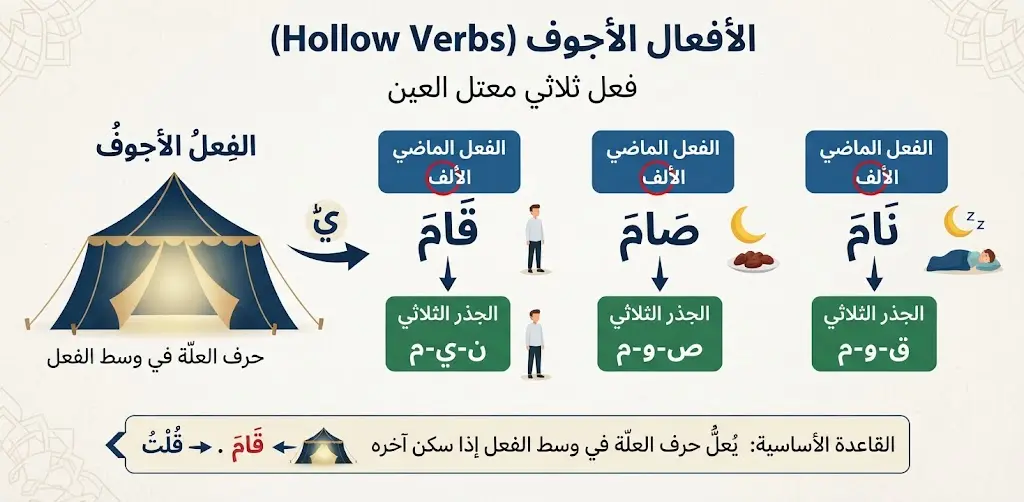
Few patterns in Arabic morphology cause as much confusion as hollow verbs and yet once you understand the logic behind them, the confusion dissolves entirely.
Arabic hollow verbs follow rules so consistent that, after an hour of focused study, you can predict every form of any hollow verb you encounter, whether you have seen it before or not.
This guide breaks down the definition, the two verb families, every conjugation pattern across past, present, and imperative, the passive voice.
And the participles with full conjugation tables and practical exercises drawn from authentic Arabic texts in eight points.
If you are still building your foundational literacy, the resource on how to Read Arabic letters in the UAE is a solid first step before diving into morphology.
Read also: The Best Arabic Activity For Kids In The UAE

1. Why Should UAE Learners Crack Arabic Hollow Verbs Code First?
Arabic hollow verbs are one of the most important weak-verb categories for learners to understand because their middle root letter behaves differently during conjugation.
Once you understand the rule behind these changes, many common Arabic verbs become much easier to recognize and conjugate.
A. Why Are Arabic Hollow Verbs Important?
Arabic hollow verbs, الفعل الأجوف, are three-letter root verbs whose middle letter (the ‘ayn of the verb) is a weak letter: either a waw (و) or a ya (ي).
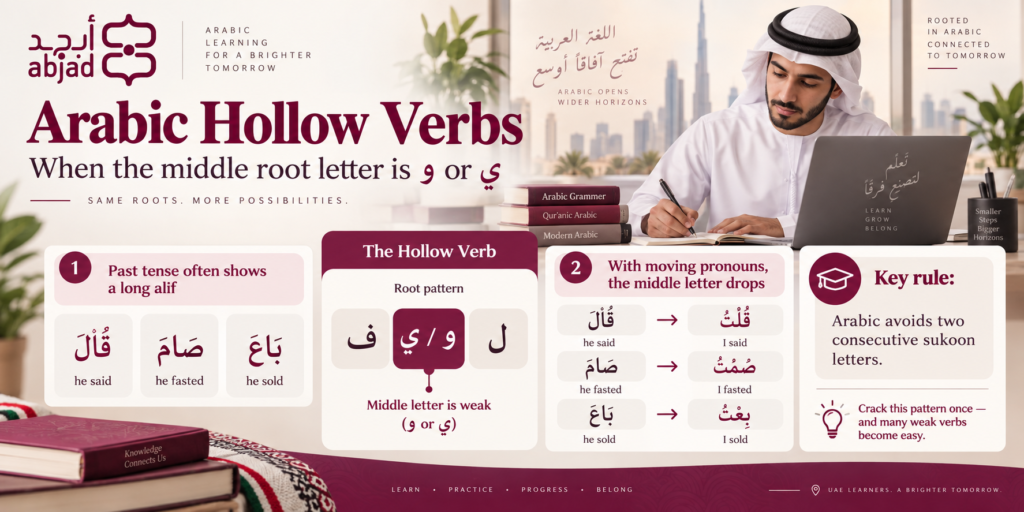
In the past tense surface form, this middle weak letter almost always appears as a long alif (ا), producing verbs like قَالَ (he said), صَامَ (he fasted), and بَاعَ (he sold).
The label “hollow” is the centre of the verb is occupied by a letter that behaves differently from a regular consonant. Under certain conjugation conditions, this middle letter drops out entirely, leaving what looks like a two-letter verb.
That disappearance is not irregular; it is governed by a single phonological rule that applies without exception across the entire class.
For anyone exploring the benefits of learning Quranic Arabic, mastering hollow verbs is not a detour, it is the highway.
B. Why Does The Middle Letter Sometimes Disappear?
Arabic phonology does not permit two consecutive sukoon (silent) letters within a word.
When a hollow verb is conjugated with a “mobile pronoun” (ضمير متحرك), a pronoun ending that begins with a vowel, such as تُ (I/you did) or نَا (we did), the final consonant of the verb takes a sukoon.
At that moment, the middle weak letter is also sukoon-bearing. Two sukoon letters in a row are not permitted, so the middle letter drops.
The vowel quality of the dropped letter—damma for waw verbs, kasra for ya verbs is then transferred to the first radical.
This single rule, the prohibition on two consecutive sukoon letters, explains every change you will encounter across all hollow verb conjugations. Understand it once and the entire class unlocks.
Don’t Let Language Be a Barrier in the UAE via Basic Arabic Course at Abjad Institute

2. The Two Families Of Arabic Hollow Verbs
Before conjugating any hollow verb, you need to identify which of the two families it belongs to.
This affects the vowel on the first radical whenever the middle letter drops, which in turn determines the entire pattern across past tense, present tense, and imperative forms.
The easiest identification method: brings the present tense form. The present tense always reveals the true identity of the middle weak letter, and you only need to perform this check once per verb.
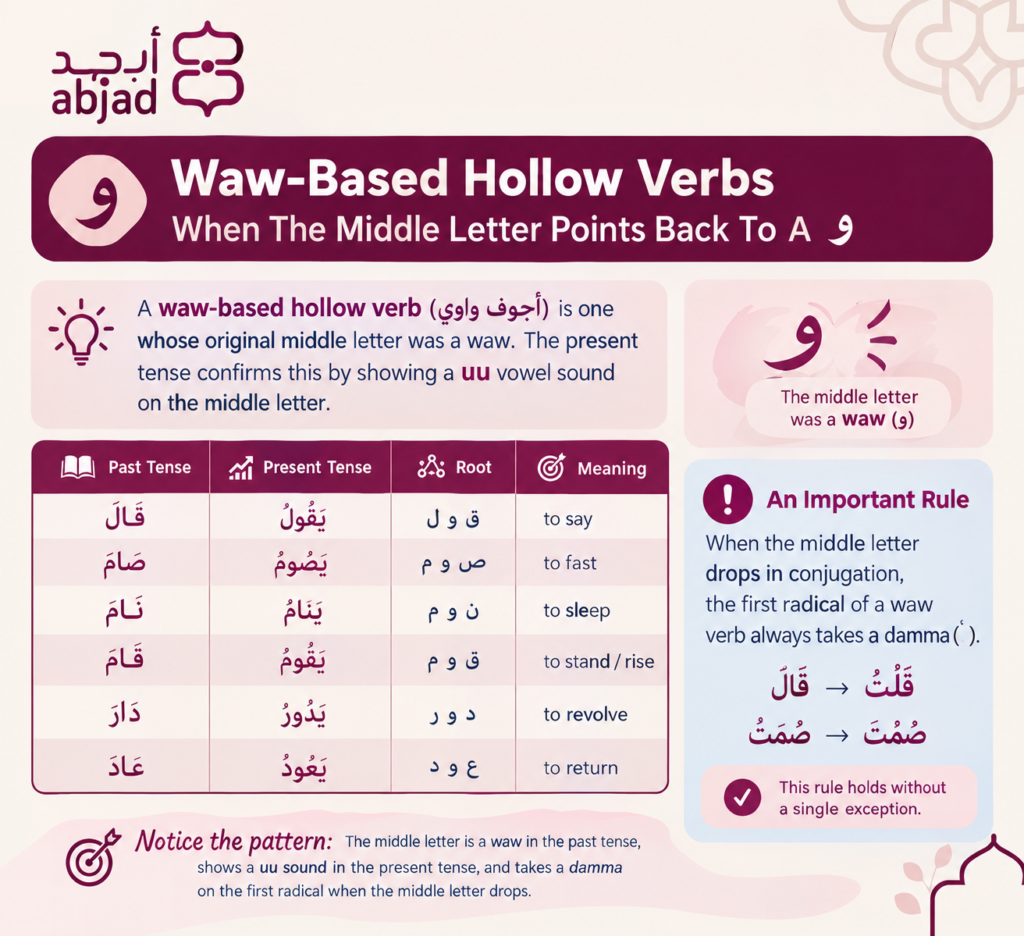
A. Waw-Based Hollow Verbs When The Middle Letter Points Back To A و
A waw-based hollow verb (أجوف واوي) is one whose original middle letter was a waw. The present tense confirms this by showing a uu vowel sound on the middle letter.
The table below lists the most common examples encountered in everyday Arabic, formal writing, and classical texts.
| Past Tense | Present Tense | Root | Meaning |
| قَالَ | يَقُولُ | ق و ل | to say |
| صَامَ | يَصُومُ | ص و م | to fast |
| نَامَ | يَنَامُ | ن و م | to sleep |
| قَامَ | يَقُومُ | ق و م | to stand / rise |
| دَارَ | يَدُورُ | د و ر | to revolve |
| عَادَ | يَعُودُ | ع و د | to return |
When the middle letter drops in conjugation, the first radical of a waw verb always takes a damma (ُ): قَالَ → قُلْتُ, صَامَ → صُمْتُ. This rule holds without a single exception.
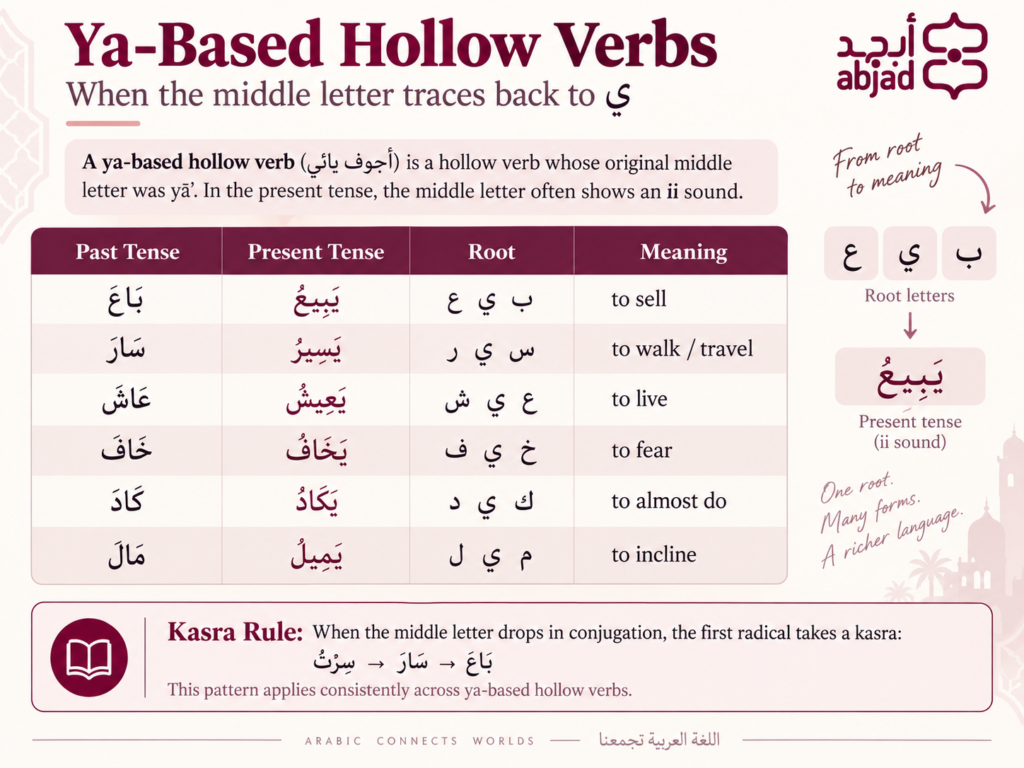
B. Ya-Based Hollow Verbs When The Middle Letter Traces Back To A ي
A ya-based hollow verb (أجوف يائي) is one whose original middle letter was a ya. The present tense shows an ii vowel sound on the middle letter.
The following table covers the most frequently used ya-based hollow verbs in the Arabic lexicon.
| Past Tense | Present Tense | Root | Meaning |
| بَاعَ | يَبِيعُ | ب ي ع | to sell |
| سَارَ | يَسِيرُ | س ي ر | to walk / travel |
| عَاشَ | يَعِيشُ | ع ي ش | to live |
| خَافَ | يَخَافُ | خ ي ف | to fear |
| كَادَ | يَكَادُ | ك ي د | to almost do |
| مَالَ | يَمِيلُ | م ي ل | to incline |
When the middle letter drops in conjugation, the first radical of a ya verb takes a kasra (ِ): بَاعَ → بِعْتُ, سَارَ → سِرْتُ. Again, the rule holds universally.
C. The Two-Second Test That Tells You Which Family A Verb Belongs To
Take any unfamiliar hollow verb and bring its present tense—either from memory or a reference. If the middle vowel sound in the present tense is uu (as in يَقُولُ), the verb is waw-origin.
If it is ii (as in يَبِيعُ), the verb is ya-origin. Apply this check once per new verb and you will know the first-radical vowel for every contracted form that verb will ever produce.
Join the Best Online Arabic Grammar Course in the UAE

3. Conjugating Arabic Hollow Verbs In The Past Tense
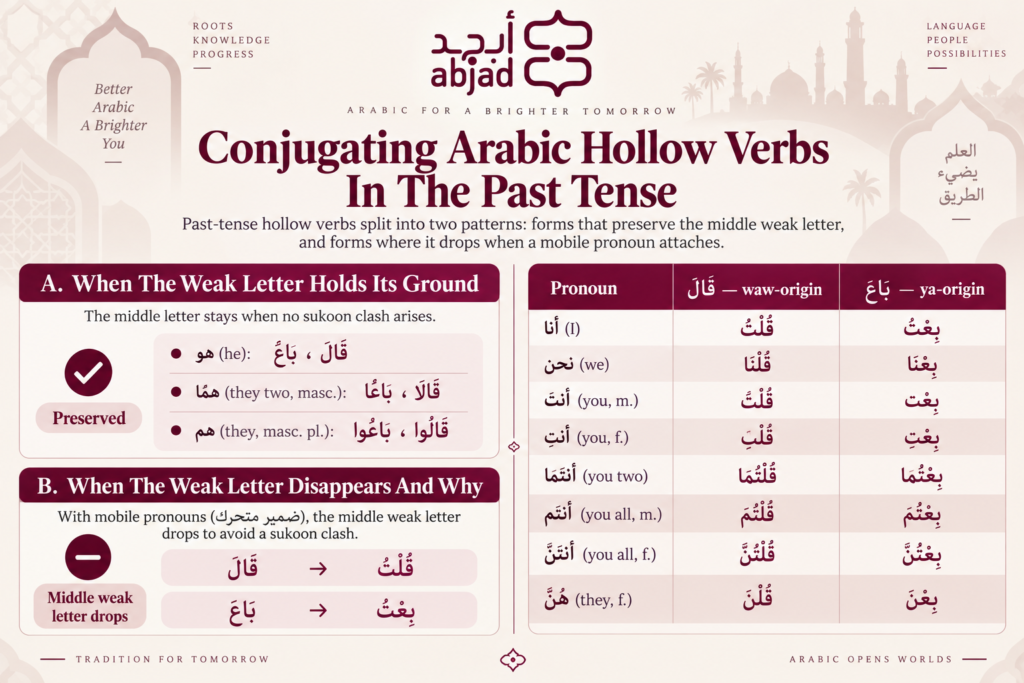
The past tense is where most learners first encounter the hollow verb’s shifting middle letter. The conjugation divides cleanly into two groups depending on the pronoun type: those that preserve the middle letter, and those that cause it to drop.
The core principle: when the attached pronoun carries a vowel (mobile pronoun, ضمير متحرك), the middle letter drops to prevent a sukoon clash.
When the pronoun ending begins with a long vowel or a static element (static pronoun, ضمير ساكن), the middle letter stays.
A. When The Weak Letter Holds Its Ground?
The middle letter is preserved when the following pronoun forms attach in the past tense. These are the forms where no sukoon clash arises:
- هو (he): قَالَ, بَاعَ
- هما (they two, masc.): قَالَا, بَاعَا
- هم (they, masc. pl.): قَالُوا, بَاعُوا
One point worth noting: with هي (she), the taa’ al-ta’neeth (ـتْ) carries a sukoon, which produces the same clash. The middle letter drops here too: قَالَتْ, بَاعَتْ.
Read also: Irregular Verbs In Arabic – Types, Rules, and Conjugation Patterns
B. When The Weak Letter Disappears And Why?
When a mobile pronoun ending attaches, the final consonant must take sukoon to carry the pronoun’s own vowel, triggering the drop.
The table below gives the full pattern for قَالَ (waw-origin) and بَاعَ (ya-origin) across all mobile pronoun forms.
| Pronoun | قَالَ — waw-origin | بَاعَ — ya-origin |
| أنا (I) | قُلْتُ | بِعْتُ |
| نحن (we) | قُلْنَا | بِعْنَا |
| أنتَ (you, m.) | قُلْتَ | بِعْتَ |
| أنتِ (you, f.) | قُلْتِ | بِعْتِ |
| أنتما (you two) | قُلْتُمَا | بِعْتُمَا |
| أنتم (you all, m.) | قُلْتُمْ | بِعْتُمْ |
| أنتنَّ (you all, f.) | قُلْتُنَّ | بِعْتُنَّ |
| هُنَّ (they, f.) | قُلْنَ | بِعْنَ |
The damma on قُـ marks a waw verb; the kasra on بِـ marks a ya verb. This distinction is consistent without exception and is the single most important thing to memorise before moving forward.
Begin Your Classical Arabic Path Today

Watch Our Classes in Action
Curious what a real session looks like? Take a peek inside our interactive classrooms and see how our expert instructors bring the Arabic language to life. Watch a sample lesson below!
Begin Your Arabic Journey in the UAE
Join Abjad Institute for a professional and immersive Arabic language experience tailored to your goals.
Book Your Free Trial4. How Arabic Hollow Verbs Behave In The Present Tense And Imperative?
The present tense and imperative follow the same underlying principle: avoid two consecutive sukoon letters but the forms look different.
That is because the middle weak letter has been restored to its original waw or ya in the base form of the present tense.
A useful framing: in the present tense, the weak letter has “come home.” The verb يَقُولُ shows the waw openly; يَبِيعُ shows the ya.
Drops and shifts only occur at the edges, with specific pronoun endings that reintroduce the sukoon problem.
A. The Present Tense When The Weak Letter Comes Back
In the present tense, the weak letter returns and appears as a long vowel in most conjugated forms.
It drops only when the feminine plural pronoun (نون النسوة) is attached, because that ending carries a sukoon that triggers the familiar clash. The table below shows the full present-tense conjugation for both verb families.
| Pronoun | يَقُولُ — waw | يَبِيعُ — ya |
| هو | يَقُولُ | يَبِيعُ |
| هي | تَقُولُ | تَبِيعُ |
| هما | يَقُولَانِ | يَبِيعَانِ |
| هم | يَقُولُونَ | يَبِيعُونَ |
| هنَّ | يَقُلْنَ | يَبِعْنَ |
| أنتَ | تَقُولُ | تَبِيعُ |
| أنتِ | تَقُولِينَ | تَبِيعِينَ |
| أنتم | تَقُولُونَ | تَبِيعُونَ |
| أنتنَّ | تَقُلْنَ | تَبِعْنَ |
| أنا | أَقُولُ | أَبِيعُ |
| نحن | نَقُولُ | نَبِيعُ |
The jussive (after لَمْ, لَمَّا, لِـ, etc.) also drops the middle letter when the verb stands alone: لَمْ يَقُلْ (he did not say), لَمْ يَبِعْ (he did not sell).
Master the Language of the Quran at Abjad Institute with a first session free

B. The Imperative Form Short, Sharp, And Predictable
The imperative is built from the jussive, which already shows the dropped middle letter in the singular masculine form.
This is why hollow verb imperatives are notably short one of the features that makes them distinctive in everyday spoken and written Arabic.
The following table gives the imperative across all addressee pronouns for both verb families:
| Pronoun | قَالَ — imperative | بَاعَ — imperative |
| أنتَ (m. sing.) | قُلْ | بِعْ |
| أنتِ (f. sing.) | قُولِي | بِيعِي |
| أنتما (you two) | قُولَا | بِيعَا |
| أنتم (you all, m.) | قُولُوا | بِيعُوا |
| أنتنَّ (you all, f.) | قُلْنَ | بِعْنَ |
Notice the pattern: when the static pronoun endings (ا, وا, ي) attach, the middle letter returns. When the mobile نَ attaches, it drops again. Fully consistent.
Meet our Arabic and Quran Dedicated Skilled teachers

5. The Passive Voice Of Hollow Verbs Follows A Single Rule You Can Memorise In Five Minutes
Forming the passive of a hollow verb follows a rule distinct from what learners are used to with sound verbs—but it is just as consistent, and the template is easy to absorb.
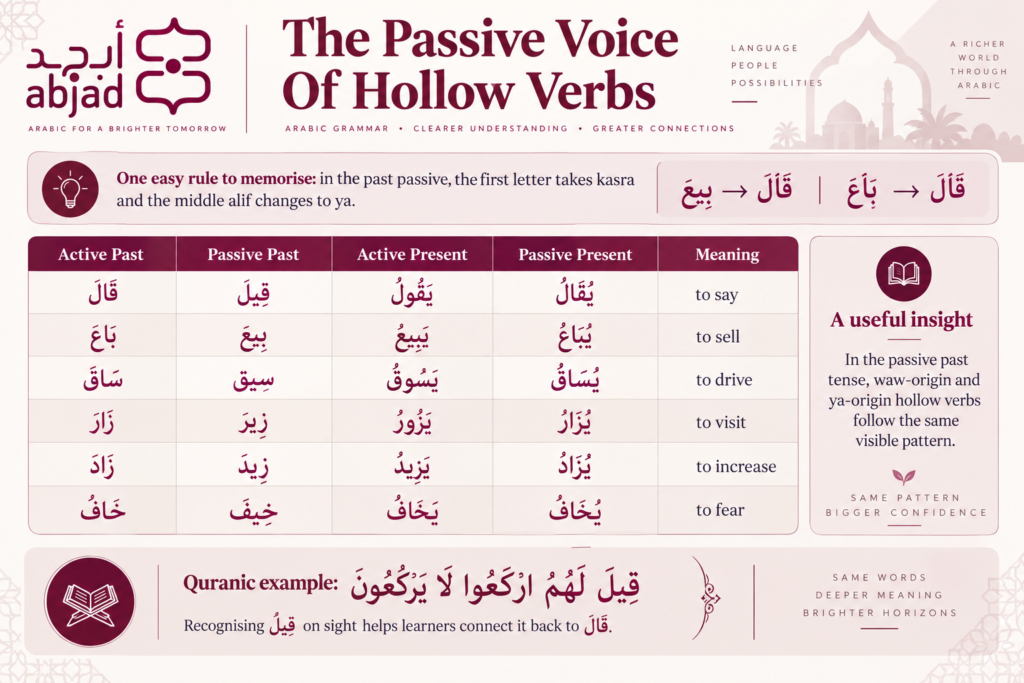
In the past tense passive, the first letter takes a kasra and the middle alif converts to a ya, regardless of whether the verb is waw-origin or ya-origin.
The table below shows the passive forms of the most common hollow verbs. Notice that the waw/ya distinction collapses in the passive past tense: both types produce the same قِيلَ / بِيعَ pattern.
| Active Past | Passive Past | Active Present | Passive Present | Meaning |
| قَالَ | قِيلَ | يَقُولُ | يُقَالُ | to say |
| بَاعَ | بِيعَ | يَبِيعُ | يُبَاعُ | to sell |
| سَاقَ | سِيقَ | يَسُوقُ | يُسَاقُ | to drive |
| زَارَ | زِيرَ | يَزُورُ | يُزَارُ | to visit |
| زَادَ | زِيدَ | يَزِيدُ | يُزَادُ | to increase |
| خَافَ | خِيفَ | يَخَافُ | يُخَافُ | to fear |
The Quranic verse قِيلَ لَهُمُ ارْكَعُوا لَا يَرْكَعُونَ is a classical example of the hollow verb passive in action.
For learners whose primary goal is Quranic comprehension, recognising this form on sight—and knowing it derives from قَالَ—is non-negotiable.
Read also: The Imperative Verb In Arabic – Rules, Forms, And Conjugation
6. Active And Passive Participles From Hollow Verbs
Participles from hollow verbs carry the same logic forward: the original weak letter is restored and then interacts with the standard participial pattern.
The results look distinctive but follow a rule that can be applied mechanically once understood.
A. Forming The Active Participle (اسم الفاعل)
The active participle of a hollow verb uses the فَاعِل pattern. When the alif of this pattern meets the original waw or ya of the verb root, the two combine to produce a hamza (ء). The derivation runs: قَاوِل → قَائِل.
The table below shows the active participle derivation for both waw and ya hollow verbs, with the original underlying form included so the derivation is transparent rather than arbitrary.
| Verb | Present | Active Participle | Original Form |
| قَالَ | يَقُولُ | قَائِلٌ | قَاوِلٌ |
| زَارَ | يَزُورُ | زَائِرٌ | زَاوِرٌ |
| صَامَ | يَصُومُ | صَائِمٌ | صَاوِمٌ |
| نَامَ | يَنَامُ | نَائِمٌ | نَاوِمٌ |
| بَاعَ | يَبِيعُ | بَائِعٌ | بَايِعٌ |
| سَارَ | يَسِيرُ | سَائِرٌ | سَايِرٌ |
| عَاشَ | يَعِيشُ | عَائِشٌ | عَايِشٌ |
B. Forming The Passive Participle (اسم المفعول)
The passive participle (مَفْعُول pattern) is derived through three steps: (1) bring the present tense to reveal the original weak letter, (2) replace the present tense prefix with a meem carrying a fatha.
(3) contract the resulting double weak letters. The table below includes the uncontracted original forms so learners can trace the derivation clearly, rather than memorising contracted outcomes in isolation.
| Verb | Present | Passive Participle | Original Form |
| قَالَ | يَقُولُ | مَقُولٌ | مَقْوُولٌ |
| زَارَ | يَزُورُ | مَزُورٌ | مَزْوُورٌ |
| بَاعَ | يَبِيعُ | مَبِيعٌ | مَبْيُوعٌ |
| كَالَ | يَكِيلُ | مَكِيلٌ | مَكْيُولٌ |
Start Your Child’s Journey to Speak Arabic

7. Practical Exercises On Arabic Hollow Verbs—Test Yourself Before Moving On
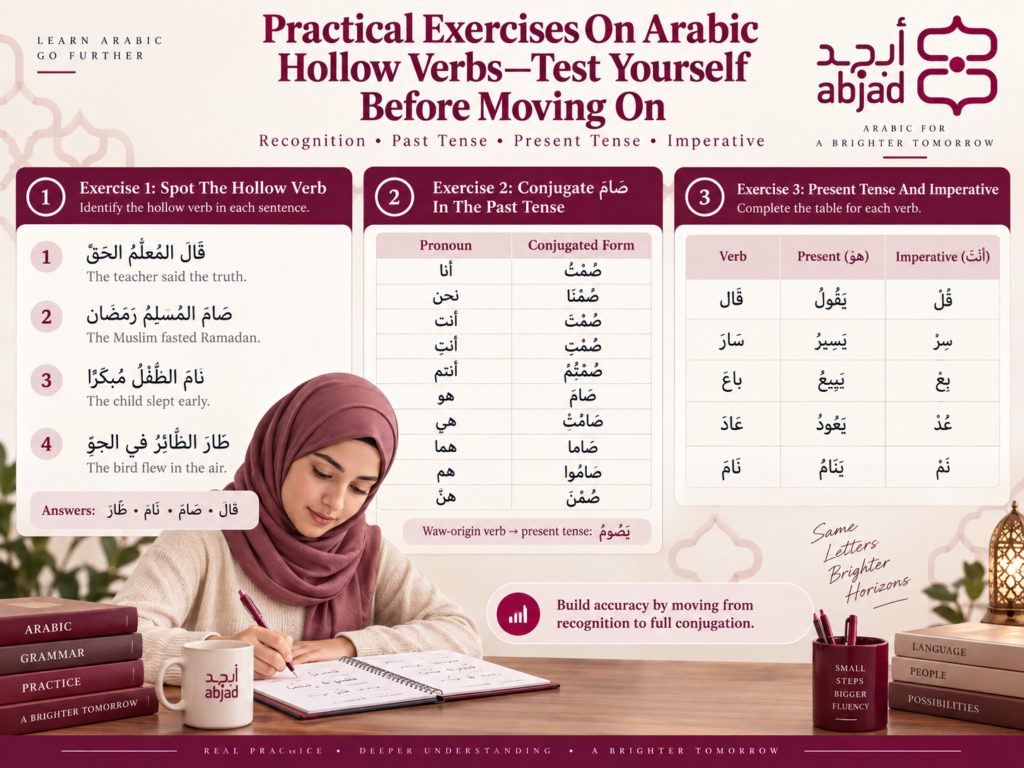
No grammar point truly belongs to you until you have worked through it under your own effort. The following exercises move progressively from recognition to full conjugation and cover every major pattern discussed in this guide.
Exercise 1: Spot The Hollow Verb
Identify the hollow verb in each sentence below:
- قَالَ المُعَلِّمُ الحَقَّ. (The teacher said the truth.)
- صَامَ المُسْلِمُ رَمَضَانَ. (The Muslim fasted Ramadan.)
- نَامَ الطِّفْلُ مُبَكِّرًا. (The child slept early.)
- طَارَ الطَّائِرُ في الجَوِّ. (The bird flew in the air.)
Answers: قَالَ, صَامَ, نَامَ, طَارَ
Exercise 2: Conjugate صَامَ In The Past Tense
The verb صَامَ is waw-origin (its present tense is يَصُومُ). Complete the conjugation table below, then check your answers against the rules covered above.
| Pronoun | Conjugated Form |
| أنا | صُمْتُ |
| نحن | صُمْنَا |
| أنتَ | صُمْتَ |
| أنتِ | صُمْتِ |
| أنتم | صُمْتُمْ |
| هو | صَامَ |
| هي | صَامَتْ |
| هما | صَامَا |
| هم | صَامُوا |
| هنَّ | صُمْنَ |
Read also: Arabic Long Vowels – A Complete Guide to Alif, Waw, and Ya
Exercise 3: Present Tense And Imperative
Produce the present tense (هو form) and the imperative (أنتَ form) for each of the verbs below. Use the two-second test to identify waw vs. ya origin before writing the imperative.
| Verb | Present (هو) | Imperative (أنتَ) |
| قَالَ | يَقُولُ | قُلْ |
| سَارَ | يَسِيرُ | سِرْ |
| بَاعَ | يَبِيعُ | بِعْ |
| عَادَ | يَعُودُ | عُدْ |
| نَامَ | يَنَامُ | نَمْ |
For UAE learners who want to complement grammar practice with reading fluency work, how to get better at Reading Arabic in the UAE? offers practical steps that sit alongside structured morphology study.
Read also: How To Memorize Arabic Verb Forms? – Patterns, Examples, and Study Plan
Inside Our Live Classes
Don’t just take our word for it—see for yourself! Click below to watch short clips from our live classes and meet the instructors who will guide your learning journey.
Begin Your Arabic Journey in the UAE
Join Abjad Institute for a professional and immersive Arabic language experience tailored to your goals.
Book Your Free Trial8. Start Building Real Arabic Fluency At Abjad Institute In The UAE
Arabic grammar does not have to be intimidating, and hollow verbs are proof: a handful of rules, applied consistently, unlock hundreds of verbs across the entire Arabic lexicon.
The right instruction makes the difference between grinding through grammar charts in isolation and building fluency that compounds week by week.
Abjad Institute, based in the UAE, offers structured Arabic learning programmes for all levels—from learners taking their first steps to those tackling advanced morphology and classical Arabic texts.
Their courses are designed for the UAE context: Arabic for daily life, for professional settings, and for Quranic understanding.
If you are newer to the language and want a structured starting point, learn how to write and Read Arabic for beginners is a resource their team recommends before advancing into verb morphology.
Book your free trial session today
Discover Our Arabic Courses
- Arabic Course in the UAE
- Arabic Intensive Course
- Learn Arabic from Scratch Course
- Madinah Arabic Course
- Arabic Classes for Adults
- Arabic Classes for Beginners
- Self-Paced Arabic Course
- Basic Arabic Course
- Arabic Speaking Classes
- Learn to Write Arabic Course
- Arabic Grammar Course
- Learn Arabic Alphabet Course

Conclusion
Arabic hollow verbs are one of the most logical and predictable categories in Arabic morphology once the underlying principle is clear. The avoidance of two consecutive sukoon letters explains every conjugation shift.
The middle weak letter drops when a mobile pronoun is attached, and returns when a static pronoun ending follows. The damma on the first radical marks a waw-origin verb; the kasra marks a ya-origin verb.
The passive voice consolidates into one clean template while the participles restore the original weak letter through the present tense before applying the standard derivational patterns.
If you are still working on reading fluency in parallel with grammar study, how to Read Arabic script in the UAE addresses the practical side of recognising conjugated forms on the page.
And for learners who prefer a flexible self-study path alongside in-person or online instruction, how to learn to Read Arabic online for free is a practical resource to explore between sessions.
Frequently Asked Questions
What Is A Hollow Verb In Arabic?
A hollow verb (الفعل الأجوف) is a three-letter root verb whose middle radical is a weak letter—either a waw (و) or a ya (ي)—which appears as a long alif (ا) in the past tense. Examples include قَالَ (to say), بَاعَ (to sell), and صَامَ (to fast).
How Do I Identify Whether A Hollow Verb Is Waw-Origin Or Ya-Origin?
Bring the present tense form of the verb. If the middle vowel is a uu sound—as in يَقُولُ—the root is waw-origin. If it is an ii sound—as in يَبِيعُ—the root is ya-origin. The present tense always reveals the hidden weak letter.
Why Does The Middle Letter Of A Hollow Verb Disappear In Some Conjugations?
When a mobile pronoun ending (such as تُ or نَا) attaches, the final letter of the verb takes a sukoon and the middle weak letter, also sukoon-bearing at that point, must drop to resolve the clash.
The dropped letter’s vowel quality is then transferred to the first radical.
What Does The Passive Of A Hollow Verb Look Like?
In the past tense passive, the first letter takes a kasra and the middle alif converts to ya: قَالَ → قِيلَ, بَاعَ → بِيعَ.
In the present tense passive, the first letter takes a damma and the middle appears as a long alif: يَقُولُ → يُقَالُ. This template applies to all hollow verbs.
How Is The Active Participle Formed From A Hollow Verb?
The active participle follows the فَاعِل pattern. The alif of the pattern and the original weak letter (waw or ya) combine to produce a hamza in the middle: قَالَ → قَائِلٌ (from the original قَاوِلٌ), بَاعَ → بَائِعٌ (from the original بَايِعٌ).
Do Hollow Verbs Appear Frequently In The Quran?
Hollow verbs are among the most common verb types in classical Arabic and appear throughout the Quran.
Forms such as قِيلَ (it was said), قَالُوا (they said), يَخَافُ (he fears), قُلْ (say), and يُقِيمُونَ (they establish the prayer) are all hollow verb conjugations in various tenses and passive forms.






Leave a Reply