 Quran
| Key Takeaways |
| Ten core Arabic sentences cover greetings, thanks, prices, directions, and farewells, which is most of what a visitor needs daily. |
| Modern Standard Arabic is understood in every Arab country, while Emirati and Gulf expressions make daily conversation in the UAE sound natural. |
| Arabic replies come in fixed pairs, so learning the response matters as much as learning the opening sentence. |
| Masculine and feminine endings change almost every sentence, and using the wrong form is the most common beginner mistake. |
Arabic is the official language of the United Arab Emirates and the first language of more than 400 million speakers worldwide. A short list of practical sentences gives a beginner immediate speaking ability without waiting for grammar study.
Residents of Dubai, Abu Dhabi, and Sharjah hear these expressions daily in offices, taxis, souqs, and family gatherings. Using them correctly signals respect and usually changes how a conversation goes from the first second.
This guide covers the most used sentences in Arabic with full Arabic script, transliteration, and meaning, plus the reply each one expects. The ten sentences are as follows.
1. Greeting Anyone Confidently With As-Salamu Alaykum
السَّلامُ عَلَيْكُم (as-salāmu ʿalaykum) means “peace be upon you” and works in every Arab country, at every level of formality, at any hour of the day.
Its reply is fixed. The listener answers وَعَلَيْكُمُ السَّلام (wa ʿalaykumu as-salām), meaning “and peace be upon you too.” Skipping the reply sounds abrupt, so learn both halves together.
This phrase is the safest greeting in Arabic language use because it carries no time restriction and no regional limitation. Emirati colleagues use it in meetings exactly as neighbors use it at the door.
| Arabic | Pronunciation | Meaning |
| السَّلامُ عَلَيْكُم | as-salāmu ʿalaykum | Peace be upon you |
| وَعَلَيْكُمُ السَّلام | wa ʿalaykumu as-salām | And peace be upon you too |
| أَهْلاً وَسَهْلاً | ahlan wa sahlan | Welcome |
2. Saying Hello in Arabic Language With Marhaban
مَرْحَباً (marḥaban) is the everyday equivalent of “hello” and suits shops, hotels, and first meetings where a religious greeting may feel too formal for the setting.

Speakers in the Gulf often shorten it to مَرْحَبا (marḥaba). The warmer reply is مَرْحَبْتَيْن (marḥabtayn), literally “two hellos,” which Emirati speakers use constantly in casual exchanges.
Time-based options exist alongside it. Saying hello in Arabic language terms before noon usually means صَباحُ الخَيْر (ṣabāḥu al-khayr), and the expected answer is صَباحُ النُّور (ṣabāḥu an-nūr).
| Arabic | Pronunciation | Meaning |
| مَرْحَباً | marḥaban | Hello |
| صَباحُ الخَيْر | ṣabāḥu al-khayr | Good morning |
| مَساءُ الخَيْر | masā’u al-khayr | Good evening |
3. Asking How Someone Is Doing With Kayfa Halak
كَيْفَ حالُكَ؟ (kayfa ḥāluka?) means “how are you?” when speaking to a man. For a woman, the ending changes to كَيْفَ حالُكِ؟ (kayfa ḥāluki?).
Gulf speakers usually say شْلونَك؟ (shlōnak?) instead, which carries the same meaning in Emirati, Kuwaiti, and Iraqi speech. Both forms are understood across the United Arab Emirates without any confusion.
The standard answer is أَنا بِخَيْر، شُكْراً (anā bikhayr, shukran), meaning “I am fine, thank you.” Many speakers add الحَمْدُ لِله (al-ḥamdu lillāh), meaning “praise be to Allah.”
Abjad Academy teaches these conversational pairs inside its Arabic Speaking Course, where every sentence is practiced live with a tutor until the response becomes automatic.

Try a Free Speaking Lesson Today
4. Saying Thank You in Arabic and Replying With Afwan
شُكْراً (shukran) is the single most repeated courtesy word in daily speech. Adding جَزيلاً gives شُكْراً جَزيلاً (shukran jazīlan), meaning “thank you very much.”
Religious gratitude is just as common.
جَزاكَ اللهُ خَيْراً (jazāka Allāhu khayran) means “may Allah reward you with good,” and it carries more warmth than a plain thank you in Arabic conversation.
The reply is عَفْواً (ʿafwan), meaning “you are welcome.” The same word also means “excuse me” when you need to interrupt someone politely or ask them to repeat a sentence.
| Arabic | Pronunciation | Meaning |
| شُكْراً | shukran | Thank you |
| شُكْراً جَزيلاً | shukran jazīlan | Thank you very much |
| عَفْواً | ʿafwan | You are welcome |
| بارَكَ اللهُ فيك | bāraka Allāhu fīk | May Allah bless you |
5. Introducing Yourself With Ismi and Ana Min
اِسْمي أَحْمَد (ismī Aḥmad) means “my name is Ahmad.” Replace the name and the sentence is ready, with no verb and no article needed in between. Two follow-up sentences complete any introduction.
أَنا مِن مِصْر (anā min Miṣr) means “I am from Egypt,” and أَنا أَعْمَلُ مُهَنْدِساً (anā aʿmalu muhandisan) means “I work as an engineer.”
Asking back is equally simple.
مَا اسْمُكَ؟ (mā ismuka?) is used with a man, مَا اسْمُكِ؟ (mā ismuki?) with a woman, and مِنْ أَيْنَ أَنْتَ؟ (min ayna anta?) asks where someone is from.
A polite closing line for a first meeting is تَشَرَّفْتُ بِلِقائِك (tasharraftu biliqā’ik), meaning “I am honored to meet you.” Emirati colleagues often answer with الشَّرَفُ لي (ash-sharafu lī), meaning “the honor is mine.”
Read also: Connecting Arabic Letters Practice with Drills And Real Words
6. Asking the Price of Something in a Dubai Souq
بِكَمْ هَذا؟ (bikam hādhā?) means “how much is this?” and it is the sentence most visitors to Deira and the Gold Souq need before any other.
Bargaining has its own short lines.
هَذا غالٍ جِدّاً (hādhā ghālin jiddan) means “this is very expensive,” while هَلْ يُمْكِنُكَ تَخْفيضُ السِّعْر؟ (hal yumkinuka takhfīḍu as-siʿr?) asks for a lower price.
Shopkeepers in the United Arab Emirates reply in dirhams, so numbers matter here more than grammar. Learning one to ten first covers the majority of everyday price exchanges.
| Arabic | Pronunciation | Meaning |
| بِكَمْ هَذا؟ | bikam hādhā? | How much is this? |
| هَذا غالٍ جِدّاً | hādhā ghālin jiddan | This is very expensive |
| أُريدُ هَذا | urīdu hādhā | I want this |
| أَتَصَفَّحُ فَقَط | ataṣaffaḥu faqaṭ | I am just browsing |
7. Asking for Directions With Ayna in a New City
أَيْنَ الحَمّام؟ (ayna al-ḥammām?) means “where is the bathroom?” and the word أَيْنَ opens every direction question in the language. Swap the final noun and the sentence still works.
أَيْنَ المَحَطَّة؟ (ayna al-maḥaṭṭa?) asks for the station, and أَيْنَ أَقْرَبُ صَيْدَلِيَّة؟ (ayna aqrabu ṣaydaliyya?) asks for the nearest pharmacy.
Answers come back with a small set of words worth memorizing in advance:
- عَلى اليَمين (ʿalā al-yamīn) means to the right.
- عَلى اليَسار (ʿalā al-yasār) means to the left.
- مُباشَرَةً (mubāsharatan) means straight ahead.
- بِجانِب (bijānib) means next to.
Abjad Academy builds this vocabulary from the first lesson in its Arabic Course for Beginners, which moves learners from single words to full questions within weeks.
Book Your Free Beginner Lesson
See Us in Action!
Curious about what our online classrooms look like? Watch the short clips below to see how our interactive, one-on-one sessions bring learning to life with real-time feedback and engaging teaching methods.
Begin Your Arabic Journey in the UAE
Join Abjad Institute for a professional and immersive Arabic language experience tailored to your goals.
Book Your Free Trial8. Saying Goodbye in Arabic Language Without Awkwardness
مَعَ السَّلامَة (maʿa as-salāma) means “go with peace” and is the standard farewell in offices, taxis, and phone calls across the Arab world. Shorter options fit casual settings.
إِلى اللِّقاء (ilā al-liqā’) means “until we meet,” and أَراكَ قَريباً (arāka qarīban) means “see you soon” when speaking to a man.
Saying goodbye in Arabic language settings often includes a wish for the other person.
اِعْتَنِ بِنَفْسِك (iʿtani binafsik) means “take care,” and بِالتَّوْفيق (bit-tawfīq) means “good luck.”
| Arabic | Pronunciation | Meaning |
| مَعَ السَّلامَة | maʿa as-salāma | Goodbye |
| إِلى اللِّقاء | ilā al-liqā’ | Until we meet |
| تُصْبِحُ عَلى خَيْر | tuṣbiḥu ʿalā khayr | Good night |
| بِالتَّوْفيق | bit-tawfīq | Good luck |
9. Apologizing Politely With Ana Asif and Law Samaht
أَنا آسِف (anā āsif) means “I am sorry” from a man, and أَنا آسِفَة (anā āsifa) from a woman. The ending changes with the speaker, not the listener.
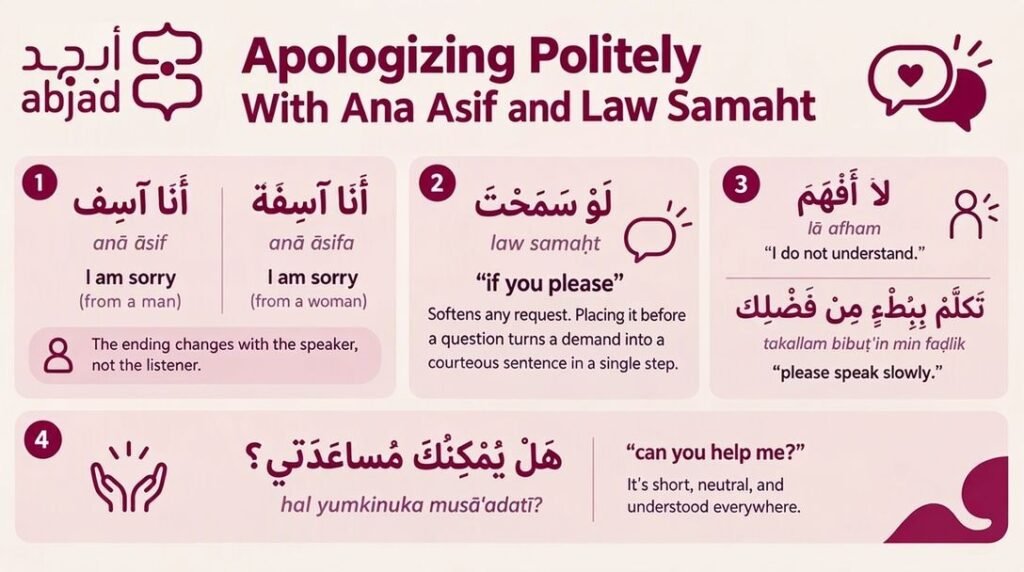
لَوْ سَمَحْت (law samaḥt) means “if you please” and softens any request. Placing it before a question turns a demand into a courteous sentence in a single step.
Two more lines prevent most misunderstandings.
لا أَفْهَم (lā afham) means “I do not understand,” and تَكَلَّمْ بِبُطْءٍ مِنْ فَضْلِك (takallam bibuṭ’in min faḍlik) means “please speak slowly.”
A sentence worth memorizing for emergencies is هَلْ يُمْكِنُكَ مُساعَدَتي؟ (hal yumkinuka musāʿadatī?), meaning “can you help me?” It is short, neutral, and understood everywhere.
10. Saying Happy Birthday in Arabic Language
عيدُ ميلادٍ سَعيد (ʿīdu mīlādin saʿīd) is how to say happy birthday in Arabic language use, literally “a happy birthday feast.” Celebration vocabulary extends well beyond birthdays.
مَبْروك (mabrūk) means “congratulations,” and كُلُّ عامٍ وَأَنْتَ بِخَيْر (kullu ʿāmin wa anta bikhayr) means “may you be well every year,” used at Eid and at anniversaries.
Replies follow a pattern worth copying. Someone wished مَبْروك usually answers اللهُ يُبارِكُ فيك (Allāhu yubāriku fīk), meaning “may Allah bless you.”
| Arabic | Pronunciation | Meaning |
| عيدُ ميلادٍ سَعيد | ʿīdu mīlādin saʿīd | Happy birthday |
| مَبْروك | mabrūk | Congratulations |
| عيد مُبارَك | ʿīd mubārak | Blessed Eid |
| رَمَضان مُبارَك | ramaḍān mubārak | Blessed Ramadan |
Habibi Meaning in Arabic and Other Words of Affection
حَبيبي (ḥabībī) means “my beloved” and is used between friends, relatives, and colleagues without any romantic sense attached to it. The habibi meaning in Arabic shifts with tone rather than with the word itself. A taxi driver in Dubai may use it with a passenger, and a father uses the feminine حَبيبَتي (ḥabībatī) with his daughter.
Family terms appear just as often in daily speech.
أُمّي (ummī) is how to say mom in Arabic language terms, and أَبي (abī) means “my father,” both used constantly in conversation.
Compliments follow the same gender pattern. The word for gorgeous in Arabic language use is جَميل (jamīl) for a man and جَميلَة (jamīla) for a woman, while ما شاءَ الله (mā shā’a Allāh) is added to praise without envy.
| Arabic | Pronunciation | Meaning |
| حَبيبي | ḥabībī | My beloved (to a man) |
| حَبيبَتي | ḥabībatī | My beloved (to a woman) |
| أُمّي | ummī | My mother |
| جَميلَة | jamīla | Gorgeous, beautiful |
Abjad Academy covers this register of daily speech inside its Emirati Arabic Course, which focuses on the expressions actually heard in homes and workplaces across the United Arab Emirates.

Start Learning Emirati Arabic for Free
Haram Meaning in Arabic Everyday Conversation
حَرام (ḥarām) means “forbidden” in Islamic law, covering actions a Muslim must avoid. Its opposite is حَلال (ḥalāl), meaning permitted.
Outside legal rulings, the haram meaning in Arabic becomes an expression of sympathy. Saying حَرام عَلَيْك (ḥarām ʿalayk) to someone means “that was unfair of you,” spoken with mild reproach rather than a verdict.
Several religious words appear constantly in ordinary sentences.
إِنْ شاءَ الله (in shā’a Allāh) means “if Allah wills,” and الحَمْدُ لِله (al-ḥamdu lillāh) means “praise be to Allah.”
Learners who recognize these four words follow much more of a conversation than their vocabulary size suggests. They function as connectors, not as religious statements, in most daily exchanges.
Inside Our Virtual Classrooms
We believe in full transparency and proven quality. Take a look at these actual snippets from our live classes to experience our modern learning platform, patient instructors, and interactive student participation.
Begin Your Arabic Journey in the UAE
Join Abjad Institute for a professional and immersive Arabic language experience tailored to your goals.
Book Your Free TrialMost Used Sentences in Arabic for Daily Life in the UAE
Modern Standard Arabic is the written and formal standard understood in all Arab countries. The most used sentences in Arabic daily life, however, often appear in a Gulf dialect form.
Both registers are worth knowing in the United Arab Emirates. Formal settings, documents, and news use Fusha, while markets, taxis, and friendships run on Emirati and Gulf expressions.
The table below pairs the standard form with its common Gulf equivalent so that neither one sounds unfamiliar when you hear it.
| Meaning | Modern Standard Arabic | Gulf and Emirati Form |
| How are you? | كَيْفَ حالُك (kayfa ḥāluk) | شْلونَك (shlōnak) |
| What is this? | ما هَذا (mā hādhā) | شو هَذا (shū hādhā) |
| I want | أُريد (urīd) | أَبي (abī) |
| Now | الآن (al-ān) | الحين (al-ḥīn) |
Read also: Arabic Broken Plurals And How Each Pattern Is Formed
Mistakes Beginners Make With Arabic Sentences
Gender endings cause the most errors. A woman saying أَنا آسِف instead of أَنا آسِفَة is immediately noticeable, even though the meaning still comes across clearly.
Pronunciation of the deep letters is the second obstacle. The letters ح, ع, ق, and ض have no English equivalent, and replacing them with the nearest English sound changes the word entirely.
Three habits prevent most of these problems:
- Learn every sentence together with its expected reply.
- Say each new sentence aloud rather than reading it silently.
- Record yourself weekly and compare the recording with a native speaker.
Abjad Academy corrects these errors in real time through its Modern Standard Arabic Course, where certified tutors monitor pronunciation letter by letter during live sessions.
Fix Your Pronunciation With a Free Lesson
Start Speaking Arabic With Abjad Academy Expert Tutors
Abjad Academy teaches Arabic online to learners across the United Arab Emirates through one-on-one live sessions with native tutors who correct pronunciation as you speak, not afterward.
What sets Abjad Academy apart:
- Native Arab tutors trained to teach non-Arabic speakers from zero.
- Separate tracks for Modern Standard Arabic, Emirati dialect, and Quranic Arabic.
- Flexible scheduling that fits Gulf working hours and school timetables.
Our Arabic Courses
- Arabic Speaking Course
- Arabic Course for Beginners
- Emirati Arabic Course
- Modern Standard Arabic Course
- Arabic Course for Kids
- Arabic Course for Professionals
Conclusion
Ten sentences carry a beginner further than hundreds of isolated words, because each one opens an exchange that a native speaker already knows how to continue.
Greetings, thanks, prices, directions, and farewells appear in nearly every interaction in Dubai and Abu Dhabi. Learning the reply alongside each sentence turns passive recognition into real conversation.
The most used sentences in Arabic become permanent through daily speaking, not through reading lists. Choose three sentences, use them tomorrow, and add three more the week after.
FAQs
What Are the Most Useful Arabic Sentences for Beginners?
The most useful sentences are السَّلامُ عَلَيْكُم (as-salāmu ʿalaykum) for greeting, شُكْراً (shukran) for thanks, بِكَمْ هَذا؟ (bikam hādhā?) for prices, and أَيْنَ؟ (ayna?) for directions. These four cover most daily situations.
Should I Learn Modern Standard Arabic or Emirati Dialect?
Start with Modern Standard Arabic because it is understood in every Arab country and used in writing, media, and formal settings. Add Emirati expressions afterward for casual conversation in the United Arab Emirates.
What Does Habibi Actually Mean in Arabic?
حَبيبي (ḥabībī) means “my beloved” and is used between friends, family members, and even strangers as a friendly address. Context and tone decide whether it carries affection, warmth, or mild frustration.
How Long Does It Take to Learn Basic Arabic Sentences?
Most learners memorize 50 to 100 practical sentences within four to six weeks of daily practice of 15 to 20 minutes. Speaking them aloud with a tutor shortens that timeline considerably.
Do Arabic Sentences Change for Men and Women?
Yes, most sentences change their ending based on the speaker or the listener.
أَنا آسِف becomes أَنا آسِفَة for a female speaker, and كَيْفَ حالُكَ becomes كَيْفَ حالُكِ when addressing a woman.





[…] Read also: 10 Most Used Sentences in Arabic With Pronunciation […]
[…] Read also: 10 Most Used Sentences in Arabic With Pronunciation […]