 Quran
| Key Takeaways |
| Arabic broken plurals reshape the inside of a singular noun instead of adding a suffix, which is why no single ending signals plurality. |
| Classical grammarians recorded more than seventy plural shapes, yet fewer than thirty appear with any real frequency in written Arabic. |
| Plural of fewness covers three to ten items through four patterns, while plural of abundance covers eleven and above through many more. |
| Plurals on the muntaha al-jumuʿ shapes are diptote, so they refuse tanween and take fatha in the genitive case. |
| Non-human plurals take feminine singular agreement, so al-kutubu mufidatun is correct and al-kutubu mufidun is not. |
Arabic broken plurals, known in Arabic as جمع تكسير (jamʿ taksir, literally “plural of breaking”), reshape a word from the inside instead of attaching an ending. Learners who expect a tidy suffix meet them in the first weeks of study.
Roughly four in ten of the most frequent Arabic nouns take this internal plural, so skipping the topic is not a realistic option. Grammarians catalogued over seventy shapes, though only a few dozen carry genuine weight in real texts.
Behind the apparent disorder sits a root and pattern system that morphology specialists mapped in precise detail. What follows covers the formation mechanics, the working pattern tables, the case endings, and the agreement rules that quietly cost learners marks.
What Arabic Broken Plurals Are in Classical Grammar
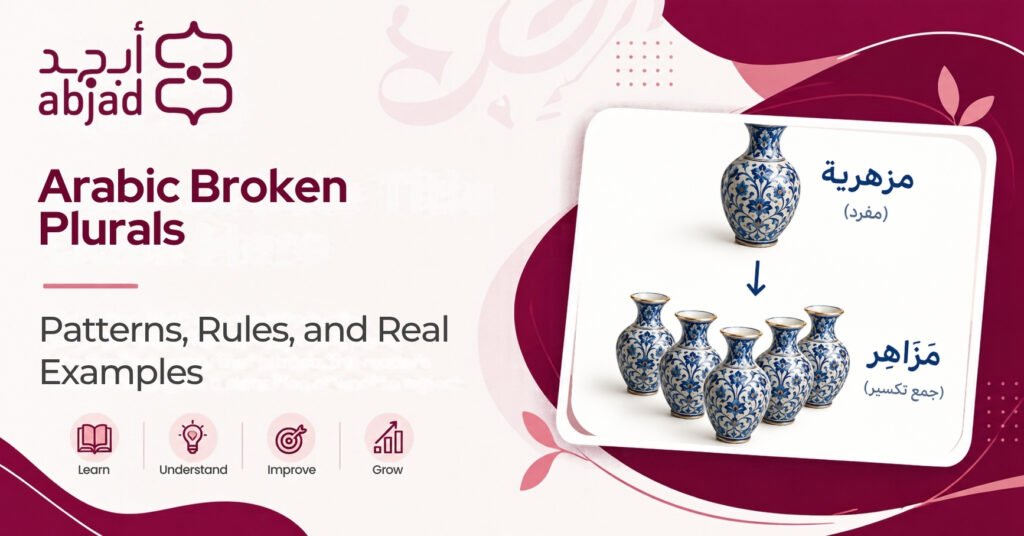
A broken plural is a plural formed by altering the internal vowel and consonant structure of the singular noun rather than by adding a suffix to it. The singular is metaphorically broken apart and rebuilt.
Two sciences govern the behavior. Sarf, written الصرف (al-sarf, Arabic morphology), explains how the plural shape is built from the root. Nahw, written النحو (al-nahw, Arabic syntax), explains how that plural behaves inside a sentence.
English offers a faint parallel in pairs like foot and feet, or mouse and mice. Arabic, however, uses internal change as a mainstream strategy rather than a handful of surviving irregularities.
How Root Letters and Patterns Build a Broken Plural
Every Arabic noun carries a consonantal root, usually three letters, that holds the core meaning. Patterns, called أوزان (awzan, “measures” or templates), pour vowels and occasional extra letters around that root.
Three Changes That Turn a Singular Into a Plural
Classical analysis identifies three mechanisms by which a singular noun becomes a broken plural. Most plurals use more than one of them at the same time.
- Adding letters, as قَلْب (qalb, heart) becomes قُلُوب (qulub, hearts).
- Removing letters, as رَسُول (rasul, messenger) becomes رُسُل (rusul, messengers).
- Changing the vowels only, as أَسَد (asad, lion) becomes أُسُد (usud, lions).
How One Arabic Root Produces Several Plural Shapes
The root ك ت ب (k, t, b) carries the sense of writing. Each derived noun built on that root selects its own plural shape, which is why learners cannot apply one rule across a whole root family.
| Singular | Meaning | Plural | Plural Pattern |
| كِتَاب (kitab) | book | كُتُب (kutub, books) | فُعُل (fuʿul) |
| كَاتِب (katib) | writer | كُتَّاب (kuttab, writers) | فُعَّال (fuʿʿal) |
| مَكْتَب (maktab) | office | مَكَاتِب (makatib, offices) | مَفَاعِل (mafaʿil) |
| مَكْتُوب (maktub) | letter | مَكَاتِيب (makatib, letters) | مَفَاعِيل (mafaʿil) |
Abjad Academy offers an Arabic Grammar Course that teaches root and pattern analysis directly, so students derive plural forms instead of memorizing isolated word pairs.
Start Pattern Based Grammar Training Today
Sound Plurals vs Broken Plurals in Arabic
Sound plurals keep the singular stem untouched and attach a fixed suffix, which makes them fully predictable. Broken plurals rebuild the stem, which makes them unpredictable without pattern knowledge.
The practical contrast below shows why learners meet far less resistance with sound forms and far more with internal ones.
| Feature | Sound Plural | Broken Plural |
| Stem | unchanged | internally restructured |
| Marker | ـون (-un) and ـين (-in), or ـات (-at) | vowel and letter pattern |
| Predictability | fully regular | pattern based, partly memorized |
| Typical users | rational masculine nouns, feminine nouns | most other nouns, human and non-human |
| Case marking | by letter change | by short vowel ending |
Plural of Fewness Patterns in Arabic (جمع القلة)
The plural of fewness, جمع القلة (jamʿ al-qillah), refers to a quantity between three and ten. Four patterns carry this meaning, and each one is tied to specific singular shapes.
| Pattern | Singular | Plural | Meaning |
| أَفْعُل (afʿul) | نَفْس (nafs) | أَنْفُس (anfus) | souls |
| أَفْعَال (afʿal) | قَلَم (qalam) | أَقْلَام (aqlam) | pens |
| أَفْعِلَة (afʿilah) | طَعَام (taʿam) | أَطْعِمَة (atʿimah) | foods |
| فِعْلَة (fiʿlah) | صَبِيّ (sabiyy) | صِبْيَة (sibyah) | young boys |
Arabic speakers no longer observe the numerical limit strictly in everyday usage. Classical texts and Quranic exegesis, however, treat the distinction as meaningful, and university syllabuses still test it directly.
Read also: Arabic Alphabet Number Of Letters Explained Simply
Plural of Abundance Patterns in Arabic (جمع الكثرة)
The plural of abundance, جمع الكثرة (jamʿ al-kathrah), refers to eleven items and upward with no fixed ceiling. This group holds the largest share of working vocabulary and the widest range of shapes.
| Pattern | Singular | Plural | Meaning |
| فُعُل (fuʿul) | كِتَاب (kitab) | كُتُب (kutub) | books |
| فُعُول (fuʿul) | بَيْت (bayt) | بُيُوت (buyut) | houses |
| فِعَال (fiʿal) | جَبَل (jabal) | جِبَال (jibal) | mountains |
| فُعَل (fuʿal) | غُرْفَة (ghurfah) | غُرَف (ghuraf) | rooms |
| فُعَّال (fuʿʿal) | طَالِب (talib) | طُلَّاب (tullab) | students |
| فُعَلَاء (fuʿalaʾ) | عَالِم (ʿalim) | عُلَمَاء (ʿulamaʾ) | scholars |
| أَفْعِلَاء (afʿilaʾ) | صَدِيق (sadiq) | أَصْدِقَاء (asdiqaʾ) | friends |
| فِعْلَان (fiʿlan) | غُلَام (ghulam) | غِلْمَان (ghilman) | boys |
Quranic vocabulary illustrates these shapes constantly, which is why reciters absorb them faster than textbook learners. The fuʿul pattern appears in one of the most quoted verses in the Quran, where qalb becomes qulub.
الَّذِينَ آمَنُوا وَتَطْمَئِنُّ قُلُوبُهُم بِذِكْرِ اللَّهِ ۗ أَلَا بِذِكْرِ اللَّهِ تَطْمَئِنُّ الْقُلُوبُ
(Alladhina amanu wa tatmaʾinnu qulubuhum bi dhikri Allah, ala bi dhikri Allahi tatmaʾinnu al-qulub)
“Those who have believed and whose hearts are assured by the remembrance of Allah. Unquestionably, by the remembrance of Allah hearts are assured.”
Abjad Academy offers a Classical Arabic Course that drills abundance patterns through graded readings from classical prose, with a tutor correcting every form aloud.
Read Classical Arabic With a Live Tuto
Ultimate Plural Patterns in Arabic (منتهى الجموع)
Ultimate plural, منتهى الجموع (muntaha al-jumuʿ, “the furthest point of plurals”), covers the longest broken plural shapes. A plural belongs here when two letters follow the plural alif, or three with a quiescent middle one.
| Pattern | Singular | Plural | Meaning |
| مَفَاعِل (mafaʿil) | مَسْجِد (masjid) | مَسَاجِد (masajid) | mosques |
| مَفَاعِيل (mafaʿil) | مِفْتَاح (miftah) | مَفَاتِيح (mafatih) | keys |
| فَوَاعِل (fawaʿil) | شَارِع (shariʿ) | شَوَارِع (shawariʿ) | streets |
| فَعَائِل (faʿaʾil) | رِسَالَة (risalah) | رَسَائِل (rasaʾil) | messages |
| فَعَالِل (faʿalil) | دَفْتَر (daftar) | دَفَاتِر (dafatir) | notebooks |
| فَعَالِيل (faʿalil) | صُنْدُوق (sunduq) | صَنَادِيق (sanadiq) | boxes |
These shapes matter for more than vocabulary. Every plural in this category is grammatically diptote, a point covered in the next section, and that status changes how the word ends.
See Us in Action!
Curious about what our online classrooms look like? Watch the short clips below to see how our interactive, one-on-one sessions bring learning to life with real-time feedback and engaging teaching methods.
Begin Your Arabic Journey in the UAE
Join Abjad Institute for a professional and immersive Arabic language experience tailored to your goals.
Book Your Free TrialCase Endings and Diptote Rules for Broken Plurals
Broken plurals split into two groups for case marking. Most behave as ordinary triptote nouns, while the ultimate plural shapes behave as diptotes and lose both tanween and the kasra.
Regular Case Endings on Triptote Broken Plurals
Ordinary broken plurals take the three standard short vowel endings exactly as singular nouns do. Nothing about the internal restructuring affects the final vowel.
| Case | Ending | Example | Function |
| Nominative, الرفع (al-rafʿ) | ـٌ (-un) | كُتُبٌ (kutubun, books) | subject |
| Accusative, النصب (al-nasb) | ـًا (-an) | كُتُبًا (kutuban, books) | object |
| Genitive, الجر (al-jarr) | ـٍ (-in) | كُتُبٍ (kutubin, books) | after a preposition |
Why Diptote Plurals Take Fatha in the Genitive
Plurals on masajid, mafatih, rasaʾil and similar shapes are ممنوع من الصرف (mamnuʿ min al-sarf, “barred from full inflection”). They refuse tanween and take fatha in the genitive instead of kasra.
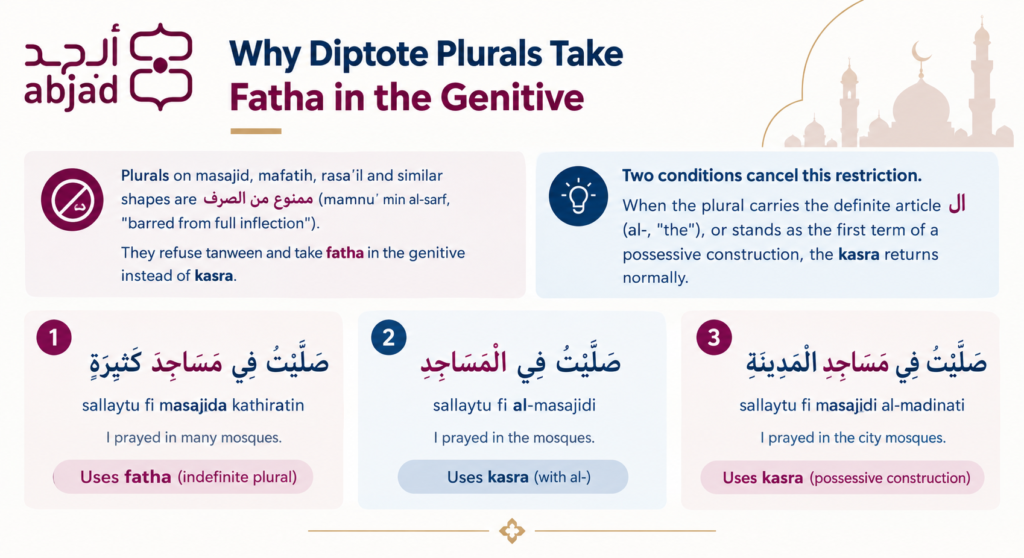
Two conditions cancel this restriction. When the plural carries the definite article الـ (al-, “the”), or stands as the first term of a possessive construction, the kasra returns normally.
- صَلَّيْتُ فِي مَسَاجِدَ كَثِيرَةٍ (sallaytu fi masajida kathiratin, “I prayed in many mosques”) uses fatha because the plural is indefinite.
- صَلَّيْتُ فِي الْمَسَاجِدِ (sallaytu fi al-masajidi, “I prayed in the mosques”) uses kasra because al- is attached.
- صَلَّيْتُ فِي مَسَاجِدِ الْمَدِينَةِ (sallaytu fi masajidi al-madinati, “I prayed in the city mosques”) uses kasra because of the possessive construction.
How Broken Plurals Agree With Adjectives and Verbs
Agreement is where most learners lose marks, because Arabic does not match plural nouns with plural adjectives automatically. Rationality decides the rule, not the plural form itself.
Non-human plurals, whether broken or sound, take feminine singular agreement. A shelf of books is الْكُتُبُ مُفِيدَةٌ (al-kutubu mufidatun, “the books are useful”), never al-kutubu mufidun, and verbs follow the same logic.
| Plural Noun | Type | Correct Agreement |
| الْكُتُبُ (al-kutubu, the books) | non-human | الْكُتُبُ جَدِيدَةٌ (al-kutubu jadidatun, the books are new) |
| الْجِبَالُ (al-jibalu, the mountains) | non-human | الْجِبَالُ شَامِخَةٌ (al-jibalu shamikhatun, the mountains are lofty) |
| الرِّجَالُ (al-rijalu, the men) | human | الرِّجَالُ كُرَمَاءُ (al-rijalu kuramaʾu, the men are generous) |
| الْعُلَمَاءُ (al-ʿulamaʾu, the scholars) | human | الْعُلَمَاءُ مُجْتَهِدُونَ (al-ʿulamaʾu mujtahiduna, the scholars are diligent) |
Human broken plurals allow flexibility that sound plurals do not. Classical Arabic permits either plural agreement or feminine singular agreement with them, which is why قَالَتِ الْأَعْرَابُ (qalati al-aʿrabu, “the bedouins said”) is perfectly sound.
Several of these shapes appear together in one verse, including al-dawabb (beasts), al-anʿam (livestock), alwan (colors), ʿibad (servants) and al-ʿulamaʾ (scholars), with the singular adjective mukhtalifun governing a non-human plural.
وَمِنَ النَّاسِ وَالدَّوَابِّ وَالْأَنْعَامِ مُخْتَلِفٌ أَلْوَانُهُ كَذَٰلِكَ ۗ إِنَّمَا يَخْشَى اللَّهَ مِنْ عِبَادِهِ الْعُلَمَاءُ ۗ إِنَّ اللَّهَ عَزِيزٌ غَفُورٌ
(Wa mina al-nasi wa al-dawabbi wa al-anʿami mukhtalifun alwanuhu kadhalik, innama yakhsha Allaha min ʿibadihi al-ʿulamaʾ, inna Allaha ʿazizun ghafur)
“And among people and moving creatures and grazing livestock are various colors similarly. Only those fear Allah, from among His servants, who have knowledge. Indeed, Allah is Exalted in Might and Forgiving.”
Abjad Academy offers a Quranic Arabic Course that trains students to parse agreement and case directly from Quranic verses instead of from invented textbook sentences.

Parse Quranic Arabic With Certified Tutors
Most Common Arabic Broken Plurals Learners Meet First
A small core of broken plurals covers a disproportionate share of daily reading. Learning these first gives faster returns than working alphabetically through a dictionary.
| Singular | Plural | Meaning | Pattern |
| كِتَاب (kitab) | كُتُب (kutub) | books | فُعُل (fuʿul) |
| وَلَد (walad) | أَوْلَاد (awlad) | boys | أَفْعَال (afʿal) |
| رَجُل (rajul) | رِجَال (rijal) | men | فِعَال (fiʿal) |
| بَيْت (bayt) | بُيُوت (buyut) | houses | فُعُول (fuʿul) |
| مَدِينَة (madinah) | مُدُن (mudun) | cities | فُعُل (fuʿul) |
| مَدْرَسَة (madrasah) | مَدَارِس (madaris) | schools | مَفَاعِل (mafaʿil) |
| قَلَم (qalam) | أَقْلَام (aqlam) | pens | أَفْعَال (afʿal) |
| طَالِب (talib) | طُلَّاب (tullab) | students | فُعَّال (fuʿʿal) |
| بَاب (bab) | أَبْوَاب (abwab) | doors | أَفْعَال (afʿal) |
| سُؤَال (suʾal) | أَسْئِلَة (asʾilah) | questions | أَفْعِلَة (afʿilah) |
| صَدِيق (sadiq) | أَصْدِقَاء (asdiqaʾ) | friends | أَفْعِلَاء (afʿilaʾ) |
| دَقِيقَة (daqiqah) | دَقَائِق (daqaʾiq) | minutes | فَعَائِل (faʿaʾil) |
Read also: 10 Most Used Sentences in Arabic With Pronunciation
Common Mistakes Learners Make With Broken Plurals
Certain errors repeat across almost every classroom, and each one traces back to a missing rule rather than weak memory. Naming them makes them easier to catch while writing.
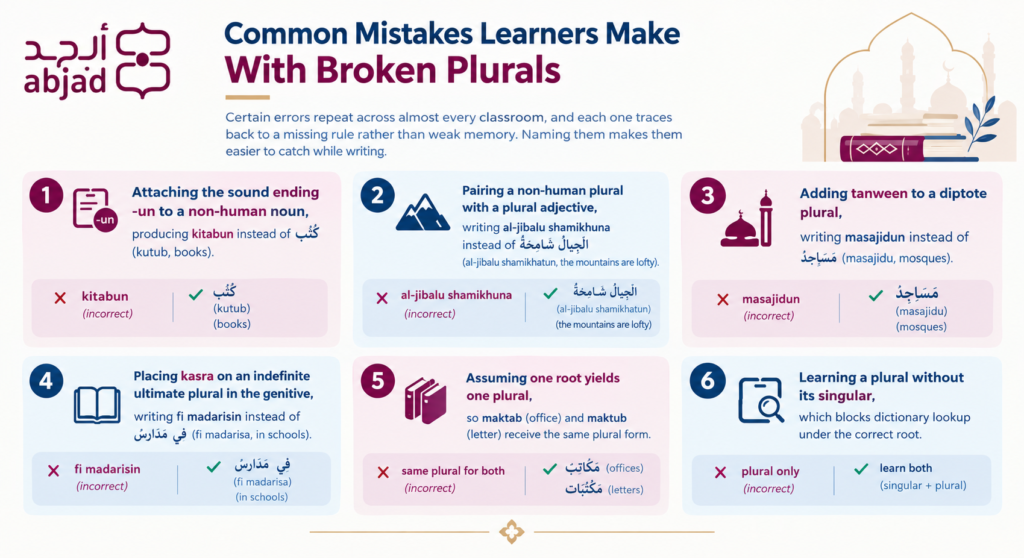
- Attaching the sound ending -un to a non-human noun, producing kitabun instead of كُتُب (kutub, books).
- Pairing a non-human plural with a plural adjective, writing al-jibalu shamikhuna instead of الْجِبَالُ شَامِخَةٌ (al-jibalu shamikhatun, the mountains are lofty).
- Adding tanween to a diptote plural, writing masajidun instead of مَسَاجِدُ (masajidu, mosques).
- Placing kasra on an indefinite ultimate plural in the genitive, writing fi madarisin instead of فِي مَدَارِسَ (fi madarisa, in schools).
- Assuming one root yields one plural, so maktab (office) and maktub (letter) receive the same plural form.
- Learning a plural without its singular, which blocks dictionary lookup under the correct root.
Inside Our Virtual Classrooms
We believe in full transparency and proven quality. Take a look at these actual snippets from our live classes to experience our modern learning platform, patient instructors, and interactive student participation.
Begin Your Arabic Journey in the UAE
Join Abjad Institute for a professional and immersive Arabic language experience tailored to your goals.
Book Your Free TrialHow to Learn Broken Plural Patterns Without Rote Memory
Memorizing isolated pairs works slowly and fades fast. Pattern-first study produces recognition that transfers to unfamiliar words, which is what real reading fluency actually requires.
- Learn each new noun together with its plural from the first encounter, never separately.
- Group vocabulary by plural pattern rather than by topic, so all fuʿul words sit together.
- Read the pattern aloud with a sample word until the rhythm itself becomes familiar.
- Test yourself in the reverse direction, moving from plural back to singular.
- Mark every diptote plural in your notes, since the case ending behaves differently.
- Pull examples from real Arabic texts, because frequency teaches priority better than any list.
Learners across the UAE often study alongside daily exposure to written Arabic on signage, official forms, and news media, which turns passive reading into free pattern practice. That exposure works best when a tutor corrects endings early.
Abjad Academy offers a Modern Standard Arabic Course that builds plural recognition through news texts, dictation, and spaced review inside live one on one sessions.
Build Your Arabic Plurals Through Live Practice
Learn Arabic Broken Plurals With Abjad Academy Tutors
Arabic broken plurals reward correction more than repetition, because a wrong ending repeated privately becomes permanent. Abjad Academy pairs every student with a certified tutor who hears each form and fixes it immediately.
What sets Abjad Academy apart:
- Live one-on-one sessions with native-speaking, certified Arabic tutors.
- Pattern-based grammar instruction that teaches derivation instead of word lists.
- Flexible scheduling built around UAE working and school hours.
Our Arabic Courses:
- Arabic Grammar Course
- Modern Standard Arabic Course
- Classical Arabic Course
- Quranic Arabic Course
- Arabic Course for Adults
- Arabic Course for Beginners
Conclusion
Arabic broken plurals look chaotic only until the root and pattern system becomes visible. Once a learner reads qulub as the root q, l, b poured into the shape fuʿul, the form stops being an exception and becomes an instance of a rule.
Three layers carry the whole topic. Pattern knowledge tells you how the plural is built, the fewness and abundance distinction tells you what quantity it signals, and the diptote rule tells you how it ends.
Agreement deserves the final word, because it is the error that survives longest. Treat non-human plurals as feminine singular, give rational plurals their flexibility, and most remaining mistakes disappear on their own.
FAQs
What Is a Broken Plural in Arabic?
A broken plural is a plural formed by changing the internal structure of the singular noun rather than adding a suffix. The root consonants stay, while vowels and sometimes extra letters change, as qalb becomes qulub.
How Many Broken Plural Patterns Are There in Arabic?
Grammarians documented more than seventy broken plural shapes, but fewer than thirty appear often enough to matter. Mastering roughly a dozen high-frequency patterns covers the overwhelming majority of nouns encountered in ordinary reading.
Do Arabic Broken Plurals Follow Predictable Rules?
Broken plurals are partly predictable. Certain singular shapes strongly favor certain plural patterns, and derived nouns such as maktab and miftah behave almost perfectly. Simple static nouns still require memorization alongside pattern recognition.
Why Do Some Broken Plurals Take Fatha in the Genitive Case?
Plurals on the muntaha al-jumuʿ shapes, such as masajid and mafatih, are diptote and refuse tanween. In the genitive they take fatha instead of kasra, unless they carry al- or head a possessive construction.
Should Beginners Memorize Broken Plurals or Learn the Patterns?
Beginners should do both, starting with patterns. Learn each noun with its plural, then group those pairs by shared pattern. Pattern grouping builds recognition that transfers to new words, which isolated memorization never achieves.





[…] Read also: Arabic Broken Plurals And How Each Pattern Is Formed […]