 Quran
| Key Takeaways |
| Twenty-two of the 28 Arabic letters join on both sides, while six letters (ا د ذ ر ز و) join only to the letter before them. |
| Every joining letter has up to four shapes (isolated, initial, medial, and final), so each letter should be practiced in all four positions. |
| Short daily sessions of 15 minutes, moving from tracing to freehand words, build steadier joined handwriting than one long weekly session. |
| Splitting real words into segments, then rebuilding them from separate letters, is the fastest self-check for joining accuracy. |
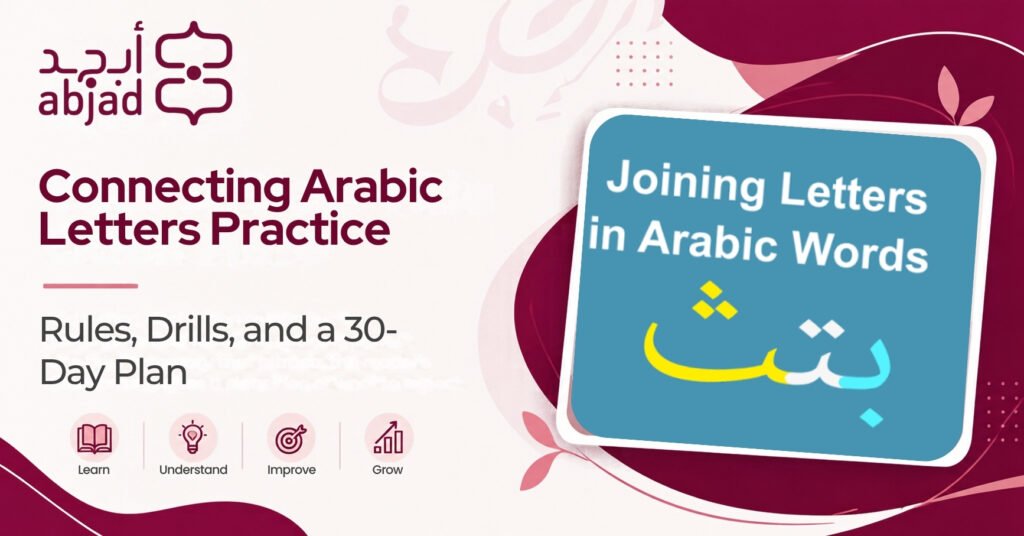
Connecting Arabic letters practice is the stage where beginners move from recognizing isolated shapes to reading and writing real words. Because Arabic script is cursive, most letters change shape depending on the letters sitting beside them.
Many learners in the UAE, from expatriate parents in Dubai to students preparing for school Arabic exams in Abu Dhabi, know all 28 letters yet stall once those letters must join. Reading slows down, and handwriting looks broken and uneven.
This guide explains the joining rules, the six letters that split a word into segments, and the letter families that share one body. It also gives graded exercises with answers, a daily routine, and a thirty-day plan.
Right-to-Left Joining Rule Behind Every Arabic Word
Arabic letters join from right to left, and each joining letter takes a different shape according to its position. A letter can appear isolated, at the start, in the middle, or at the end of a connected group.
Linguists call these the four positional forms. Some letters change only slightly, keeping the same body with a shortened tail, while others such as ع (Ayn) and ه (Ha) look almost like different letters in each position.
Below, one stable letter, ب (Baa), and one shape-shifting letter, ه (Ha), appear across all four positions, with a real word and its meaning for each form.
| Position | ب (Baa) | Example Word | ه (Ha) | Example Word |
| Isolated | ب | بَاب (baab, door) | ه | مِيَاه (miyaah, water) |
| Initial | بـ | بَيْت (bayt, house) | هـ | هَوَاء (hawaa’, air) |
| Medial | ـبـ | صَبْر (sabr, patience) | ـهـ | نَهْر (nahr, river) |
| Final | ـب | كَلْب (kalb, dog) | ـه | وَجْه (wajh, face) |
Notice that ب keeps its dot and its tooth in every form, while ه changes completely in the medial position. In our experience at Abjad Academy, learners who drill positional forms early read joined text noticeably faster.
Six Arabic Letters That Never Join the Next Letter
Six letters join only to the letter before them and never to the letter after: ا (Alif), د (Daal), ذ (Dhaal), ر (Raa), ز (Zaay), and و (Waaw). Whenever one appears, the word breaks and the next letter starts fresh.
| Letter | Name | Example Word | Meaning | How the Word Splits |
| ا | Alif | بَاب (baab) | door | با + ب |
| د | Daal | وَرْد (ward) | rose | و + ر + د |
| ذ | Dhaal | ذَهَب (dhahab) | gold | ذ + هب |
| ر | Raa | رَسْم (rasm) | drawing | ر + سم |
| ز | Zaay | زَيْت (zayt) | oil | ز + يت |
| و | Waaw | وَلَد (walad) | boy | و + لد |
Those forced breaks create word segments and explain most of the gaps learners notice in printed Arabic. Two related ideas, segments and special end letters, complete the picture of how non-joining letters behave.
Word Segments Created by Non-Joining Letters
A word segment is a group of letters written without lifting the pen. The word مَدْرَسَة (madrasa, school) has three segments: مد, then ر, then سة, because د and ر both refuse to join forward.
Segments matter for reading speed. Once learners spot the six non-joiners, they stop mistaking a gap for the end of a word and start reading each segment as one complete visual unit.
Hamza, Ta Marbuta, and Alif Maqsura at Word Endings
Three extra shapes appear only in specific places. Hamza (ء) standing alone on the line never joins either side, as in سَمَاء (samaa’, sky). Ta marbuta (ة) and Alif maqsura (ى) appear only at the end of a word.
Both ending letters attach to the letter before them whenever that letter allows it. For example, ة becomes ـة in غُرْفَة (ghurfa, room), and ى becomes ـى in عَلَى (ala, on), keeping the word in one smooth segment.
Abjad Academy offers an Arabic Alphabet Course that drills every letter in its four positions, so non-joiners and end letters become automatic before learners move on to full words.

Start Your Free Arabic Alphabet Trial Today
Letter Families That Share One Connected Shape
Most Arabic letters belong to families that share the same body and differ only in their dots. Practicing a whole family together reduces the shapes a learner must memorize from 28 to fewer than 20 base forms.
| Family | Shared Base Shape | What Changes | Practice Word |
| بـ تـ ثـ نـ يـ | Short tooth on the baseline | Number and position of dots | بِنْت (bint, girl) |
| ج ح خ | Open hook | One dot below, none, or one above | خُبْز (khubz, bread) |
| د ذ | Small angle | Dot above ذ | دَار (daar, home) |
| ر ز | Short downward curve | Dot above ز | رِزْق (rizq, provision) |
| س ش | Three small teeth | Three dots above ش | شَمْس (shams, sun) |
| ص ض | Closed loop with a tooth | Dot above ض | ضَيْف (dayf, guest) |
| ط ظ | Loop with an upright stroke | Dot above ظ | طِفْل (tifl, child) |
| ع غ | Open cup | Dot above غ | عَيْن (ayn, eye) |
| ف ق | Round head | One dot above ف, two above ق | قَلْب (qalb, heart) |
Quick exercise: Write بـ تـ ثـ نـ يـ in a row, then write بِنْت (bint, girl) and بَيْت (bayt, house) five times each. Check that every tooth sits on the baseline and only the dots differ.
Read also: Past Continuous Tense in Arabic Explained With Examples
Common Joining Mistakes and How to Fix Each One
Most joining errors come from treating a letter as if it kept its isolated shape inside a word. Below are the mistakes Abjad Academy tutors correct most often, alongside the right form for each one.
| Mistake | What Learners Write | Correct Form |
| Joining a non-joiner forward | ر attached to the next letter in رسم | ر + سم, as in رَسْم (rasm, drawing) |
| Writing Lam and Alif separately | لـا with two strokes | One ligature لا (laa, no) |
| Using the isolated Ayn mid-word | Open ع inside the word | Closed ـعـ, as in بَعْد (ba’d, after) |
| Confusing Ta marbuta with Ha | مدرسه without dots | مَدْرَسَة (madrasa, school) with two dots |
| Writing medial Ha in isolated form | Round ه inside نهر | Medial ـهـ, as in نَهْر (nahr, river) |
| Lifting the pen inside a segment | ك ت ا written as three shapes | One segment كتا, then ب in كِتَاب (kitaab, book) |
Lam-Alif deserves special attention because it is the only required ligature in everyday writing. Whenever ل meets ا, the two merge into لا, which appears in common words such as سَلَام (salaam, peace).
See Us in Action!
Curious about what our online classrooms look like? Watch the short clips below to see how our interactive, one-on-one sessions bring learning to life with real-time feedback and engaging teaching methods.
Begin Your Arabic Journey in the UAE
Join Abjad Institute for a professional and immersive Arabic language experience tailored to your goals.
Book Your Free TrialWhy Handwritten Practice Builds Faster Arabic Reading
Handwriting trains the eye and the hand together, so learners who write joined letters by hand recognize them faster on the page. Typing hides the joining process because the keyboard shapes each letter automatically.
Islam has always connected the pen with learning. In the very first revelation to the Prophet Muhammad ﷺ, Allah describes Himself as the One who taught humanity through the pen:
الَّذِي عَلَّمَ بِالْقَلَمِ
(Alladhee ‘allama bil-qalam)
(“Who taught by the pen”)
For learners today, the lesson is practical. Writing joined words by hand slows the brain enough to notice each connection, and that attention transfers directly to reading speed in both Quranic and modern Arabic texts.
Daily Connecting Arabic Letters Practice Routine
A 15-minute daily session works better than one long weekly session, because joining depends on muscle memory that fades without repetition. Split the time between tracing, building words, and breaking words apart.
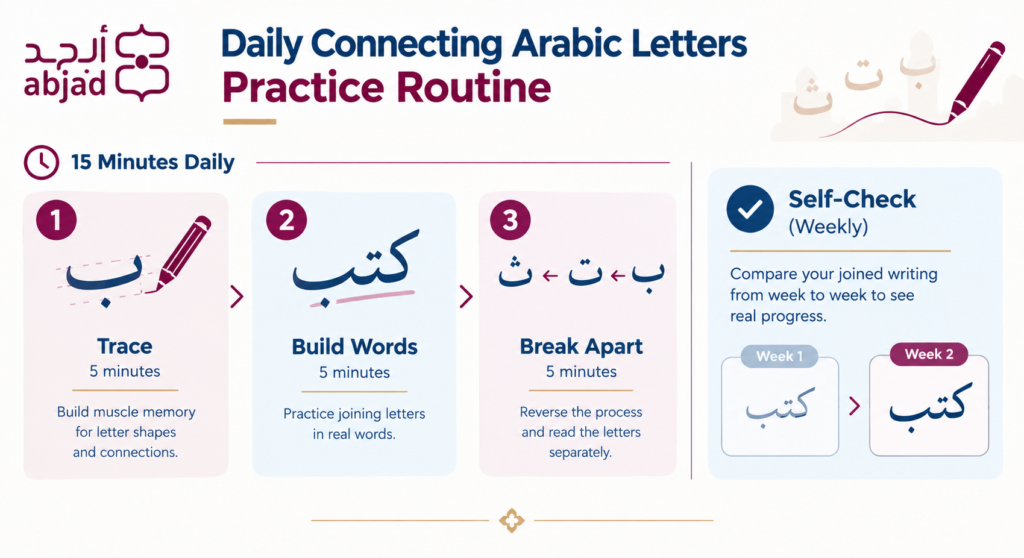
This routine has two parts: a structured session plan for each day and a short self-check that shows whether joined writing is genuinely improving from one week to the next.
Fifteen-Minute Session Plan for Joined Handwriting
Each block in the plan targets one skill, and the order matters. Tracing warms up the hand, building trains joining decisions, and breaking words apart trains the eye for reading.
| Minutes | Activity | Goal |
| 0 to 3 | Trace the four positional forms of two letters | Warm up stroke direction |
| 3 to 7 | Write isolated letters, then join them into words | Build joining decisions |
| 7 to 11 | Split printed words into letters and segments | Train reading recognition |
| 11 to 14 | Copy one short sentence by hand | Apply joining in context |
| 14 to 15 | Compare with the model and circle errors | Develop self-correction |
Weekly Self-Check for Connected Letter Accuracy
At the end of each week, write the same ten words from memory and compare them with a printed model. Score your work against this numbered checklist:
- Every non-joiner breaks the word in the correct place.
- Medial letters sit on one baseline without gaps.
- Dots match the correct letter in each family.
- Lam-Alif appears as one ligature.
- Final forms carry their full tail.
Connecting Arabic letters practice becomes measurable this way. Most learners using this checklist at Abjad Academy see visible gains in baseline control and dot placement within two to three weeks of daily sessions.
Abjad Academy offers an Arabic Writing Course where tutors review handwritten joining live on camera, correcting baseline, spacing, and letter proportions during every one-on-one lesson.

Book a Free Arabic Writing Lesson
Graded Joining Exercises from Letter Pairs to Sentences
These four levels move from joining two letters to writing a complete sentence. Cover the answer column, write each item by hand, then check your work carefully before moving to the next level.
Level One Joining Letter Pairs into Short Words
Two-letter words teach the most basic joining decision: does the first letter connect to the second? Join each pair by hand, then read the result aloud using the transliteration.
| Letters | Joined Word | Transliteration | Meaning |
| م + ن | مِن | min | from |
| ف + ي | فِي | fee | in |
| ل + ا | لَا | laa | no |
| ه + و | هُوَ | huwa | he |
| ي + د | يَد | yad | hand |
Level Two Building Three-Letter Words from Roots
Three-letter roots form the backbone of Arabic vocabulary, so they make ideal joining practice. Two items below contain only non-joiners, which tests whether every segment break lands correctly.
| Letters | Joined Word | Transliteration | Meaning |
| ك + ت + ب | كَتَبَ | kataba | he wrote |
| ق + ل + م | قَلَم | qalam | pen |
| ش + م + س | شَمْس | shams | sun |
| د + ر + س | دَرْس | dars | lesson |
| و + ر + د | وَرْد | ward | rose |
Level Three Splitting Longer Words into Segments
Reverse the process at this level: read each word, count its segments, and write them separately. This builds the reading eye that printed books, school texts, and road signs across the UAE all demand.
| Word | Meaning | Segments | Count |
| كِتَاب (kitaab) | book | كتا + ب | 2 |
| سَيَّارَة (sayyaara) | car | سيا + ر + ة | 3 |
| مَدْرَسَة (madrasa) | school | مد + ر + سة | 3 |
| طَاوِلَة (taawila) | table | طا + و + لة | 3 |
| بُرْتُقَال (burtuqaal) | orange | بر + تقا + ل | 3 |
Level Four Writing a Full Arabic Sentence by Hand
Sentence copying applies every joining rule at once. Copy the sentence below three times, checking each segment after every attempt and circling any letter that joined in the wrong direction.
أَنَا أُحِبُّ اللُّغَةَ الْعَرَبِيَّةَ
(Ana uhibbu al-lughata al-‘arabiyyah)
(“I love the Arabic language”)
Count the segments as you check.
أنا has two, أحب has two, اللغة has two, and العربية has three, giving nine segments across four words because Alif breaks the joining each time.
Joining Practice Activities for Children in UAE Schools
Children learn joining best through short, playful sessions that use movement and color before pencil precision. With Arabic taught as a core subject across UAE schools, steady home practice keeps young learners confident in class.
The right activity depends on age, since fine motor control develops gradually. Two age bands cover most primary learners in Dubai, Abu Dhabi, and Sharjah classrooms, each with its own focus.
Ages 4 to 7 Tactile Letter Joining Games
Young children need to feel letter shapes before writing them. Shape ب and ا from play dough, then join them to build بَاب (baab, door), leaving a clear gap after the Alif.
Sessions of five to ten minutes work best at this age. Finger tracing on sand trays or whiteboards adds movement, and children enjoy hunting for the six non-joiners in picture books.
Ages 8 to 12 Word Building and Segment Races
Older children enjoy challenge and speed. Give siblings or classmates pairs of letter cards and let them race to join the cards into real words such as قَلَم (qalam, pen) or شَمْس (shams, sun).
Segment races work well too. Children read a word from their school textbook, count its segments, and write them out, ideally in 15-minute sessions three to five times weekly.
Abjad Academy offers Arabic Classes for Kids that turn joining practice into games and stories, with patient tutors scheduling sessions around UAE school hours in Gulf Standard Time.

Book Your Child’s Free Arabic Class
Keyboard Tools That Support Joined Arabic Writing
Digital tools help learners see joining rules in action, because Arabic keyboards shape letters automatically. Type ك, then ت, then ب, and watch three isolated letters become كتب (kataba, he wrote) on screen.
That instant feedback makes typing a useful checking tool for connecting Arabic letters practice, though it cannot replace handwriting. The screen does the joining for you, so the hand never learns the stroke.
| Tool | How to Use It | Best For |
| Phone Arabic keyboard | Add Arabic in keyboard settings and type letter by letter | Watching positional forms change |
| Printable lined tracing sheets | Trace each form along a fixed baseline | Stroke direction and proportion |
| Mini whiteboard | Write, check, and erase quickly | Fast repetition for children |
| Lined notebook | Keep every letter on one baseline | Spacing and height control |
Use the keyboard to check, then return to paper to practice. A pencil is the best starting tool, since mistakes erase easily and light strokes give better control than a pen.
Read also: Arabic Alphabet Number Of Letters Explained Simply
How Long Does Fluent Letter Joining Usually Take?
Most adult beginners join letters accurately within four to six weeks of daily 15-minute practice, while young children may need eight to ten weeks. Speed and neatness keep improving for months after that.
This thirty-day plan suits adult beginners and older children who already recognize the 28 isolated letters and want a clear weekly target for joined writing.
| Period | Focus | Daily Task |
| Week 1 | Positional forms | Trace and write the four forms of seven letters |
| Week 2 | Non-joiners and segments | Split ten printed words into segments |
| Week 3 | Letter families and Lam-Alif | Build ten words from one family, including لا |
| Week 4 | Words and sentences | Copy one sentence and complete the self-check |
| Days 29 to 30 | Review | Write the ten test words from memory |
Abjad Academy offers an Arabic for Beginners Course that follows a similar weekly structure, moving learners from joined letters to reading, vocabulary, and simple conversations with qualified tutors.

Claim Your Free Beginner Arabic Lesson
Inside Our Virtual Classrooms
We believe in full transparency and proven quality. Take a look at these actual snippets from our live classes to experience our modern learning platform, patient instructors, and interactive student participation.
Begin Your Arabic Journey in the UAE
Join Abjad Institute for a professional and immersive Arabic language experience tailored to your goals.
Book Your Free TrialStart Joining Arabic Letters with Abjad Academy in the UAE
Abjad Academy pairs every learner with a qualified Arabic tutor for live one-on-one online lessons, so joining errors are corrected the moment they appear. Flexible morning and evening slots fit work and school schedules across the Emirates.
Adults, beginners, and children all start with a free trial lesson that checks current letter knowledge and recommends the right starting level, from alphabet foundations to confident reading and writing.
Our Arabic Courses
- Arabic Alphabet Course.
- Arabic Writing Course.
- Arabic for Beginners Course.
- Arabic Classes for Kids.
- Noorani Qaida for Kids.
- Arabic from Scratch Course.

Conclusion
Joining Arabic letters rests on a few clear rules. Letters connect from right to left, change shape by position, and break after the six non-joiners ا د ذ ر ز و, turning scattered shapes into readable words.
Consistent connecting Arabic letters practice, built on positional drills, letter families, graded exercises, and weekly self-checks, produces neat joined handwriting within weeks. Children progress fastest through games, while adults benefit most from structured daily sessions.
Start with fifteen minutes today: trace four forms, build five words, and split three words into segments. With steady effort and a qualified tutor’s feedback, reading and writing connected Arabic soon becomes second nature.
FAQs
How Many Arabic Letters Connect on Both Sides?
Twenty-two of the 28 Arabic letters connect on both sides. The remaining six, ا (Alif), د (Daal), ذ (Dhaal), ر (Raa), ز (Zaay), and و (Waaw), connect only to the letter before them and never to the letter after.
What Is the Best Way to Practice Connecting Arabic Letters?
Daily 15-minute sessions work best: trace positional forms, join separate letters into real words, then split printed words into segments. Finish each week by writing ten words from memory and comparing them with a printed model.
Why Do Lam and Alif Form a Special Shape?
Lam and Alif combine into the ligature لا (laa) whenever ل is followed by ا. Standard Arabic script treats this pair as one required shape, so writing them as two separate strokes is considered incorrect.
Can Children Learn Arabic Joining Before Reading Fluently?
Yes, children can learn joining before reading fluently, and joining practice actually speeds up reading. Writing a letter in all four forms helps children recognize those same forms on the page, especially between ages 5 and 8.
Does Typing in Arabic Help with Handwriting?
Yes, typing helps learners check joining rules, because Arabic keyboards shape letters automatically. It cannot train the hand’s strokes, though, so typing should support handwriting practice rather than replace it, especially for school learners.





[…] Read also: Connecting Arabic Letters Practice with Drills And Real Words […]