 Quran

English learners usually meet “I was reading” long before they meet its Arabic equivalent. The structure exists in Arabic too, but it is assembled from two separate verbs rather than one tense ending.
That difference trips up most beginners. They look for a single conjugation pattern, find none, and conclude that Arabic cannot express ongoing past action at all. It can, and the system behind it is remarkably consistent.
This guide covers the past continuous tense in Arabic from formation and full conjugation to negation, questions, Quranic evidence, and the errors that cost learners marks in exams and credibility in conversation.
How the Past Continuous Tense in Arabic Is Formed
Arabic builds past progressive meaning with a two-verb compound: the auxiliary كَانَ (kana) carrying the past time frame, followed by an imperfect verb carrying the ongoing action.
Neither verb works alone.
كَانَ on its own means “was” or “existed,” and the imperfect verb on its own refers to the present. Together they place an unfinished action inside past time.
Role of Kana as the Past Tense Auxiliary
كَانَ belongs to a family of verbs Arabic grammarians call كَانَ وَأَخَوَاتُهَا (kana wa akhawatuha), meaning “kana and its sisters.” These verbs govern nominal sentences and shift them into a specific time frame.
The noun that follows كَانَ is called اِسْم كَانَ (ism kana), the subject, and it carries the nominative case. What comes after it is خَبَر كَانَ (khabar kana), the predicate, which sits in the accusative position.
When that predicate is an imperfect verb, the whole sentence reads as an action that was running rather than a state that simply existed. This is the grammatical engine behind every example in this article.
Role of the Imperfect Verb After Kana
The second verb appears in الْفِعْل الْمُضَارِع (al-fi’l al-mudari’), the imperfect or present-tense form. It keeps its indicative ending, a damma on the final letter, because nothing has placed it in the subjunctive or jussive.
Consider the simplest possible model:
كَانَ يَقْرَأُ
(kana yaqra’u)
“He was reading.”
The imperfect verb also keeps its own prefix matching the subject, which means both verbs agree with the same person. That double agreement is what most beginners forget first.
Abjad Academy teaches this compound structure inside a dedicated Arabic Grammar Course that drills verb agreement patterns through live correction instead of silent worksheet practice.

Try a Free Grammar Lesson With a Certified Tutor
Full Conjugation of Kana With the Imperfect Verb
Both verbs conjugate, and both must match the same subject. The table below uses the model root فَعَلَ (fa’ala), meaning “to do,” which Arabic grammar books use as the standard pattern verb.
| Person | Arabic | Transliteration | Meaning |
| He | كَانَ يَفْعَلُ | kana yaf’alu | He was doing |
| They two (m) | كَانَا يَفْعَلَانِ | kana yaf’alani | They both were doing |
| They (m) | كَانُوا يَفْعَلُونَ | kanu yaf’aluna | They were doing |
| She | كَانَتْ تَفْعَلُ | kanat taf’alu | She was doing |
| They two (f) | كَانَتَا تَفْعَلَانِ | kanata taf’alani | They both were doing |
| They (f) | كُنَّ يَفْعَلْنَ | kunna yaf’alna | They were doing |
| You (m, sing) | كُنْتَ تَفْعَلُ | kunta taf’alu | You were doing |
| You (f, sing) | كُنْتِ تَفْعَلِينَ | kunti taf’alina | You were doing |
| You two | كُنْتُمَا تَفْعَلَانِ | kuntuma taf’alani | You both were doing |
| You (m, pl) | كُنْتُمْ تَفْعَلُونَ | kuntum taf’aluna | You were doing |
| You (f, pl) | كُنْتُنَّ تَفْعَلْنَ | kuntunna taf’alna | You were doing |
| I | كُنْتُ أَفْعَلُ | kuntu af’alu | I was doing |
| We | كُنَّا نَفْعَلُ | kunna naf’alu | We were doing |
Notice the stem change. In the third person, the verb keeps its long alif as كَانَ, but with first and second person endings it contracts to كُنْ, producing كُنْتُ and كُنَّا.
When the subject is an explicit noun rather than a pronoun, كَانَ stays singular and the noun follows it, as in كَانَ الْأَوْلَادُ يَلْعَبُونَ (kana al-awladu yal’abuna), meaning “the boys were playing.”
Read also: Masculine And Feminine Nouns In Arabic
Five Meanings Arabic Past Continuous Can Express
A single structure covers several distinct functions in Arabic. Recognizing which one a sentence carries depends on context words and on the surrounding clause, not on any change in form.
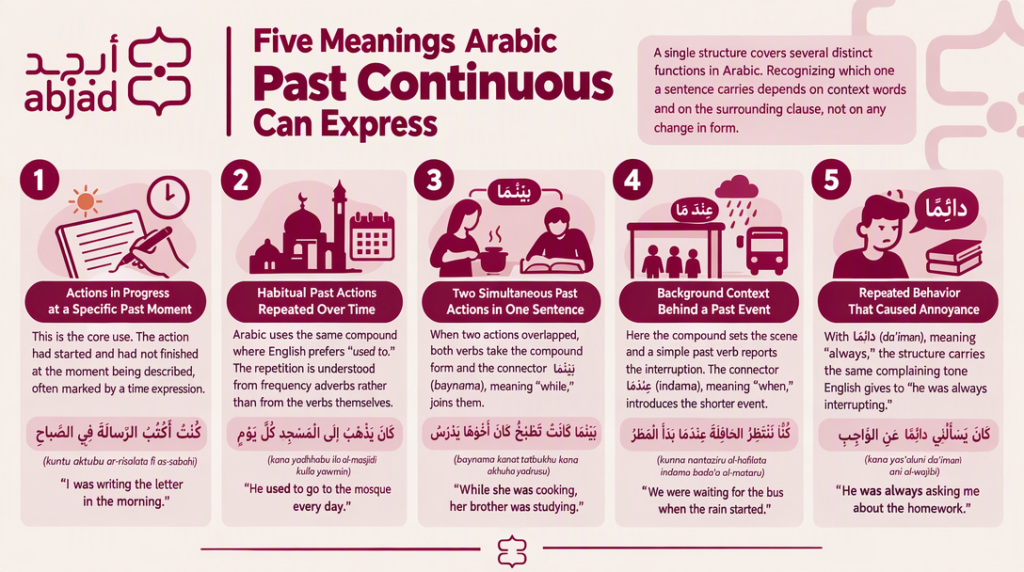
1. Actions in Progress at a Specific Past Moment
This is the core use. The action had started and had not finished at the moment being described, often marked by a time expression.
كُنْتُ أَكْتُبُ الرِّسَالَةَ فِي الصَّبَاحِ
(kuntu aktubu ar-risalata fi as-sabahi)
“I was writing the letter in the morning.”
2. Habitual Past Actions Repeated Over Time
Arabic uses the same compound where English prefers “used to.” The repetition is understood from frequency adverbs rather than from the verbs themselves.
كَانَ يَذْهَبُ إِلَى الْمَسْجِدِ كُلَّ يَوْمٍ
(kana yadhhabu ila al-masjidi kulla yawmin)
“He used to go to the mosque every day.”
3. Two Simultaneous Past Actions in One Sentence
When two actions overlapped, both verbs take the compound form and the connector بَيْنَمَا (baynama), meaning “while,” joins them.
بَيْنَمَا كَانَتْ تَطْبُخُ كَانَ أَخُوهَا يَدْرُسُ
(baynama kanat tatbukhu kana akhuha yadrusu)
“While she was cooking, her brother was studying.”
4. Background Context Behind a Past Event
Here the compound sets the scene and a simple past verb reports the interruption. The connector عِنْدَمَا (indama), meaning “when,” introduces the shorter event.
كُنَّا نَنْتَظِرُ الْحَافِلَةَ عِنْدَمَا بَدَأَ الْمَطَرُ
(kunna nantaziru al-hafilata indama bada’a al-mataru)
“We were waiting for the bus when the rain started.”
5. Repeated Behavior That Caused Annoyance
With دَائِمًا (da’iman), meaning “always,” the structure carries the same complaining tone English gives to “he was always interrupting.”
كَانَ يَسْأَلُنِي دَائِمًا عَنِ الْوَاجِبِ
(kana yas’aluni da’iman ani al-wajibi)
“He was always asking me about the homework.”
See Us in Action!
Curious about what our online classrooms look like? Watch the short clips below to see how our interactive, one-on-one sessions bring learning to life with real-time feedback and engaging teaching methods.
Begin Your Arabic Journey in the UAE
Join Abjad Institute for a professional and immersive Arabic language experience tailored to your goals.
Book Your Free TrialHow to Negate the Arabic Past Continuous Correctly
Negation attaches to كَانَ only. The imperfect verb that follows never changes, which makes this one of the simpler rules in Arabic verb grammar.
Two particles do the job, and classical and modern texts use both freely. The choice affects style and case endings, not meaning.
Negating Kana With Ma Before the Verb
The particle مَا (ma) sits directly before كَانَ and leaves it fully intact. This form is common in Quranic style and in formal written Arabic.
مَا كُنْتُ أَعْرِفُ الطَّرِيقَ
(ma kuntu a’rifu at-tariqa)
“I did not know the way.”
Negating Kana With Lam and the Jussive Form
The particle لَمْ (lam) forces كَانَ into the jussive, producing يَكُنْ (yakun). The time reference stays firmly in the past despite the present-looking form.
لَمْ يَكُنْ يَدْرُسُ عِنْدَمَا اتَّصَلْتُ بِهِ
(lam yakun yadrusu indama ittasaltu bihi)
“He was not studying when I called him.”
Abjad Academy covers negation particles and their case effects inside a structured Modern Standard Arabic Course built around the sentence patterns learners actually read in news and books.

Book Your Free Modern Standard Arabic Session
Question Forms in the Arabic Past Continuous
Arabic does not invert word order to form questions. A question particle is placed at the front of the sentence and everything else stays exactly where it was.
Three question openers cover almost every case learners need:
- هَلْ (hal) for yes-or-no questions, as in هَلْ كُنْتَ تَدْرُسُ؟ (hal kunta tadrusu?), meaning “Were you studying?”
- أَ (a), a shorter prefixed alternative to هَلْ, as in أَكُنْتَ تَدْرُسُ؟ (a-kunta tadrusu?), carrying the same meaning.
- مَاذَا (madha) for content questions, as in مَاذَا كُنْتَ تَفْعَلُ؟ (madha kunta taf’alu?), meaning “What were you doing?”
Other question words follow the identical pattern.
أَيْنَ كُنْتُمْ تَسْكُنُونَ؟ (ayna kuntum taskununa?) means “Where were you living?” and لِمَاذَا كَانَتْ تَبْكِي؟ (limadha kanat tabki?) means “Why was she crying?”
Quranic Examples of Kana Plus the Imperfect Verb
The Quran uses this compound constantly, which makes it the most reliable source of authentic examples for learners. Each verse below shows the structure in a different function.
Surah Al-Baqarah 2:184 on Fasting and Knowledge
The closing phrase of this verse pairs كُنْتُمْ with an imperfect verb to describe a continuing state of knowledge rather than a single past act.
وَأَن تَصُومُوا خَيْرٌ لَّكُمْ ۖ إِن كُنتُمْ تَعْلَمُونَ
(Wa an tasumu khayrun lakum in kuntum ta’lamun)
“And to fast is better for you, if you only knew.”
Surah Al-Ma’idah 5:75 on the Human Nature of Prophets
This verse uses the dual form كَانَا with a dual imperfect verb, describing a habitual action that proves the human nature of Isa and his mother.
كَانَا يَأْكُلَانِ الطَّعَامَ
(Kana ya’kulani at-ta’am)
“They both used to eat food.”
Surah Al-Mulk 67:10 on Regret in the Hereafter
Here the compound appears inside a conditional sentence, expressing an ongoing capacity that was never exercised during worldly life.
وَقَالُوا لَوْ كُنَّا نَسْمَعُ أَوْ نَعْقِلُ مَا كُنَّا فِي أَصْحَابِ السَّعِيرِ
(Wa qalu law kunna nasma’u aw na’qilu ma kunna fi ashabi as-sa’ir)
“And they will say, If only we had been listening or reasoning, we would not be among the companions of the Blaze.”
Abjad Academy connects grammar study to scripture through a focused Quranic Arabic Course that trains students to parse verse structures instead of memorizing translations.

Start Reading the Quran in Arabic Today
Past Continuous, Simple Past, and Past Perfect in Arabic
Learners confuse these three because all of them refer to past time. The difference lies entirely in the second element placed after كَانَ, or in whether كَانَ appears at all.
| Structure | Arabic Example | Transliteration | English Meaning |
| Simple past | دَرَسَ | darasa | He studied |
| Past continuous | كَانَ يَدْرُسُ | kana yadrusu | He was studying |
| Past perfect | كَانَ قَدْ دَرَسَ | kana qad darasa | He had studied |
Reading the table from top to bottom shows one clear rule. An imperfect verb after كَانَ gives ongoing action, while a past verb with قَدْ (qad) gives completed action before another past point.
The practical consequence matters in writing. Describing a scene calls for the continuous compound, while reporting a finished event calls for the plain past verb with no auxiliary at all.
Read also: Arabic Sentence Structure Explained With Clear Examples
Common Mistakes Learners Make With Kana Sentences
These errors appear in nearly every beginner composition, and each one has a quick fix once the underlying rule is clear.
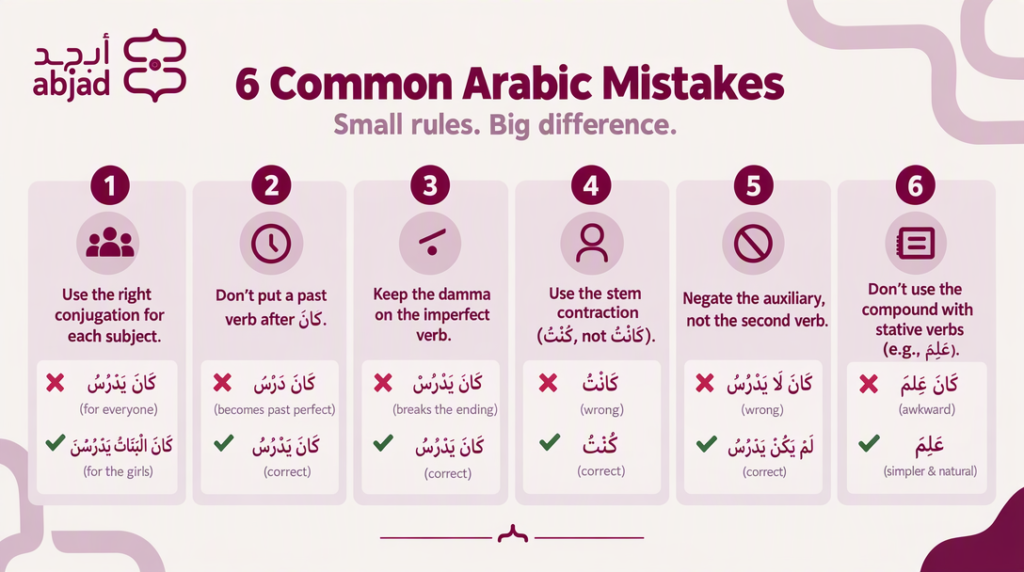
- Writing كَانَ يَدْرُسُ for every subject instead of conjugating the auxiliary, which produces disagreement in sentences like كَانَ الْبَنَاتُ.
- Placing a past-tense verb after كَانَ, which silently converts the sentence into the past perfect.
- Dropping the damma from the imperfect verb and writing كَانَ يَدْرُسْ, which breaks the indicative ending.
- Forgetting the stem contraction and writing كَانْتُ instead of كُنْتُ for the first person.
- Negating the second verb rather than the auxiliary, producing كَانَ لَا يَدْرُسُ where لَمْ يَكُنْ يَدْرُسُ was intended.
- Using the compound with stative verbs such as عَلِمَ (alima), meaning “to know,” where plain past tense reads far more naturally.
Across our classrooms in the UAE, the agreement error in point one accounts for more correction time than every other mistake on this list combined.
Inside Our Virtual Classrooms
We believe in full transparency and proven quality. Take a look at these actual snippets from our live classes to experience our modern learning platform, patient instructors, and interactive student participation.
Begin Your Arabic Journey in the UAE
Join Abjad Institute for a professional and immersive Arabic language experience tailored to your goals.
Book Your Free TrialPractice Exercises for the Arabic Past Continuous
Translation drills expose gaps faster than recognition drills. Cover the answers, translate each sentence into Arabic, then check both the auxiliary and the imperfect ending.
- I was reading the Quran. Answer: كُنْتُ أَقْرَأُ الْقُرْآنَ (kuntu aqra’u al-Qur’ana).
- They were playing in the garden. Answer: كَانُوا يَلْعَبُونَ فِي الْحَدِيقَةِ (kanu yal’abuna fi al-hadiqati).
- She was not listening to the teacher. Answer: لَمْ تَكُنْ تَسْمَعُ الْمُعَلِّمَةَ (lam takun tasma’u al-mu’allimata).
- Were you writing a letter? Answer: هَلْ كُنْتَ تَكْتُبُ رِسَالَةً؟ (hal kunta taktubu risalatan?).
- We used to live in Dubai. Answer: كُنَّا نَسْكُنُ فِي دُبَيَّ (kunna naskunu fi Dubayy).
Repeat the set daily for one week, then rebuild each sentence with a different subject pronoun. That second pass is where the conjugation finally becomes automatic.
Abjad Academy turns written drills into spoken fluency through an Arabic Speaking Course where tutors correct tense choice live during conversation rather than afterward.

Speak Arabic With a Live Tutor This Week
Start Learning Arabic Grammar With Abjad Academy Tutors
Grammar rules stick when somebody hears your mistakes and corrects them in the moment. Abjad Academy runs one-on-one live sessions with native-speaking tutors, flexible scheduling across UAE time zones, and a placement test that starts you at the right level.
What sets Abjad Academy apart:
- Every session is one-on-one and live, never pre-recorded.
- Tutors are native speakers trained in teaching Arabic as a second language.
- Lesson times are scheduled around your week, including evenings and weekends.
Our Arabic Courses
- Arabic Grammar Course.
- Modern Standard Arabic Course.
- Quranic Arabic Course.
- Arabic Speaking Course.
- Arabic Course for Beginners.
- Arabic Course for Adults.
Conclusion
Arabic expresses ongoing past action through a compound rather than a tense ending, and كَانَ is the piece that carries the time while the imperfect verb carries the motion. Once that split is clear, the rest follows.
Agreement is where the structure is won or lost. Both verbs must match the same subject, the imperfect verb must keep its indicative damma, and negation attaches to the auxiliary alone through either مَا or لَمْ.
Learners who master the past continuous tense in Arabic gain more than one grammar point. They gain the ability to narrate, to set a scene, and to read Quranic verses with the precision those verses were written to carry.
FAQs
How Do You Form the Past Continuous Tense in Arabic?
Place the conjugated auxiliary كَانَ before an imperfect verb, with both matching the same subject.
كَانَ carries past time, the imperfect verb carries the ongoing action, as in كَانَ يَكْتُبُ (kana yaktubu), meaning “he was writing.”
What Is the Difference Between Kana Yaf’alu and Kana Qad Fa’ala?
كَانَ يَفْعَلُ describes an action still in progress at a past moment, while كَانَ قَدْ فَعَلَ describes an action completed before another past event. The first is past continuous, the second is past perfect.
Can Arabic Express Past Continuous Without Kana?
No, the auxiliary is required. An imperfect verb standing alone refers to present or future time, so removing كَانَ removes the past reference entirely and changes the meaning of the sentence.
Which Particle Negates the Arabic Past Continuous?
Both مَا and لَمْ work.
مَا precedes كَانَ unchanged, while لَمْ forces the jussive form يَكُنْ. The imperfect verb after the auxiliary stays exactly the same in both constructions.
Do Stative Verbs Work in the Arabic Past Continuous?
Rarely. Verbs describing states rather than actions, such as عَلِمَ (alima), meaning “to know,” normally appear in simple past form. Forcing them into the compound structure sounds unnatural to native speakers.





[…] Read also: Past Continuous Tense in Arabic Explained With Examples […]
[…] Read also: Past Continuous Tense in Arabic […]