 Learn Arabic
If you’ve picked up an Arabic newspaper in Dubai or tried to read a street sign in Sharjah and found the letters running together into an unreadable blur, you’re not alone. Most people learning how to read Arabic for beginners in the UAE hit the same wall in the first few weeks: the script looks nothing like the Latin alphabet, letters change shape depending on where they sit in a word, and the short vowels that guide pronunciation are often missing entirely from real-world text.
The good news is that reading Arabic is a learnable skill with a clear sequence, not a talent some people have and others don’t. This guide breaks down exactly how to read Arabic for beginners step by step, starting from the alphabet and ending with the habits that turn recognition into real reading fluency.
Whether you’re starting from zero or want a free way to test the waters before committing to a structured course, the process below works the same way at Abjad Academy — because Arabic script itself doesn’t change, only how deliberately you approach it.
Step 1: Learn The Arabic Alphabet And Letter Shapes
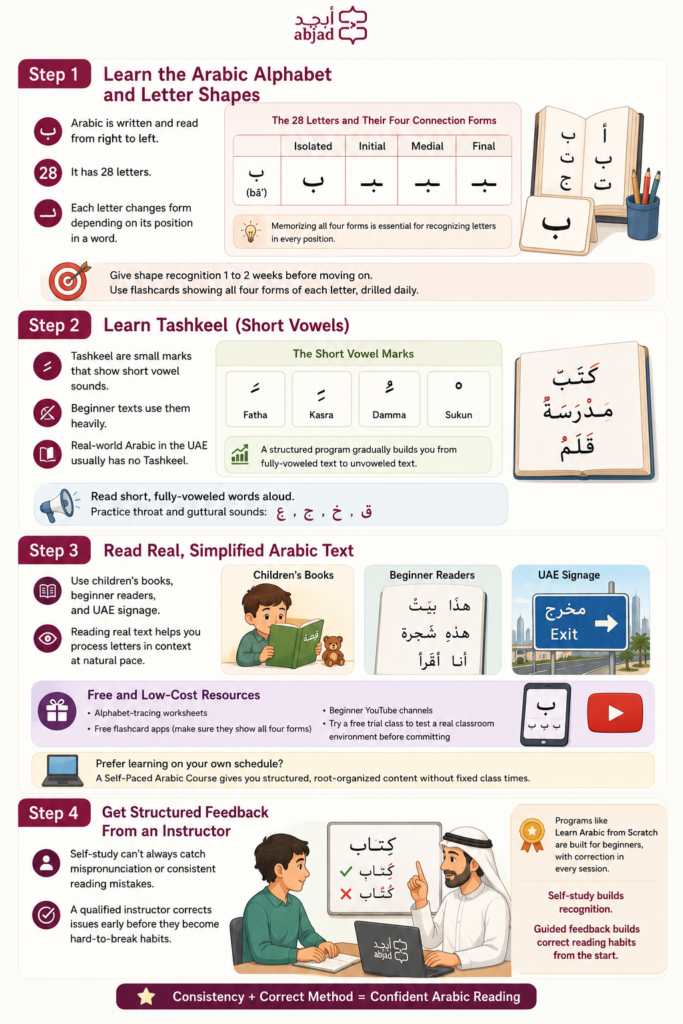
The first step in how to read Arabic for beginners is shape recognition, not vocabulary. Arabic is written and read from right to left, and each of its 28 letters can change form depending on its position in a word — a detail that surprises most people the first time they open an Arabic textbook.
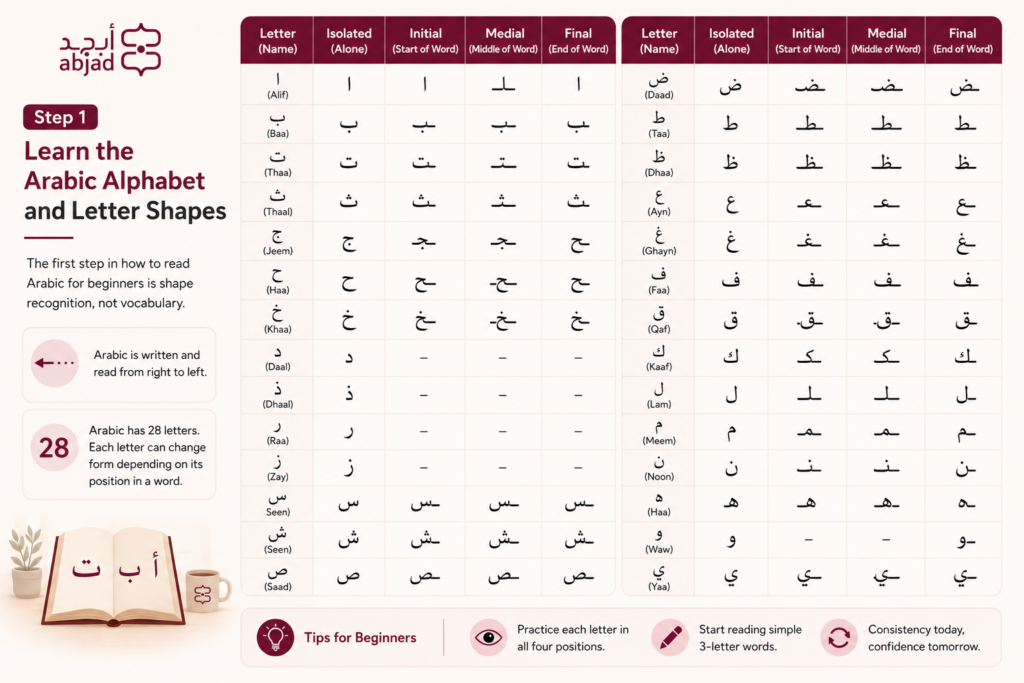
The 28 Letters and Their Four Connection Forms
Every Arabic letter has up to four written forms: isolated, initial (start of a word), medial (middle of a word), and final (end of a word). The letter ب (bā’), for example, looks different depending on whether it opens a word, sits in the middle, or closes it — but it always represents the same sound.
Learning all four forms is not optional groundwork you can skip. A learner who memorizes only the isolated form will struggle to recognize the same letter three lines later in a different position.
This is why a structured Learn Arabic Alphabet Course drills all four forms from lesson one, rather than treating the isolated form as the whole picture.
Give shape recognition one to two weeks before moving on — not speed, not vocabulary. Flashcards showing all four positional forms of each letter, drilled daily, build the visual pattern-recognition that every later step depends on.
Step 2: Learn Tashkeel (Short Vowels)
Once letter shapes feel automatic, the next step is Tashkeel — the small diacritical marks (fatha, kasra, damma, and sukun) placed above or below a letter to indicate short vowel sounds. Beginner materials use Tashkeel heavily so learners can sound out words accurately.
Real-world Arabic in the UAE — street signage, newspapers, most books written for adults — drops these marks entirely.
Readers are expected to infer the correct vowel from context and vocabulary knowledge. This is exactly why a structured Arabic Classes for Beginners program builds up gradually from fully-voweled text to unvoweled text, instead of leaving learners to make that jump alone.
Read Short, Fully-Voweled Words Aloud
Once you can identify a letter’s form without hesitating, read short, fully-voweled words aloud. This is also the stage to start practicing the throat and guttural sounds — ع, ح, خ, ق — that don’t exist in English and need dedicated repetition, not just visual recognition.
Read Also: Learn How To Write And Read Arabic For Beginners In The UAE
Step 3: Read Real, Simplified Arabic Text
Children’s books, beginner readers, and labeled UAE signage give you real Arabic without overwhelming complexity. Reading real text, even simple text, does something flashcards can’t: it forces you to process letters in context, at natural reading pace.
Free And Low-Cost Resources For This Stage
You don’t need to pay for anything to take your first steps here. This is the stage where most people looking for how to read Arabic for beginners free get the most value: alphabet-tracing worksheets, free flashcard apps with spaced repetition, and beginner YouTube channels covering letter forms and Tashkeel are enough to work through Steps 1 and 2 at no cost.
Look specifically for resources that show all four positional forms of each letter — many free apps only show the isolated form, which leaves a gap you’ll have to correct later.
If you want to test a real classroom environment before committing, a free trial class is the most efficient way to gauge whether a program’s pace and teaching style suit you. This is genuinely useful for anyone comparing how to read Arabic for beginners online free against in-person instruction, since it lets you experience both before deciding.
For learners who prefer working through material independently on their own schedule, a Self-Paced Arabic Course gives you root-organized, structured content without fixed class times.
Read also: How To Read Arabic Letters In The UAE? A Step-By-Step Guide For Beginners
Watch Our Classes in Action
Curious what a real session looks like? Take a peek inside our interactive classrooms and see how our expert instructors bring the Arabic language to life. Watch a sample lesson below!
Begin Your Arabic Journey in the UAE
Join Abjad Institute for a professional and immersive Arabic language experience tailored to your goals.
Book Your Free TrialStep 4: Get Structured Feedback From An Instructor
Self-study gets you through Steps 1 to 3. What it rarely catches is a mispronunciation habit that’s become automatic, or a shape you’re consistently misreading without realizing it. A qualified instructor spots these gaps early — before they turn into habits that are far harder to unlearn six months in.
Programs like Learn Arabic from Scratch are built specifically around this beginner sequence, with correction built into every session.
Self-study builds recognition. Guided feedback builds correct reading habits from the start, which is a meaningfully different outcome for how to read Arabic for beginners in the UAE long-term.
Common Mistakes Beginners Make When Reading Arabic
Certain mistakes show up so consistently in beginner learners that they’re worth naming directly.
1. Skipping Letter Forms to “Save Time”
Learners who memorize only the isolated letter form move faster in week one and then hit a wall in week three, when they can’t recognize the same letter mid-word. The four forms are not extra credit — they’re the baseline.
2. Relying Only on Passive Video Watching
Watching alphabet videos without actively writing or reading the letters back produces recognition, not reading ability. The learners who progress fastest write every letter by hand in all four forms, rather than just watching someone else write it.
3. Jumping to Unvoweled Text Too Early
Reading a UAE street sign or newspaper headline before you’re solid on Tashkeel usually means guessing wrong and reinforcing incorrect pronunciation. Build the fully-voweled foundation first; the unvoweled reading skill comes after, not instead of it.
Read Also: How To Read Arabic Letters In The UAE?
How Long Does It Take to Read Arabic Fluently?
There’s no single fixed number, but a realistic framework helps set expectations. Most dedicated beginners can read fully-voweled simple text confidently within four to six weeks of consistent daily practice.
Reading unvoweled real-world text — signage, basic news headlines — typically takes several months of continued exposure, since it depends on vocabulary growth as much as letter recognition.
A useful way to frame this progress is what we call the Shape–Sound–Sentence method: you move from recognizing letter shapes, to producing correct sounds including Tashkeel, to reading full sentences in context.
Each stage should feel solid before you push into the next one — rushing the sequence is what produces shaky readers who can recognize letters but can’t actually read.
For structured pacing, many Arabic programs in the UAE also map progress against the CEFR framework (A1 through C2), where basic reading of simple phrases sits at A1–A2 and independent reading of unvoweled text sits closer to B1 and above. Knowing where you’re aiming on that scale helps you judge whether your current pace is realistic.
Read also: How To Read Arabic Script In The UAE
Inside Our Live Classes
Don’t just take our word for it—see for yourself! Click below to watch short clips from our live classes and meet the instructors who will guide your learning journey.
Start Reading Arabic With Guided Support Today
Self-study gets beginners through the basics, but the mistakes that quietly slow progress — a mispronounced letter, a skipped positional form, jumping to unvoweled text too soon — are hardest to catch on your own. Abjad Academy’s beginner-focused instructors correct these gaps as they happen, not months later.

Join a structured class built specifically around how beginners actually learn to read Arabic, with real feedback from day one.
Explore the Arabic Intensive Course or browse the full range of Arabic courses at Abjad Academy to find the pace that fits your schedule.
Discover Our Arabic Courses:
- Arabic Classes for Beginners
- Arabic Course for Kids
- Arabic Conversation for Kids
- Arabic Qaida for Kids
- Beginner Arabic for Kids
- Arabic Grammar for Kids
- Teen Arabic Summer Course
- Arabic Kids Camps
- UAE Kindergarten Arabic Classes
- Modern Standard Arabic Course
- Fusha Arabic Course
- Classical Arabic Course
- Emirati Arabic Course
- Gulf Arabic Course
- Learn Saudi Arabic
- Business Arabic Course UAE
- Arabic Language Classes for Professionals in UAE
Begin Your Arabic Journey in the UAE
Join Abjad Institute for a professional and immersive Arabic language experience tailored to your goals.
Book Your Free Trial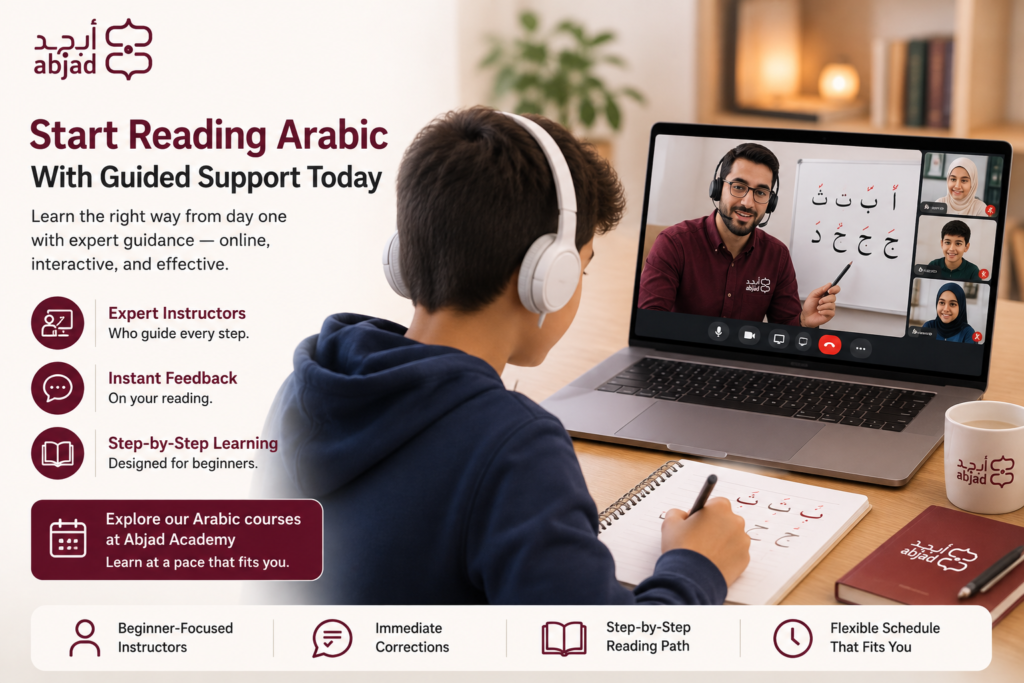
Conclusion
Reading Arabic isn’t about talent — it’s about following the right sequence. Start with the 28 letters and their four positional forms, layer in Tashkeel once shapes are automatic, then move into real, simplified text before tackling unvoweled material, and bring in feedback before habits become hard to break.
Whether you’re using free resources to get started or working through Abjad Academy’s structured beginner courses, the same principle holds: shape recognition first, sound second, full sentences last.
Follow this sequence consistently, and how to read Arabic for beginners in the UAE stops being an intimidating question and becomes a straightforward, trackable process.
Read also: How To Read Arabic Without Harakat In The UAE? — A Complete Guide

Frequently Asked Questions
The questions below cover what beginners most commonly ask about learning to read Arabic in the UAE, based on gaps this guide may not have fully answered above.
1. How long does it take to learn to read Arabic as a beginner?
Most beginners can read simple, fully-voweled Arabic text within four to six weeks of daily practice. Reading unvoweled real-world text, like signage or news headlines, generally takes a few months of continued exposure and vocabulary growth.
2. Can I learn how to read Arabic for beginners for free?
Yes, free alphabet worksheets, flashcard apps, and beginner videos can take you through letter shapes and basic Tashkeel. Most free resources fall short once you reach unvoweled text or need pronunciation correction, which is where structured classes add the most value.
3. What is the best way to learn how to read Arabic for beginners online free?
Free trial classes combined with free flashcard apps are the most effective free starting point, since they let you test a real teaching structure before committing. Look for options that cover all four letter forms, not just the isolated shape.
4. Do I need to learn Tashkeel to read Arabic?
Yes, at the beginner stage. Tashkeel marks show you the exact short vowel sounds, which is essential for correct pronunciation. Real-world UAE text usually drops these marks, so building strong Tashkeel skills first makes unvoweled reading much easier later.
5. Is Arabic script hard to learn for English speakers?
Arabic script is different from Latin-based alphabets, not inherently harder. The main challenges are the four positional letter forms and guttural sounds absent in English, both of which respond well to consistent daily practice at Abjad Academy.





Leave a Reply