 Quran
| Key Takeaways |
| Arabic recognizes only two noun genders, masculine and feminine, with no neutral category for objects or abstract ideas. |
| Taa marbutah ة marks roughly 90 percent of feminine nouns, yet words like شَمْس and يَد stay feminine with no visible sign. |
| Gender controls agreement, so adjectives, verbs, pronouns, and demonstratives all shift form to match the noun they relate to. |
| Numbers three through ten reverse gender, meaning ثَلَاثَة counts masculine items and ثَلَاث counts feminine ones. |
| Non-human plurals take singular feminine agreement, whatever the gender of the singular noun behind them. |
Every Arabic noun carries a gender, and that single fact shapes how an entire sentence is built. Masculine and feminine nouns in Arabic decide the form of adjectives, verbs, pronouns, demonstratives, and even numbers.
English speakers often meet this system with some confusion, because Arabic assigns gender to chairs, books, cities, and abstract ideas. A pen is masculine, a car is feminine, and neither one has any biological sex.
Arabic grammarians built a precise framework for all of this, with named categories, visible markers, and agreement rules that hold across Classical and Modern Standard Arabic. Getting those rules right is what makes a sentence sound native rather than translated.
Does Arabic Have Gendered Nouns?
Yes, Arabic has gendered nouns. Every noun belongs to one of two classes, masculine or feminine, and no neutral third option exists the way English uses “it” for objects.
This reach extends far beyond people and animals. A book, a city, a question, and a feeling each carry a fixed grammatical gender that the rest of the sentence must respect.
Masculine is called مُذَكَّر (mudhakkar) and feminine is called مُؤَنَّث (mu’annath). Arabic treats the masculine as the base form and the feminine as a marked form built on top of it.
A few everyday words show how little biology has to do with the assignment:
| Arabic | Transliteration | Meaning | Gender |
| كِتَاب | kitaab | book | Masculine |
| قَلَم | qalam | pen | Masculine |
| بَيْت | bayt | house | Masculine |
| سَيَّارَة | sayyaarah | car | Feminine |
| مَدِينَة | madeenah | city | Feminine |
| شَمْس | shams | sun | Feminine |
What Masculine and Feminine Nouns in Arabic Mean
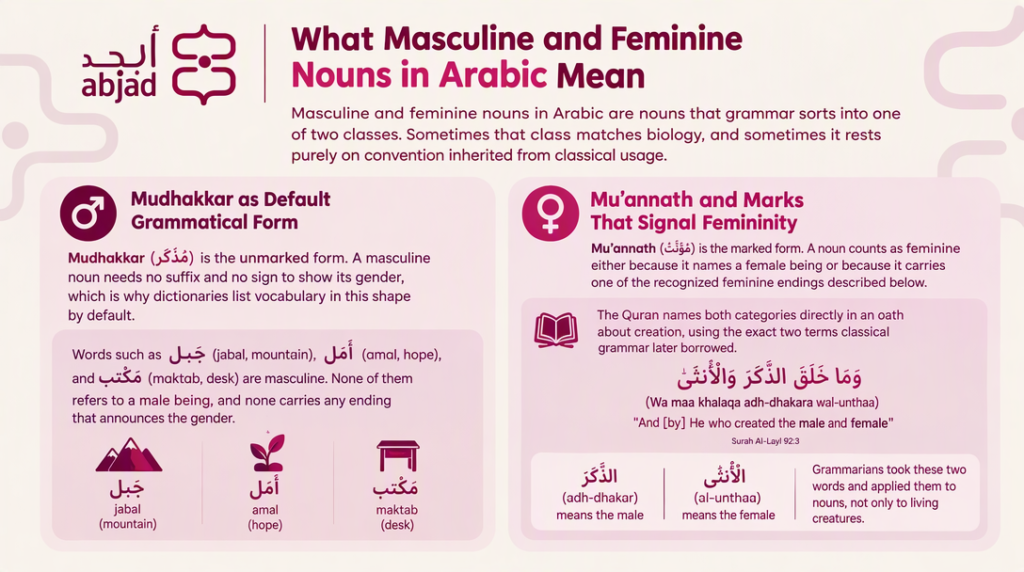
Masculine and feminine nouns in Arabic are nouns that grammar sorts into one of two classes. Sometimes that class matches biology, and sometimes it rests purely on convention inherited from classical usage.
Mudhakkar as Default Grammatical Form
Mudhakkar (مُذَكَّر) is the unmarked form. A masculine noun needs no suffix and no sign to show its gender, which is why dictionaries list vocabulary in this shape by default.
Words such as جَبَل (jabal, mountain), أَمَل (amal, hope), and مَكْتَب (maktab, desk) are masculine. None of them refers to a male being, and none carries any ending that announces the gender.
Mu’annath and Marks That Signal Femininity
Mu’annath (مُؤَنَّث) is the marked form. A noun counts as feminine either because it names a female being or because it carries one of the recognized feminine endings described below.
The Quran names both categories directly in an oath about creation, using the exact two terms classical grammar later borrowed.
وَمَا خَلَقَ الذَّكَرَ وَالْأُنثَىٰ
(Wa maa khalaqa adh-dhakara wal-unthaa)
“And [by] He who created the male and female”
الذَّكَر (adh-dhakar) means the male and الْأُنْثَى (al-unthaa) means the female. Grammarians took these two words and applied them to nouns, not only to living creatures.
Four Signs That Mark Feminine Nouns in Arabic
Four endings signal femininity. Three are visible on the page, and the fourth is assumed, meaning the word behaves as feminine through usage even though nothing marks it.
| Sign | Arabic Form | Example | Transliteration | Meaning |
| Taa marbutah | ة | مَدْرَسَة | madrasah | school |
| Alif maqsurah | ى | كُبْرَى | kubraa | greatest |
| Alif mamdudah | اء | صَحْرَاء | sahraa’ | desert |
| Assumed marker | none | شَمْس | shams | sun |
Taa Marbutah as Most Common Feminine Marker
Taa marbutah (تَاء مَرْبُوطَة) is the single most reliable feminine sign in the language. It looks like a ه with two dots above it and sits only at the end of a word.
Pronunciation shifts with position. In isolation it sounds like a soft -ah, and in a possessive phrase it sounds like -at, so مَدْرَسَة becomes مَدْرَسَةُ الْبَنَاتِ (madrasatu al-banaat, the girls’ school).
This marker also converts masculine words into feminine ones, which makes it the most productive tool in Arabic morphology:
- مُعَلِّم (mu’allim, male teacher) becomes مُعَلِّمَة (mu’allimah, female teacher).
- طَالِب (taalib, male student) becomes طَالِبَة (taalibah, female student).
- مُسْلِم (muslim, Muslim man) becomes مُسْلِمَة (muslimah, Muslim woman).
- كَبِير (kabeer, big) becomes كَبِيرَة (kabeerah, big in the feminine form).
Alif Maqsurah and Alif Mamdudah Endings
Alif maqsurah (أَلِف مَقْصُورَة) is a final ى with no dots, and alif mamdudah (أَلِف مَمْدُودَة) is a final اء. Both mark femininity when they are added to the root rather than part of it.
That condition matters. In مُصْطَفَى (Mustafaa), the final ى belongs to the root letters, so the name stays masculine. In كُبْرَى (kubraa, greatest), the ending is extra, so the word is feminine.
Common examples include حَمْرَاء (hamraa’, red), بَيْضَاء (baydaa’, white), حُبْلَى (hublaa, pregnant), and ذِكْرَى (dhikraa, memory). Each one names a feminine form built on a masculine base.
Read also: Tenses in Arabic Explained With Charts and Examples
Feminine Nouns With No Visible Marker
Some feminine nouns in Arabic carry no sign at all. Grammarians call these مُؤَنَّث سَمَاعِي (mu’annath samaa’i), meaning femininity learned by hearing native usage rather than by rule.
Two clues confirm the gender. Native speakers describe these words with feminine adjectives, and the diminutive form reveals a hidden ة, as شَمْس becomes شُمَيْسَة (shumaysah, little sun).
Abjad Academy offers an Arabic Grammar Course that drills these four markers inside full sentences until gender recognition becomes automatic instead of guesswork.

Start With a Free Grammar Session
How Masculine Nouns in Arabic Work Without Markers
Masculine nouns in Arabic carry no identifying ending, which is exactly what identifies them. When a noun shows none of the four feminine signs and appears on no exception list, it is masculine.
Real and Grammatical Masculine Nouns
Real masculine nouns name biologically male beings. Words like أَب (ab, father), أَخ (akh, brother), وَلَد (walad, boy), and حِصَان (hisaan, horse) belong to this group.
Grammatical masculine nouns name things with no sex at all.
كِتَاب (kitaab, book), بَاب (baab, door), جَبَل (jabal, mountain), and نَجْم (najm, star) are masculine only because Arabic classifies them that way.
Masculine Words That End in Taa Marbutah
A small group of masculine words ends in ة, which traps beginners constantly. These are mostly male personal names and titles, and biology outranks the ending every time.
| Arabic | Transliteration | Meaning |
| حَمْزَة | Hamzah | a man’s name |
| أُسَامَة | Usaamah | a man’s name |
| خَلِيفَة | khaleefah | caliph |
| عَلَّامَة | allaamah | great scholar |
Each of these takes masculine adjectives and masculine verbs. Writing الْخَلِيفَةُ الْعَادِلُ (al-khaleefatu al-aadil, the just caliph) with a masculine adjective is correct despite the visible ة.
Gender Agreement Across Arabic Sentences
Gender agreement is called مُطَابَقَة (mutaabaqah), and it is where noun gender stops being a vocabulary label and starts controlling grammar. Three sentence elements shift to match the noun.
a. Adjective Agreement in Arabic Noun Phrases
Arabic adjectives follow the noun and copy its gender, unlike English adjectives, which never change shape. A masculine noun takes a masculine adjective, and a feminine noun takes a feminine one.
الْوَلَدُ طَوِيلٌ (al-waladu taweelun) means “the boy is tall.” Change the noun and the adjective moves with it: الْبِنْتُ طَوِيلَةٌ (al-bintu taweelatun) means “the girl is tall.”
b. Verb Agreement With a Feminine Subject
Arabic verbs also show gender, most visibly in the past tense. A feminine singular subject adds a ت to the end of the verb, and that ending is often the clearest gender clue in a sentence.
ذَهَبَ الطَّالِبُ (dhahaba at-taalib) means “the male student went.” With a feminine subject it becomes ذَهَبَتِ الطَّالِبَةُ (dhahabat at-taalibah), meaning “the female student went.”
c. Pronoun and Demonstrative Agreement in Arabic
Pronouns split by gender too.
هُوَ (huwa) means “he” or “it” for masculine nouns, while هِيَ (hiya) means “she” or “it” for feminine nouns, including objects.
Demonstratives follow the same split.
هٰذَا (haadhaa) points to masculine nouns and هٰذِهِ (haadhihi) points to feminine ones, so هٰذَا كِتَابٌ and هٰذِهِ سَيَّارَةٌ are both correct.
See Us in Action!
Curious about what our online classrooms look like? Watch the short clips below to see how our interactive, one-on-one sessions bring learning to life with real-time feedback and engaging teaching methods.
Begin Your Arabic Journey in the UAE
Join Abjad Institute for a professional and immersive Arabic language experience tailored to your goals.
Book Your Free TrialReal, Figurative, and Heard Feminine Categories
Classical grammarians sorted feminine nouns into named categories, and those categories explain why some words follow the markers neatly while others refuse to.
| Category | Arabic Term | Definition | Example |
| Real feminine | مُؤَنَّث حَقِيقِي | Names a biologically female being | أُمّ (umm, mother) |
| Figurative feminine | مُؤَنَّث مَجَازِي | No female referent, treated as feminine | شَمْس (shams, sun) |
| Formal feminine | مُؤَنَّث لَفْظِي | Carries ة but refers to a male | خَلِيفَة (khaleefah, caliph) |
| Heard feminine | مُؤَنَّث سَمَاعِي | Feminine by usage, no visible sign | يَد (yad, hand) |
Real feminine nouns almost never cause trouble, since meaning and grammar agree.
أُخْت (ukht, sister) and بِنْت (bint, girl) are feminine for the obvious reason.
Figurative feminine nouns are the ones that surprise learners, because nothing in the meaning predicts the gender.
أَرْض (ard, earth) is feminine while قَمَر (qamar, moon) is masculine.
Formal feminine nouns run in the opposite direction. The ة is present, the referent is male, and grammar follows the referent rather than the ending every time.
Abjad Academy offers an Arabic Course for Beginners that introduces these categories from the first lessons, so students build correct habits before their vocabulary grows large.

Book Your Free Beginner Lesson
How to Tell a Noun’s Gender in Four Checks
No single clue settles gender for every word, so experienced learners run a short sequence of checks in a fixed order and stop at the first one that gives an answer.
- Check the meaning first, because a noun naming a male or female being takes its gender from biology.
- Look at the ending for ة, ى, or اء, since one of these marks the large majority of feminine nouns.
- Compare the word against the memorized exception list that covers شَمْس, أَرْض, نَار, and the paired body parts.
- Read the agreement in the sentence, because a feminine adjective or a ت on the verb confirms the gender.
Order matters here. Running check two before check one produces the classic error of calling خَلِيفَة feminine, since the ة is visible while the male referent is not.
Quick exercise: Read five object names aloud from any Arabic text. For each one, ask whether it ends in ة and whether the adjective beside it matches. Repeat daily for one week.
Dual and Plural Forms of Arabic Nouns by Gender
Gender does not disappear when a noun moves out of the singular. Dual and plural forms carry their own gendered endings, and the agreement rules change along with them.
Dual Endings for Masculine and Feminine Nouns
Arabic has a dedicated dual form, called الْمُثَنَّى (al-muthannaa), used for exactly two of anything. The masculine dual adds ـَانِ and the feminine dual keeps the ة before adding ـَتَانِ.
| Form | Masculine | Feminine |
| Singular | مُعَلِّم (mu’allim) | مُعَلِّمَة (mu’allimah) |
| Dual | مُعَلِّمَانِ (mu’allimaani) | مُعَلِّمَتَانِ (mu’allimataani) |
| Sound plural | مُعَلِّمُونَ (mu’allimoona) | مُعَلِّمَات (mu’allimaat) |
Sound Plurals and Broken Plural Gender
Sound plurals keep the gender of the singular. Masculine human plurals take ـُونَ or ـِينَ, and feminine plurals take ـَات, as in مُسْلِمَات (muslimaat, Muslim women).
Broken plurals rebuild the word internally instead of adding an ending.
رَجُل becomes رِجَال (rijaal, men), كِتَاب becomes كُتُب (kutub, books), and بَيْت becomes بُيُوت (buyoot, houses).
Inside Our Virtual Classrooms
We believe in full transparency and proven quality. Take a look at these actual snippets from our live classes to experience our modern learning platform, patient instructors, and interactive student participation.
Begin Your Arabic Journey in the UAE
Join Abjad Institute for a professional and immersive Arabic language experience tailored to your goals.
Book Your Free TrialNon-Human Plurals Treated as Singular Feminine
Any plural referring to non-humans takes singular feminine agreement, regardless of the singular’s gender. This rule is constant across the Quran, classical literature, and modern newspapers.
كِتَاب is masculine, yet its plural behaves as one feminine item: الْكُتُبُ جَدِيدَةٌ (al-kutubu jadeedatun) means “the books are new,” with a singular feminine adjective.
Why Arabic Numbers Reverse Noun Gender Agreement
Numbers three through ten do the opposite of what learners expect. A masculine counted noun takes a number carrying ة, while a feminine counted noun takes a number without it.
| Number | With Masculine Noun | With Feminine Noun |
| 3 | ثَلَاثَةُ كُتُبٍ (thalaathatu kutubin, three books) | ثَلَاثُ سَيَّارَاتٍ (thalaathu sayyaaraatin, three cars) |
| 5 | خَمْسَةُ أَقْلَامٍ (khamsatu aqlaamin, five pens) | خَمْسُ مُدُنٍ (khamsu mudunin, five cities) |
| 10 | عَشَرَةُ طُلَّابٍ (asharatu tullaabin, ten students) | عَشْرُ طَالِبَاتٍ (ashru taalibaatin, ten female students) |
Grammarians call this مُخَالَفَة (mukhaalafah), meaning opposition. The number deliberately takes the form opposite to the noun it counts, and the rule applies only from three to ten.
One and two behave normally, since they agree with the noun directly. Eleven and above follow separate patterns that learners usually meet at the intermediate stage.
Feminine Body Parts, Places, and Natural Elements
Three word groups are feminine by convention, and memorizing them as groups is far faster than learning each word separately. Together they cover most of the unmarked feminine nouns a learner will meet.
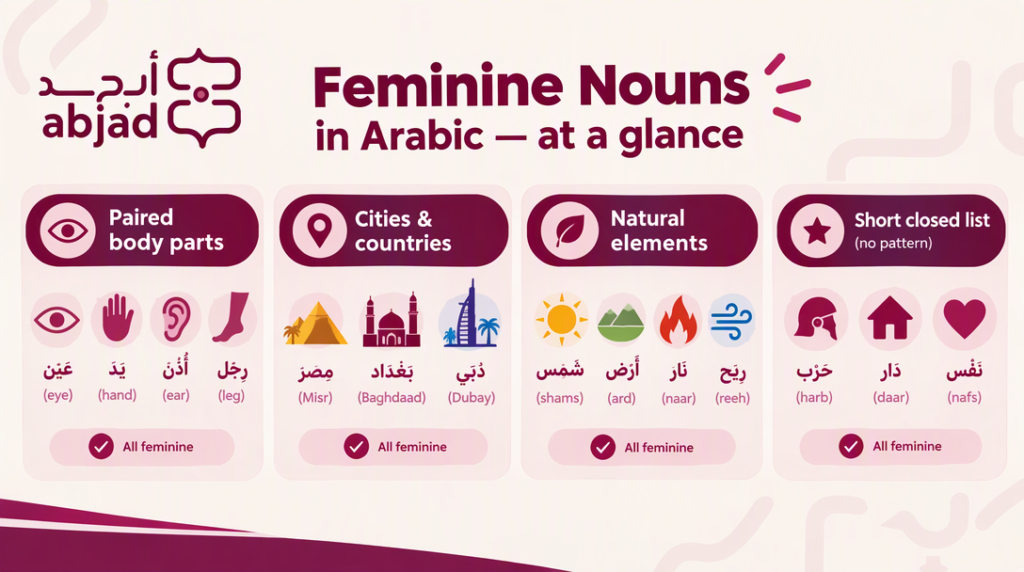
- Paired body parts are feminine: عَيْن (ayn, eye), يَد (yad, hand), أُذُن (udhun, ear), and رِجْل (rijl, leg).
- Cities and countries are feminine: مِصْر (Misr, Egypt), بَغْدَاد (Baghdaad, Baghdad), and دُبَي (Dubay, Dubai).
- Natural elements are feminine: شَمْس (shams, sun), أَرْض (ard, earth), نَار (naar, fire), and رِيح (reeh, wind).
- A short closed list stays feminine with no pattern: حَرْب (harb, war), دَار (daar, house), and نَفْس (nafs, self).
The Quran confirms the gender of شَمْس directly, attaching a feminine pronoun to it in a verse describing the orbits of the sun and the moon.
لَا الشَّمْسُ يَنبَغِي لَهَا أَن تُدْرِكَ الْقَمَرَ وَلَا اللَّيْلُ سَابِقُ النَّهَارِ وَكُلٌّ فِي فَلَكٍ يَسْبَحُونَ
(Laa ash-shamsu yanbaghee lahaa an tudrika al-qamara wa laa al-laylu saabiqu an-nahaari wa kullun fee falakin yasbahoon)
The pronoun لَهَا (lahaa, for it) is feminine and refers to الشَّمْس. The moon in the same verse takes masculine treatment, which is why the pair is quoted so often in grammar lessons.
Read also: Future Tense in Arabic Rules, Types, And Conjugation
Common Gender Mistakes Arabic Learners Make
Certain errors repeat across classrooms in Dubai, Abu Dhabi, and online sessions worldwide. Each one comes from applying a correct rule in the wrong place, not from missing the rule entirely.
- Treating يَد and عَيْن as masculine because they show no ة, which produces يَدٌ كَبِيرٌ instead of the correct يَدٌ كَبِيرَةٌ.
- Calling خَلِيفَة feminine on the strength of its ending, when the male referent decides the agreement.
- Giving a non-human plural a plural adjective instead of the required singular feminine form.
- Adding ة to numbers three through ten before feminine nouns, which reverses the polarity rule.
- Assuming every final ى marks femininity, which turns the male name مُصْطَفَى into a grammatical error.
- Memorizing isolated gender lists rather than learning each noun inside a short sentence with its adjective.
Masculine nouns in Arabic cause fewer problems than feminine ones precisely because they are unmarked. The mistakes cluster around words that look like one gender and behave like the other.
Abjad Academy offers a Modern Standard Arabic Course that corrects these errors in real time, since a live tutor hears mistakes a textbook can never catch.

Claim Your Free MSA Trial Lesson
Learn Arabic Noun Gender With Abjad Academy Instructors
Noun gender is learned fastest when a qualified teacher corrects agreement errors in the same session they appear. Abjad Academy pairs every student in the UAE with a native instructor for live one-on-one lessons.
What sets Abjad Academy apart:
- Native Arabic instructors who correct gender and agreement errors during the lesson, not after it.
- One-on-one live sessions scheduled around Gulf working hours and school timetables.
- Structured levels that move from alphabet recognition to full sentence construction with verified progress checks.
Our Arabic Courses
- Arabic Grammar Course
- Arabic Course for Beginners
- Arabic Classes for Adults
- Modern Standard Arabic Course
- Arabic Speaking Course
- Arabic Classes for Kids
Conclusion
Masculine and feminine nouns in Arabic form the structural base of the language, not a side detail of vocabulary. Every adjective, verb, pronoun, and number in a sentence depends on getting the noun’s gender right.
Feminine nouns in Arabic are identified through four markers, with taa marbutah covering the large majority and a short exception list covering the rest. Masculine nouns in Arabic need no marker, which is what distinguishes them.
Progress comes from meeting each noun inside a complete sentence with its adjective attached, rather than from memorizing gender lists in isolation. Learn شَمْس alongside الشَّمْسُ حَارَّةٌ, and the gender stops being something to recall.
FAQs
How Do You Know if an Arabic Word Is Masculine or Feminine?
Check the meaning first, then the ending. A noun naming a female being is feminine, and a noun ending in ة, ى, or اء is usually feminine. Everything else is masculine unless it appears on the exception list.
Are All Words Ending in Taa Marbutah Feminine?
Almost all are, with a documented group of exceptions. Male personal names such as حَمْزَة and أُسَامَة, plus titles like خَلِيفَة and عَلَّامَة, end in ة yet take masculine agreement throughout the sentence.
Is شَمْس Feminine in Arabic?
Yes, شَمْس (shams, sun) is feminine despite having no visible marker. Native usage confirms it, the Quran attaches the feminine pronoun لَهَا to it, and the diminutive form شُمَيْسَة reveals the hidden taa marbutah.
Do Arabic Plurals Keep the Gender of the Singular Noun?
Sound plurals keep it, while non-human plurals do not. Any plural referring to objects or animals takes singular feminine agreement, so كُتُب (books) takes a singular feminine adjective even though كِتَاب is masculine.
How Long Does It Take to Master Arabic Noun Gender?
Most learners recognize the markers within two to three weeks of daily practice. Reliable agreement in speech usually takes three to six months, because it depends on vocabulary exposure rather than on memorizing the rules.






[…] Read also: Masculine And Feminine Nouns In Arabic […]
[…] Read also: Masculine And Feminine Nouns In Arabic […]