 Learn Arabic
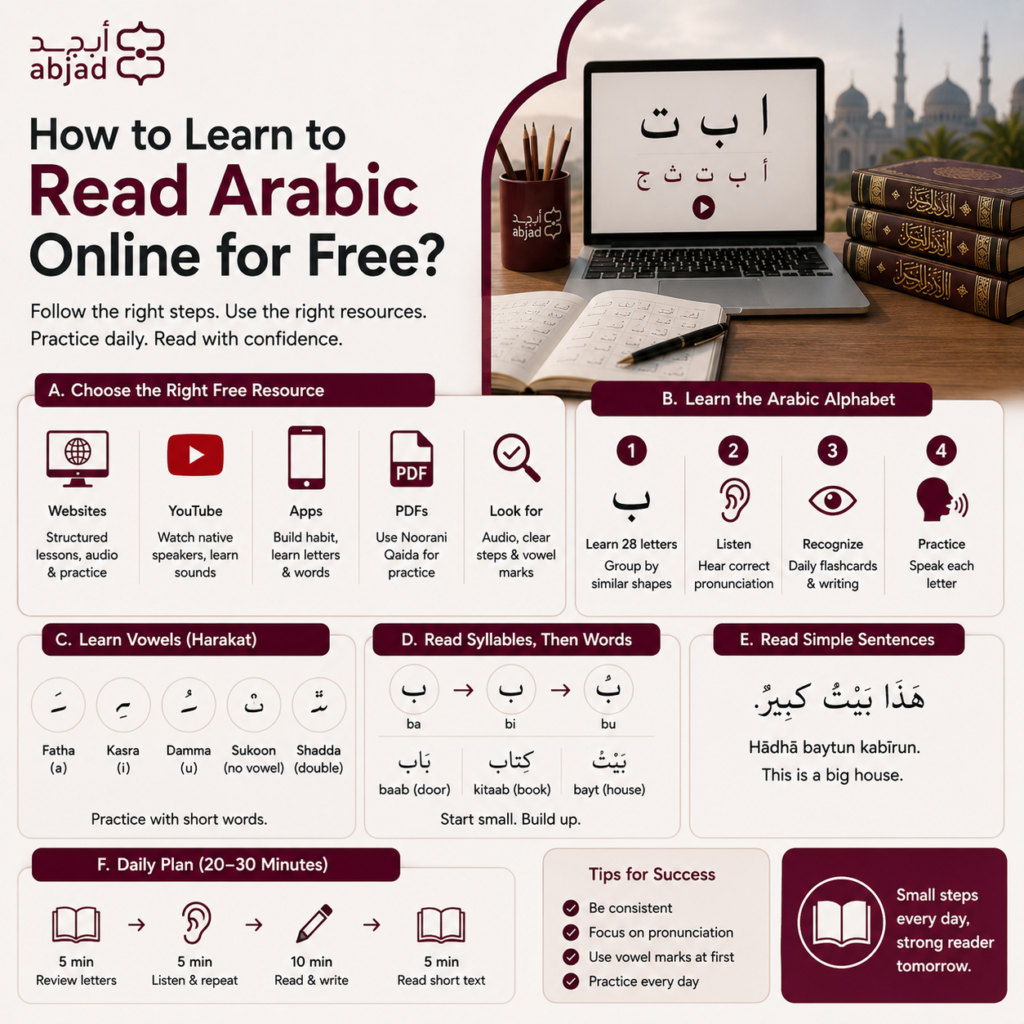
Learning to read Arabic online for free is entirely possible — but the resources alone won’t get you there. Thousands of beginners download apps, open YouTube, and start watching lessons, then stall within a few weeks without knowing why.
The problem is never motivation. It’s sequence Arabic reading is a skill built in layers. Each layer depends on the one before it — and the free tools available online are only useful when matched to the right stage. Use a grammar resource before you’ve mastered the alphabet, or jump to reading words before your vowel sounds are automatic, and you’ll hit a wall that feels like a language barrier but is actually a sequencing problem.
A. Choose the Right Free Online Resource
The first decision shapes everything that follows. Most beginners open whatever app appears first in their search results and start pressing buttons — then wonder why they’ve stalled after three weeks.
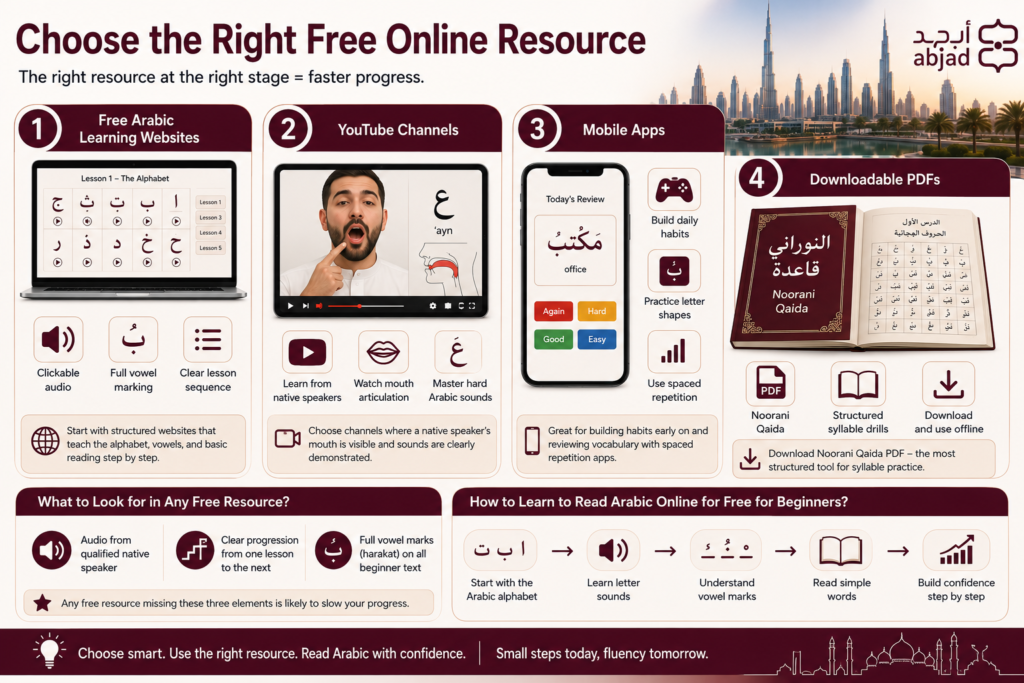
The mistake is treating all Arabic resources as interchangeable. A conversational audio app is not the right tool for learning letter shapes. A grammar website is not the right tool for drilling vowel sounds. Every type of free resource fits a specific stage — use it at the wrong time and it produces frustration, not progress.
1. Free Arabic Learning Websites
Structured free websites are the most reliable starting point for beginners. The best ones offer clickable audio on individual letters, full vowel marking on all beginner text, and a clear lesson sequence from alphabet through basic reading — without requiring registration or payment. Look for websites built around Modern Standard Arabic (MSA) rather than a specific dialect, since MSA is the written standard used in all vowelized beginner texts.
2. YouTube Channels
Video content has real instructional value at the alphabet and pronunciation stages — but only when a qualified speaker demonstrates sounds with visible articulation. Several Arabic sounds, including ع (‘ayn), ح (ha), and خ (kha), require specific throat and mouth positioning that English speakers have never used. Channels that show only on-screen text or use audio-only instruction for these sounds are insufficient. When searching for alphabet videos, look specifically for channels where a native speaker’s mouth is clearly visible.
3. Mobile Apps
Gamified apps are best understood as habit-building tools rather than complete Arabic curricula. They are genuinely useful in the first two to three weeks for getting comfortable with letter shapes in a low-pressure format. Their grammar depth is typically shallow, and most learners outgrow them quickly — but as a way to establish a daily Arabic habit from day one, they work. As vocabulary builds, spaced-repetition flashcard apps become the most effective free tool available, scheduling reviews at the exact moment before you’d forget a word.
4. Downloadable PDFs
The Noorani Qaida — the classical Arabic reading primer used across the Muslim world for generations — is available as a free PDF from multiple sources online. It is the most structured free tool for the syllable-drilling stage you’ll reach in Step 3. Download it before you need it; you’ll return to it consistently across several weeks of practice.
What to Look for in Any Free Resource?
Three criteria matter regardless of format: audio from a qualified native speaker, a clear progression from one lesson to the next, and full vowel marks (harakat) on all beginner text. Any free resource missing these three elements is likely to slow your progress rather than support it.
How to Learn to Read Arabic Online for Free for Beginners?
If you’re a complete beginner, start with free online resources designed specifically for new learners. Choose lessons that introduce the Arabic alphabet, letter sounds, and vowel marks step by step instead of jumping straight into reading full sentences. A structured beginner course, YouTube playlist, or interactive website will help you build a strong foundation without feeling overwhelmed.
When free resources start feeling insufficient — particularly for real-time pronunciation feedback and grammar correction — Abjad Institute’s beginner Arabic courses offer structured instruction with native instructors and a free trial session before any commitment.
Read More: Learn How to Write and Read Arabic for Beginners
B. Learn the Arabic Alphabet Online
The Arabic alphabet has 28 letters. This is where every reading journey starts, and where most self-directed learners make their first critical mistake: learning letter names instead of letter sounds.
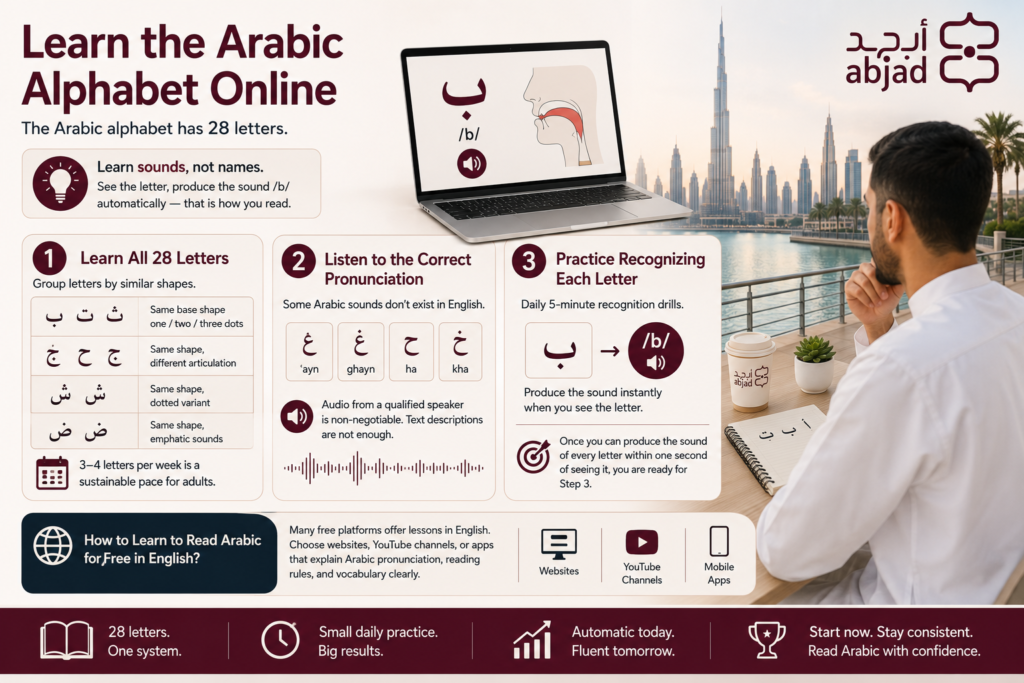
Knowing that ب is called “baa” tells you nothing useful when you’re decoding a word. What reading requires is seeing ب and instantly producing the sound /b/ — automatically, without a processing step. The difference between naming a letter and reading it is automaticity, and that only develops through sound-first practice.
1. Learn All 28 Letters
Group letters by similar shapes rather than strict alphabetical order. Several Arabic letters share a base shape and differ only in the number or placement of dots:
- ب، ت، ث — same base shape, one / two / three dots
- ج، ح، خ — same shape, different articulation point
- س، ش — same shape, dotted variant
- ص، ض — same shape, emphatic sounds
Learning shape families builds visual pattern recognition alongside sound production. Three to four letters per week is a sustainable pace for adults — rushing through all 28 at once creates recognition errors that take weeks to fix.
2. Listen to the Correct Pronunciation
Several Arabic sounds have no English equivalent: ع (‘ayn), غ (ghayn), ح (ha), and خ (kha) require specific throat and mouth positioning that English speakers have never used. Audio from a qualified speaker is non-negotiable at this stage — text descriptions of these sounds are not enough.
3. Practice Recognizing Each Letter
Daily five-minute recognition drills — flashcard by flashcard, sound produced instantly upon seeing the letter — build the automaticity that reading depends on. Once you can produce the sound of every letter within one second of seeing it, you are ready for Step 3.
How to Learn to Read Arabic Online for Free in English?
Many free Arabic learning platforms offer lessons in English, making them ideal for non-Arabic speakers. Look for websites, YouTube channels, or mobile apps that explain Arabic pronunciation, reading rules, and vocabulary using clear English instructions. Learning in your native language reduces confusion and helps you progress faster.
Read also: Does Arabic Read Right To Left?
Inside Our Live Classes
Don’t just take our word for it—see for yourself! Click below to watch short clips from our live classes and meet the instructors who will guide your learning journey.
Begin Your Arabic Journey in the UAE
Join Abjad Institute for a professional and immersive Arabic language experience tailored to your goals.
Book Your Free TrialC. Master Arabic Vowels and Letter Sounds
Arabic letters are consonants. What makes them pronounceable in written text is the harakat system — short vowel marks placed above or below letters that tell you exactly how each syllable sounds.
There are three primary short vowels every beginner must master:
| Vowel | Arabic Mark | Sound | Example |
| Fatha | َ (above) | Short “a” as in “cat” | بَ = “ba” |
| Kasra | ِ (below) | Short “i” as in “bit” | بِ = “bi” |
| Damma | ُ (above, curled) | Short “u” as in “put” | بُ = “bu” |
And two additional marks that appear constantly in beginner texts:
| Mark | Function | Example |
| Sukoon (ْ) | No vowel — sound stops at the letter | بْ = just “b” |
| Shadda (ّ) | Letter is doubled, held briefly | بّ = “bb” |
Practice Reading Syllables
Once you know all five marks, drill every combination: بَ، بِ، بُ، بْ — then مَ، مِ، مُ، مْ — then every other letter in the same pattern. The Noorani Qaida PDF you downloaded in Step 1 is built exactly for this. Work through it systematically, one lesson at a time, until every combination comes automatically.
A beginner who commits 20–25 minutes daily to this stage typically achieves confident syllable reading within three to four weeks. This is the stage most free learners skip — and the main reason they plateau before ever reading a real word.
This is the natural transition point. Abjad Institute’s structured courses — including a free trial session — are built for exactly this moment: when a learner has a solid foundation from free study and needs a native instructor to take them the rest of the way.

Read More: How Long Does It Take to Learn to Read Arabic?
D. Practice Reading Simple Arabic Words
With syllable automaticity in place, you are ready to read actual Arabic words. Two rules govern this stage: start with short words, and always use fully vowelized text.
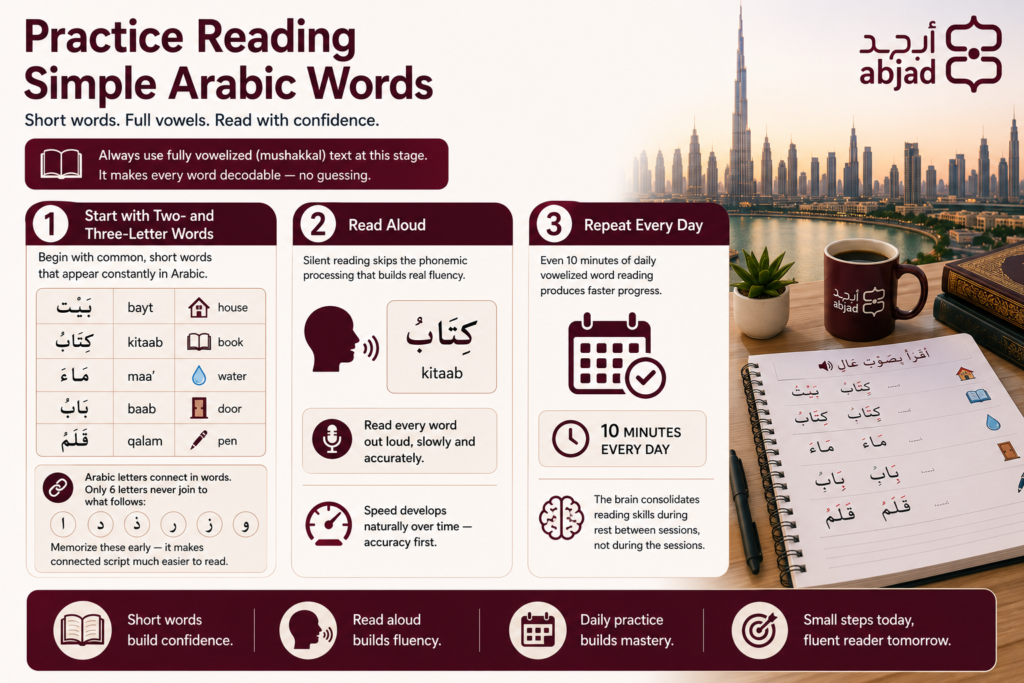
Most Arabic text online — news sites, social media, Wikipedia — is unvowelized. Arabic readers infer pronunciation from context and language knowledge. A beginner reading unvowelized text is not reading; they are guessing. Fully vowelized text (mushakkal) has every short vowel mark written in, making it fully decodable at this stage.
1. Start with Two- and Three-Letter Words
Begin with common, short words that appear constantly in Arabic:
- بَيْت (bayt) — house
- كِتَاب (kitaab) — book
- مَاء (maa’) — water
- بَاب (baab) — door
- قَلَم (qalam) — pen
Note also that Arabic letters connect when written in a word — ب looks different inside بيت than it does in isolation. Only six letters never join to the letter that follows (ا، د، ذ، ر، ز، و). Memorize these non-joining letters early and connected script becomes far more readable.
2. Read Aloud
Silent reading at this stage skips the phonemic processing that builds real fluency. Read every word out loud, slowly and accurately. Speed develops naturally over time — accuracy first.
3. Repeat Every Day
Even ten minutes of daily vowelized word reading produces faster progress than a one-hour session once a week. The brain consolidates reading skills during rest between sessions, not during the sessions themselves.
E. Read Short Arabic Texts Online
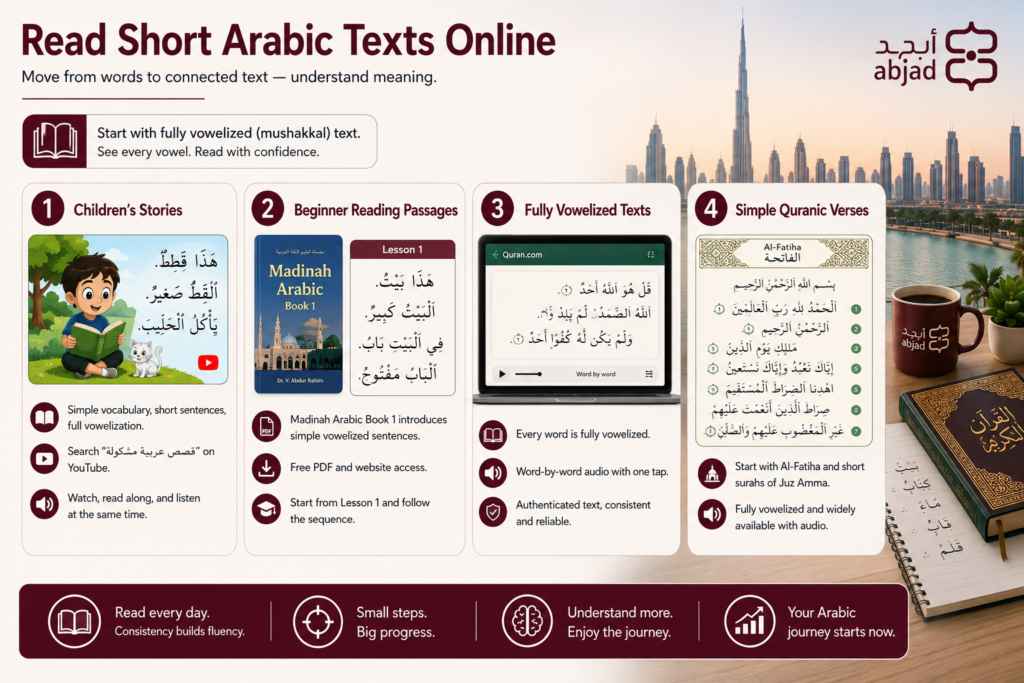
Once short words feel manageable, move to connected text — short passages where words appear in sequence and meaning begins to emerge.
1. Children’s Stories
Arabic children’s stories written for early readers use simple vocabulary, short sentences, and full vowelization. Search “قصص عربية مشكولة” (vowelized Arabic stories) on YouTube for channels that display the text on screen while narrating — you read along and hear confirmation of your decoding simultaneously.
2. Beginner Reading Passages
Madinah Arabic Book 1 introduces simple vowelized Arabic sentences in a carefully sequenced order. The full text is available as a free PDF and on the Madinah Arabic website. Start from Lesson 1 and work through it — the progression is deliberate and pedagogically tested.
3. Fully Vowelized Texts
Quran.com becomes your most useful free tool at this stage. Every word is fully vowelized, word-by-word audio is available with one tap, and the text is authenticated and consistent. Even if Quranic reading is not your primary goal, using it as a reading practice text at this stage is highly effective.
4. Simple Quranic Verses
For learners whose goal includes understanding or reciting the Quran, Surah Al-Fatiha and the short surahs of Juz Amma (the 30th section) are the standard starting point. They are short, fully vowelized in all digital versions, and widely available with audio from multiple certified reciters on Quran.com and similar platforms.
F. Build a Daily Online Reading Routine
Learning to read Arabic online for free isn’t about studying for hours—it’s about practicing consistently. Even the best free websites, apps, and video lessons won’t help if you only use them occasionally. A short daily routine will help you build reading fluency much faster than long, irregular study sessions.
Read also: How To Read Arabic-Indic Numbers (1 To 100) In English?
How to Learn to Read Arabic Online for Free for Adults?
Adults often make steady progress because they can follow a structured routine and stay consistent. Aim to study for 15–20 minutes each day, which is long enough to improve without becoming overwhelming. A short daily habit over several months is far more effective than studying for a few hours once a week.
A simple daily routine could look like this:
- Watch one lesson (5–7 minutes): Review the Arabic alphabet, vowel marks, or a beginner reading lesson from your chosen free online resource.
- Complete one exercise (5 minutes): Practice with Noorani Qaida drills, flashcards, or interactive reading exercises.
- Read one short passage (5–8 minutes): Read a fully vowelized word list, a beginner story, or a short passage from an online reading resource such as Quran.com.
This routine strengthens the three core reading skills: letter recognition, decoding, and fluent reading, while remaining easy to maintain every day.
Instead of measuring how fast you read, focus on practicing every day. Tracking your daily learning streak will help you stay motivated, and consistent practice is what ultimately leads to confident Arabic reading.
For children who need structured daily Arabic practice with a native instructor guiding each session, Abjad Institute’s Arabic Grammar courses for kids provide the curriculum and consistency that parent-led free learning often cannot sustain alone.

G. Test Your Progress and Keep Improving
Learning to read Arabic is a gradual process, so it’s important to measure your progress regularly instead of relying on how confident you feel. Free online quizzes and reading exercises can help you identify the letters, vowel patterns, or words that still need more practice. Rather than focusing on your score, use each assessment to discover your weak areas and review them before moving on.
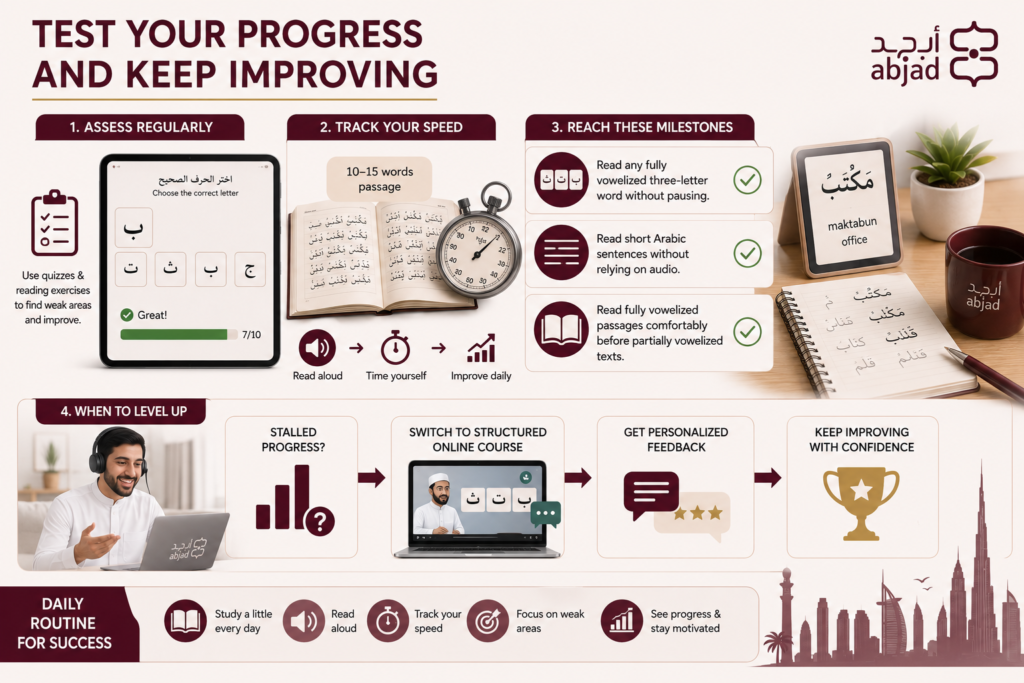
Another simple way to track improvement is to measure your reading speed. Choose a short, fully vowelized passage of 10–15 words, read it aloud, and record how long it takes. Repeat the same passage every day for a week. As your reading becomes smoother and more automatic, you’ll notice both your speed and accuracy improving.
Before moving to the next level, make sure you’ve reached these milestones:
- You can read any fully vowelized three-letter word without pausing.
- You can read short Arabic sentences without relying on audio.
- You can read fully vowelized passages comfortably before attempting partially vowelized texts.
If you find that your progress has stalled, it may be time to switch from self-study to a structured online course. Free resources are excellent for building the basics, but personalized feedback from a qualified teacher can help you correct pronunciation mistakes, strengthen your reading skills, and continue improving with confidence.
Read more: How to Learn Quranic Arabic Free Online in the UAE?
Common Mistakes That Make Learning Arabic Reading Harder
Learning to read Arabic online is much easier when you avoid the mistakes that slow down many beginners. By recognizing these common pitfalls early, you can build stronger reading habits, make steady progress, and reach fluency faster.
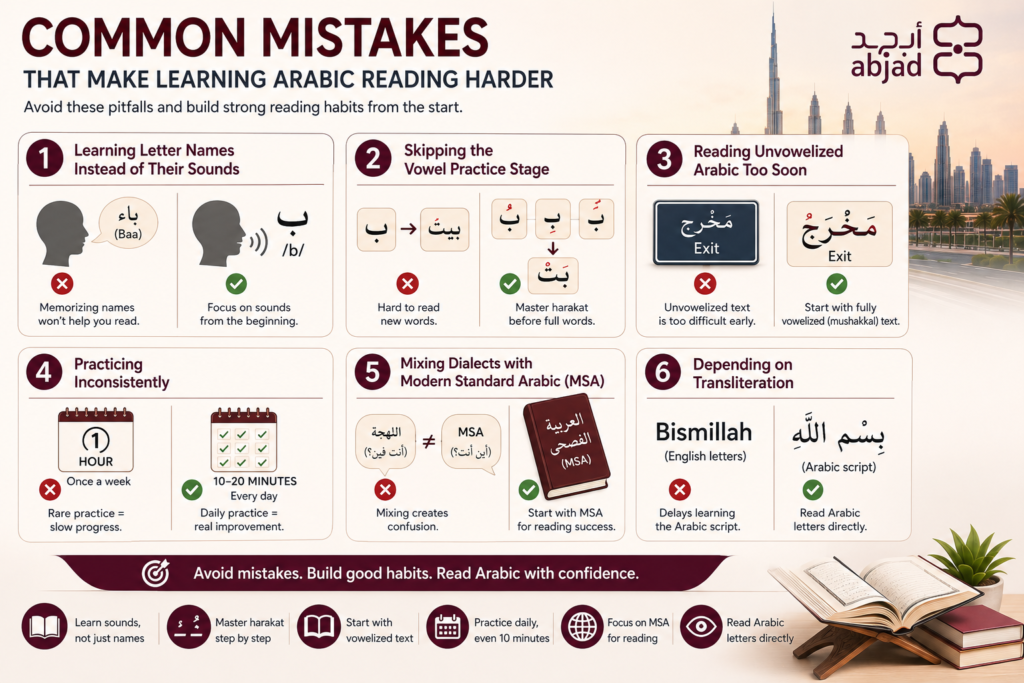
1. Learning Letter Names Instead of Their Sounds
Many beginners memorize the names of Arabic letters but don’t practice their actual sounds. While letter names are useful for reference, reading depends on recognizing and pronouncing each sound correctly. Focus on phonics from the very beginning.
2. Skipping the Vowel Practice Stage
Some learners move straight from the Arabic alphabet to reading words without mastering the vowel marks (harakat). This often leads to frustration because they can’t decode unfamiliar words. Spend enough time practicing syllables before moving on to full words.
3. Reading Unvowelized Arabic Too Soon
Most Arabic websites, newspapers, and social media posts don’t include vowel marks. Beginners should start with fully vowelized (mushakkal) texts, which clearly show pronunciation and help build reading confidence before tackling standard Arabic texts.
4. Practicing Inconsistently
Reading for an hour once a week is far less effective than practicing for 10–20 minutes every day. Daily repetition strengthens letter recognition, improves pronunciation, and helps your brain retain new reading skills.
5. Mixing Dialects with Modern Standard Arabic (MSA)
If your goal is to learn to read Arabic, begin with Modern Standard Arabic. Switching between MSA and regional dialects too early can create confusion because many words and pronunciations differ from the written language.
6. Depending on Transliteration
Reading Arabic words written in English letters—such as Bismillah instead of بِسْمِ الله—may seem easier at first, but it delays learning the Arabic script. Practice reading Arabic letters directly from the start to develop real reading ability.
Read also:Top-rated online Arabic programs for kids in UAE
Watch Our Classes in Action
Curious what a real session looks like? Take a peek inside our interactive classrooms and see how our expert instructors bring the Arabic language to life. Watch a sample lesson below!
Begin Your Arabic Journey in the UAE
Join Abjad Institute for a professional and immersive Arabic language experience tailored to your goals.
Book Your Free TrialRead Also: Arabic Writing Practice in the UAE
Start Learning Arabic with Abjad Institute
Free resources will take you through the foundational stages — alphabet, vowels, syllable reading, and basic word decoding. What they cannot provide is real-time feedback on pronunciation, structured grammar introduction at the right moment, and correction of errors before they become habits.
At Abjad Institute, Arabic courses are taught by native Arabic instructors — including native Emirati teachers — with curricula designed for learners in the UAE and beyond. Whether you’re starting from zero or bridging the gap between self-study and real fluency, a free trial session costs nothing and shows you exactly what structured instruction adds.
Book your free trial today and see how far one session takes you.

Discover Our Arabic Courses
- Arabic Course for Kids
- Arabic Conversation for Kids
- Arabic Qaida for Kids
- Beginner Arabic for Kids
- Arabic Grammar for Kids
- Teen Arabic Summer Course
- Arabic Kids Camps
- UAE Kindergarten Arabic Classes
- Modern Standard Arabic Course
- Fusha Arabic Course
- Classical Arabic Course
- Emirati Arabic Course
- Gulf Arabic Course
- Learn Saudi Arabic
- Business Arabic Course UAE
- Arabic Language Classes for Professionals in UAE
- Quranic Arabic Course
Begin Your Arabic Journey in the UAE
Join Abjad Institute for a professional and immersive Arabic language experience tailored to your goals.
Book Your Free TrialConclusion
Learning to read Arabic online for free comes down to seven steps followed in the right order: choose the right resource for your stage, learn the alphabet by sound, master the vowel marks, drill syllable combinations until they’re automatic, read vowelized words and texts, build a daily routine, and measure your progress regularly.
Pick one free resource today — Madinah Arabic for structured alphabet instruction, or the Noorani Qaida PDF for syllable drilling — and commit to 15 minutes daily. The sequence above does the rest.
When free tools stop being enough, Abjad Institute’s free trial session is the natural next step.
Frequently Asked Questions
Before you start your Arabic reading journey, you may have a few questions about the learning process. Below are answers to the most common questions beginners ask about learning to read Arabic online for free, including how long it takes, the best resources to use, and whether adults can succeed with self-study.
How to learn to read Arabic online for free for beginners?
Beginners should start with the Arabic alphabet before touching any words or sentences. The correct sequence is: letter recognition first, short vowel marks second, syllable drilling third, then simple vowelized words.
Free structured websites and the Noorani Qaida PDF cover the first three stages entirely at no cost. The most common beginner mistake is skipping the syllable-drilling stage and jumping straight to words — this is the single biggest reason most free learners stall early.
How to learn to read Arabic online for free in English?
Most free Arabic learning resources are available in English, including structured alphabet websites, YouTube channels taught by English-speaking instructors, and the Noorani Qaida primer with English explanations. Modern Standard Arabic (MSA) — the written form used in all vowelized beginner texts — is entirely learnable through English-medium free resources. No Arabic background or prior language knowledge is required to begin.
Can adults learn to read Arabic online for free?
Yes — adults often progress faster than children at the early reading stages because of stronger pattern recognition and the ability to self-direct practice. Free online resources are fully sufficient for adult beginners through the foundational stages: alphabet, vowels, syllable reading, and basic text.
The one stage where adults consistently benefit from adding structured instruction is sentence reading and grammar, where real-time correction prevents errors from becoming habits.
Can I really learn to read Arabic online for free?
Yes — free resources today are genuinely sufficient for building a foundational Arabic reading ability. Structured free websites, the Noorani Qaida primer, and vowelized reading platforms like Quran.com cover every stage from alphabet recognition through basic sentence reading at no cost.
The critical requirement is sequence: using each resource at the right stage, in the right order. Consistent daily practice of 15–20 minutes produces basic vowelized reading fluency within four to six months for most adult beginners.
How long does it take to learn to read Arabic online?
An adult beginner practicing 15–20 minutes daily typically reaches basic vowelized reading fluency in four to six months. Practicing three times per week instead of daily extends that to eight to ten months. Consistency matters more than session length — short daily practice outperforms long weekly sessions at every stage of Arabic reading development.
Do I need to learn grammar before I can read Arabic?
No. Grammar is not the starting point for Arabic reading — the alphabet and vowel system are. Reading fluency and grammar develop in parallel, not in sequence. Follow the seven steps in this guide: alphabet and sounds first, vowels second, syllable drilling third. Grammar enters naturally at the sentence-reading stage, introduced through pattern exposure before any formal rule explanation.





Leave a Reply