 Learn Arabic
You pass Arabic script every day in the UAE — on Metro signs, government forms, restaurant menus, and street names — and most of it still looks like a pattern you can’t crack. Learning how to read Arabic letters in the UAE isn’t about memorizing a foreign alphabet from a textbook written for someone in another country. It’s about connecting a logical letter system to the Arabic you actually see around you in Dubai, Abu Dhabi, and Sharjah.
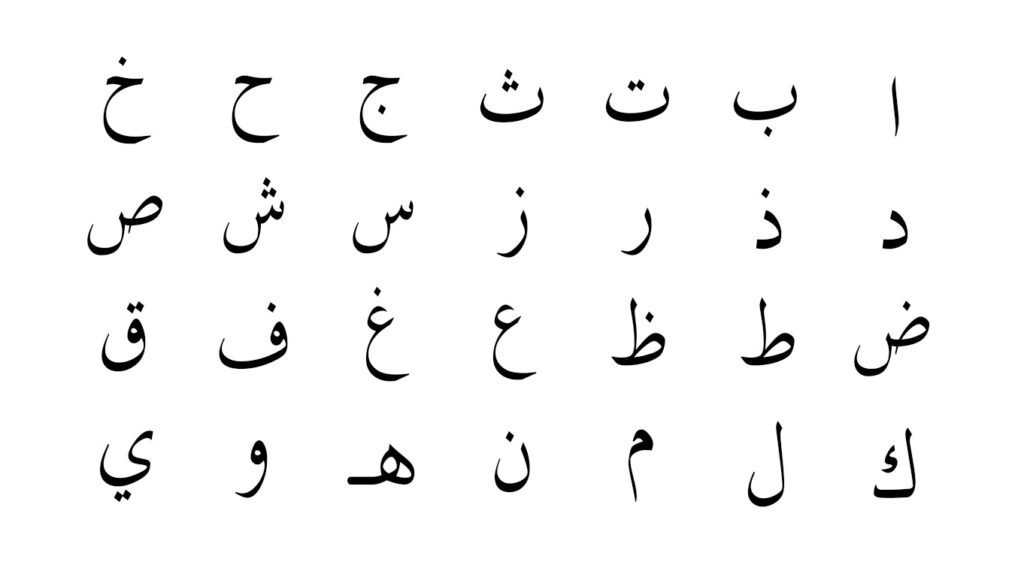
The good news: Arabic reading follows fixed, learnable rules. There are 28 consonant letters, a small set of vowel marks, and a consistent right-to-left flow. Once you understand how these pieces fit together, decoding a word stops being guesswork and starts being a process you can repeat every time. This guide is built as a practical resource on how to read Arabic letters for beginners, using examples drawn from daily life in the Emirates.
This guide walks through that process step by step, with practice habits built specifically around daily life in the UAE.
How to read Arabic letters in the UAE follows a fixed sequence. Arabic is a consonant-based writing system: each of the 28 letters represents a consonant sound, and short vowels are added separately as small marks rather than as full letters in the word. That single structural difference from English is why the steps below matter — skipping any one of them is the most common reason beginners get stuck. Work through them in order, and don’t move to the next until the previous one feels automatic.
Step 1: Read From The Right
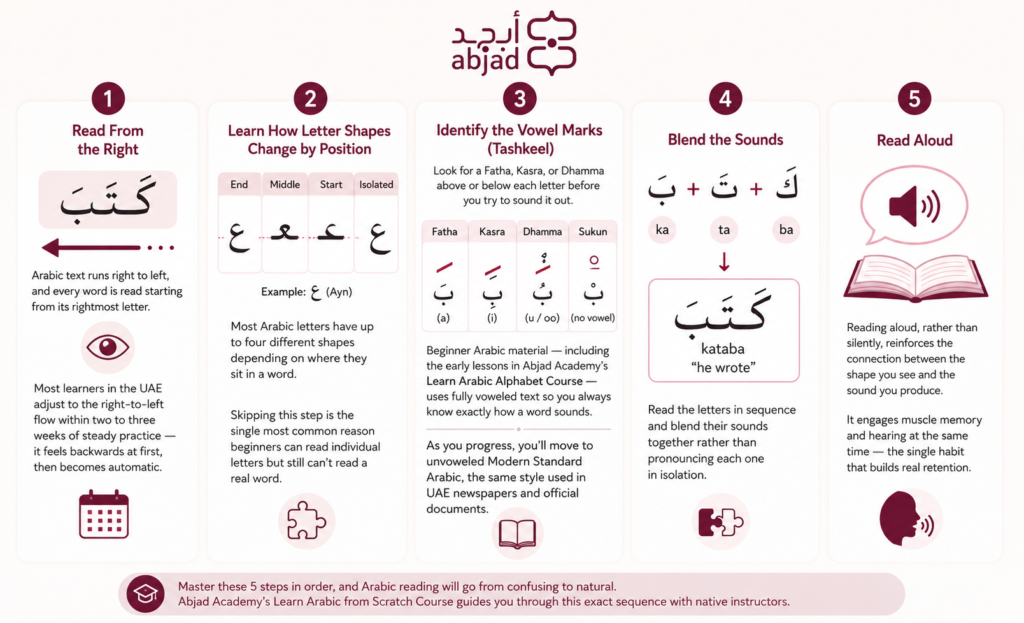
Arabic text runs right to left, and every word is read starting from its rightmost letter. This affects not just the direction your eyes move but where a sentence starts on the page and how a word is built letter by letter.
Under time pressure, beginners frequently default to left-to-right habits from English and misread the word entirely. Most learners in the UAE adjust to the right-to-left flow within two to three weeks of steady practice — it feels backwards at first, then becomes automatic.
Step 2: Learn How Letter Shapes Change By Position
Before you can read a full word, you need to recognize that most Arabic letters have up to four different shapes depending on where they sit in a word — isolated, at the start, in the middle, or at the end.
The letter ع (Ayn), for example, looks noticeably different in each of its four positions. Skipping this step is the single most common reason beginners can read individual letters but still can’t read a real word — a core problem this guide on how to read Arabic letters for beginners is built to solve.
Step 3: Identify The Vowel Marks (Tashkeel)
Tashkeel are the small marks placed above or below Arabic letters to indicate short vowel sounds that aren’t written as separate letters. Look for a Fatha (a short “a”), a Kasra (a short “i”), or a Dhamma (a short “u” or “oo”) above or below each letter before you try to sound it out. If there’s no mark, check for a Sukun, which shows the letter carries no vowel and connects directly into the next sound.
Beginner Arabic material — including the early lessons in Abjad Academy’s Learn Arabic Alphabet Course — uses fully voweled text so you always know exactly how a word sounds.
As you progress, you’ll move to unvoweled Modern Standard Arabic, the same style used in UAE newspapers and official documents, where the reader infers short vowels from vocabulary knowledge alone.
Step 4: Blend The Sounds
Read the letters in sequence and blend their sounds together rather than pronouncing each one in isolation. For example:
كَ + تَ + بَ = كَتَبَ (kataba, “he wrote”)
This blending step is where reading starts to feel like reading instead of decoding — a genuinely rewarding moment for most beginners.
Read Also: Learn How To Write And Read Arabic For Beginners In The UAE
Step 5: Read Aloud
Reading aloud, rather than silently, reinforces the connection between the shape you see and the sound you produce. This single habit does more for retention than any app or flashcard, because it engages muscle memory and hearing at the same time.
If you want a structured version of this process with live correction, Abjad Academy’s Learn Arabic from Scratch Course walks beginners through exactly this sequence with native instructors checking pronunciation from lesson one.
Arabic Letters in English: What Transliteration Can and Can’t Do
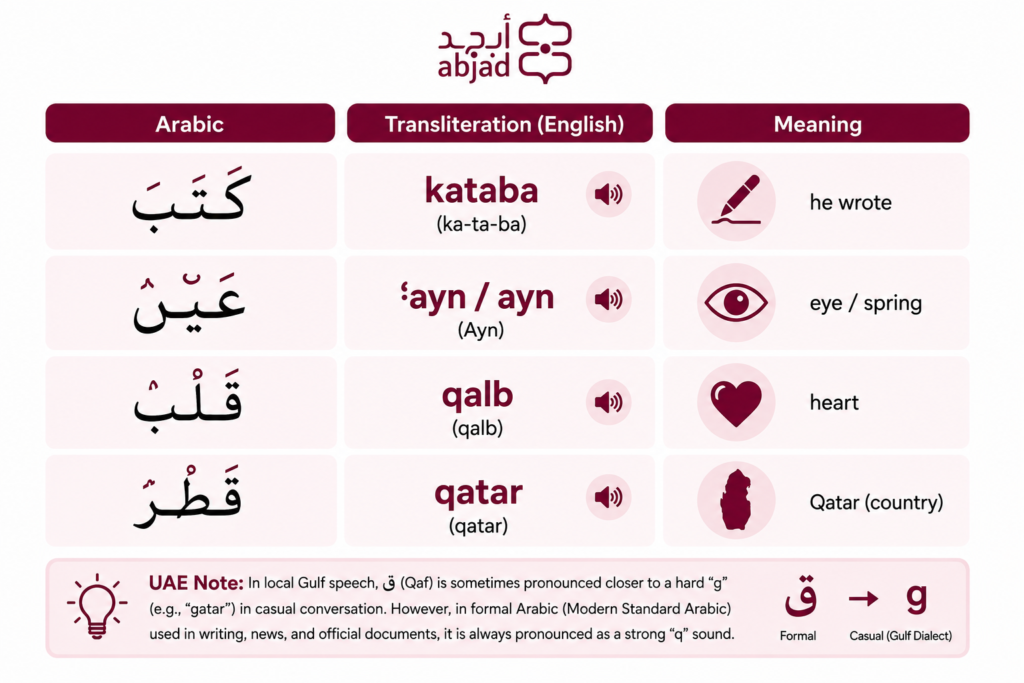
Arabic letters in English — also called transliteration — means representing Arabic sounds using the Latin alphabet, such as writing “kataba” for كَتَبَ. It’s a useful shortcut for pronunciation guides and travel phrasebooks, but it has a real limit: several Arabic sounds, like ع (Ayn) or ق (Qaf), have no true English equivalent, so transliteration always involves some approximation.
Relying on Arabic letters in English long-term slows down actual reading progress, because it trains you to depend on a workaround instead of recognizing the Arabic script directly.
Treat transliteration as training wheels for the first week or two, then move to reading the Arabic letters themselves as early as possible — this shift is one of the biggest turning points for anyone learning how to read Arabic letters for beginners.
One UAE-specific note worth knowing early: local Gulf speech sometimes pronounces ق (Qaf) closer to a hard “g” sound in casual conversation, even though formal written Arabic — the Modern Standard Arabic used in government documents and news — keeps the standard Qaf pronunciation. This is a spoken dialect variation, not a difference in how the letter is written or read.
Confusing dialect pronunciation with the written standard is one of the most common setbacks for adult learners in the UAE — and it’s exactly the kind of distinction covered early in Abjad Academy’s Arabic Classes for Beginners, so you’re not left guessing which version to trust.
Read also: How To Read Arabic-Indic Numbers (1 To 100) In English?
Watch Our Classes in Action
Curious what a real session looks like? Take a peek inside our interactive classrooms and see how our expert instructors bring the Arabic language to life. Watch a sample lesson below!
Begin Your Arabic Journey in the UAE
Join Abjad Institute for a professional and immersive Arabic language experience tailored to your goals.
Book Your Free TrialDaily Arabic Reading Practice Tips
This section answers: what does an effective, realistic daily practice routine look like for someone learning in the UAE.
Consistency matters more than the total number of hours you put in. A short, focused session every day builds reading fluency faster than occasional long study blocks — and it’s the single biggest factor in mastering how to read Arabic letters in the UAE without a classroom.
A simple 15–20 minute daily routine:
- 5 minutes: alphabet review
- 5 minutes: vowel mark (Tashkeel) practice
- 5 minutes: reading simple, short words
- 5 minutes: reading aloud
Useful tools to support this routine include Arabic alphabet worksheets, flashcards, and beginner books that include full Harakat (vowel marks) — children’s Arabic books work particularly well here, since they’re written with vowels and simple vocabulary.
The UAE also gives you a free, constantly available practice resource that learners elsewhere don’t have: every road sign, Metro station name, and shop front is real Modern Standard Arabic you can practice decoding on your commute. Reading real signage regularly — rather than only invented textbook sentences — builds the kind of practical recognition that actually transfers to daily life.
Read also:The Ultimate Parent Guide: Teaching Arabic Numbers to Kids in the UAE
Common Challenges Beginners Face
Most beginners hit the same handful of obstacles when learning how to read Arabic letters for beginners. Knowing them in advance saves weeks of frustration.
1. Letters Look Too Similar
Several Arabic letters share the same base shape and differ only by the number or placement of dots — for example ب، ت، and ث. The fix is to learn these letters in grouped pairs and contrast them directly against each other, rather than studying the alphabet in strict alphabetical order.
2. Vowels Are Missing in Real Text
Everyday Arabic in books, newspapers, and UAE signage usually leaves short vowels unmarked, since fluent readers infer them from vocabulary and context.
Beginners should start exclusively with fully voweled text and only move to unvoweled Modern Standard Arabic once word recognition is solid.
3. Confusing Dialect With Standard Arabic
Spoken Gulf Arabic varies from formal written Arabic in pronunciation and some vocabulary. The fix is to anchor your reading practice in Modern Standard Arabic (MSA) — the form used in UAE newspapers like Al Bayan and Al Khaleej, and in all official government correspondence — rather than trying to read based on what you hear spoken casually.
Read Also: How To Read Arabic Quran In The UAE
How Long Does It Take To Read Arabic Letters In The UAE?
Most motivated beginners following a structured routine can recognize individual letters within 1–2 weeks, read simple words within about a month, and read short sentences within roughly three months.
This progress is driven by consistent daily practice, not by prior language talent — someone with no background in any second language can reach the same milestones as a trained linguist, provided they practice regularly.
That timeline assumes daily practice and correction of positional letter forms early on, since incorrect reading habits formed in the first few weeks are the hardest to unlearn later — which is exactly why so many people searching how to read Arabic letters in the UAE eventually look for guided instruction.
If you’d rather compress that timeline with structured, corrected practice from day one, the Arabic Intensive Course at Abjad Academy is built for exactly this pace, pairing daily letter and vowel drills with live instructor feedback.
Read also: How To Read Arabic Script In The UAE
Inside Our Live Classes
Don’t just take our word for it—see for yourself! Click below to watch short clips from our live classes and meet the instructors who will guide your learning journey.
Start Reading Arabic With Confidence Today
Learning how to read Arabic letters in the UAE is entirely achievable with the right sequence and steady daily practice — but self-teaching from scattered videos and apps often means repeating avoidable mistakes for months before anyone corrects them.

A structured course shortens that path considerably, with an instructor catching pronunciation and letter-form errors before they become habits.
Abjad Academy offers live, beginner-focused Arabic reading instruction designed around exactly the steps in this guide — letter recognition, vowel marks, blending, and real-world reading practice using UAE-relevant Arabic.
Discover Our Arabic Courses:
- Arabic Intensive Course
- Learn Arabic from Scratch Course
- Madinah Arabic Course
- Arabic Classes for Adults
- Arabic Classes for Beginners
- Self-Paced Arabic Course
- Basic Arabic Course
- Arabic Speaking Classes
- Learn to Write Arabic Course
- Arabic Grammar Course
- Learn Arabic Alphabet Course
Begin Your Arabic Journey in the UAE
Join Abjad Institute for a professional and immersive Arabic language experience tailored to your goals.
Book Your Free Trial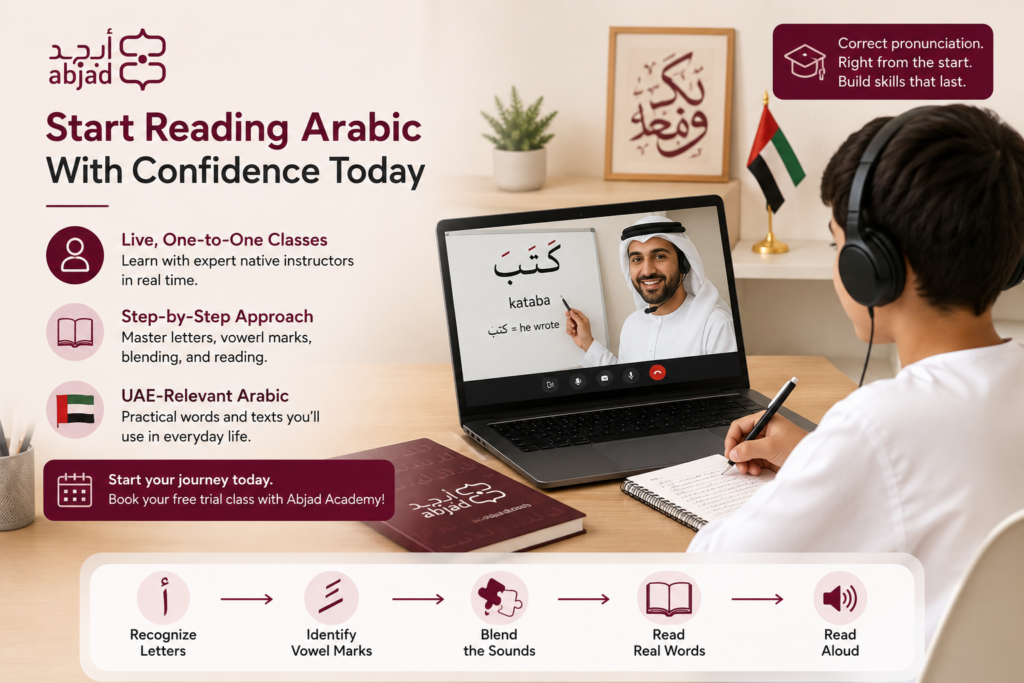
Conclusion
How to read Arabic letters in the UAE comes down to a handful of repeatable skills: reading from the right, recognizing how letters change shape by position, identifying vowel marks, blending sounds letter by letter, and reading aloud with real Arabic text from your own surroundings. None of this requires special language talent — it requires a clear system and consistent repetition.
Whether you’re decoding a Metro sign for the first time or working through a full beginner course, the path to reading Arabic letters for beginners is the same structured process outlined above.
Stay consistent, read aloud, and lean on real UAE Arabic — signage, menus, and simple texts — as your practice material, and fluent reading becomes a matter of weeks and months, not years.
Read also: How To Read Arabic Without Harakat In The UAE? — A Complete Guide

Frequently Asked Questions
The questions below cover the details beginners most often ask after starting to learn how to read Arabic letters in the UAE — from pronunciation shortcuts to realistic timelines.
1. How do you read Arabic letters in English?
Arabic letters in English refers to transliteration — spelling Arabic sounds using the Latin alphabet, like writing “kitab” for كِتَاب. It’s a helpful pronunciation aid for absolute beginners, but several Arabic sounds don’t map exactly onto English letters, so it should only be a short-term tool before reading the Arabic script directly.
2. Is it hard to read Arabic letters for beginners?
Reading Arabic letters for beginners is more structured than difficult — the challenge is unfamiliarity, not complexity. Once you learn the 28 letter shapes, their four positional forms, and the vowel marks, reading becomes a repeatable process rather than a memorization task.
3. Do UAE road signs use Modern Standard Arabic or local dialect?
UAE road signs, government forms, and official documents use Modern Standard Arabic (MSA), the same written standard used across Arabic-speaking countries. Spoken Gulf Arabic differs in pronunciation and some vocabulary, but written signage follows MSA spelling and grammar.
4. How long does it take to read Arabic letters in the UAE?
Most beginners recognize individual letters within 1–2 weeks, read simple words within about a month, and read short sentences within roughly three months, assuming consistent daily practice of 15–20 minutes.
5. Why do Arabic letters change shape in a word?
Most Arabic letters have up to four forms — isolated, initial, medial, and final — depending on their position in a word, and six letters never connect to the letter that follows them. Learning these positional forms early prevents the most common beginner reading errors.
6. Can adults learn to read Arabic letters without prior language experience?
Yes — reading Arabic depends on consistent practice and a clear step-by-step method, not prior language background. Adults with no second-language experience reach the same reading milestones as experienced language learners when they follow a structured routine.






Leave a Reply