 Learn Arabic
Arabic is the UAE’s official language, woven into schools, mosques, government services, and everyday life. Yet many parents – Arab and non-Arab alike — are unsure where to begin, which methods actually work, or how to make the process enjoyable rather than a daily battle of wills.
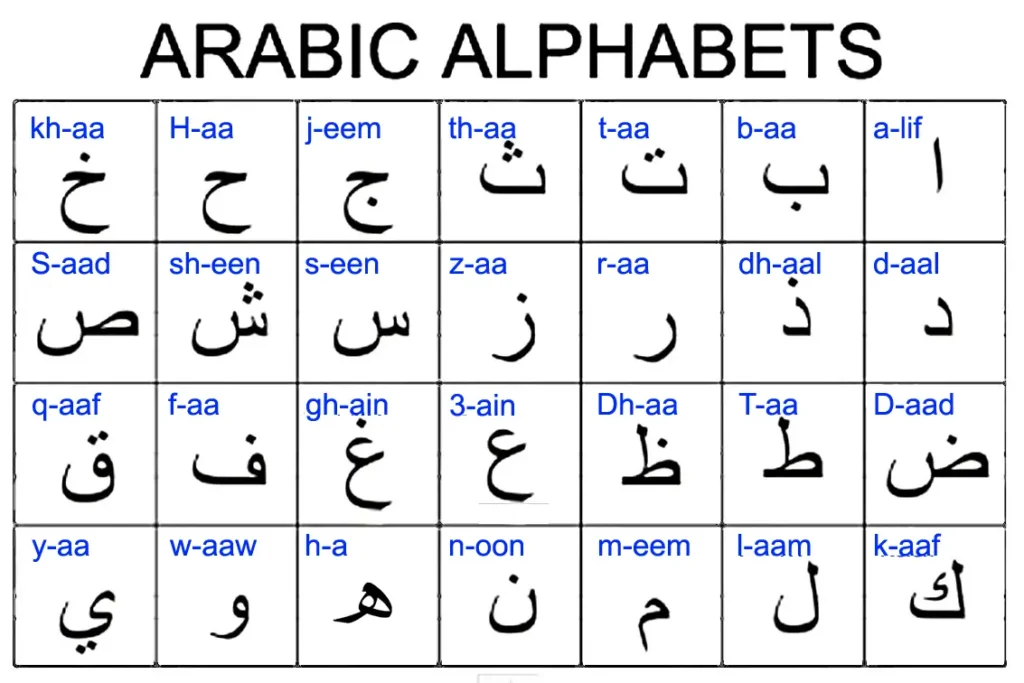
Every language has a starting point. For Arabic, that point is the alphabet — 28 letters running from ألف (Alef) to ياء (Ya), written right to left in a flowing cursive script that has remained largely unchanged for seventeen centuries. For families living in the UAE, Arabic Alphabet kids teaching is both a cultural priority and a practical one.
This guide covers the full picture: the structure of the Arabic alphabet, the right age to begin, the teaching methods that produce lasting results, and the bridge from first letters to confident reading.
What you’ll learn in this article:
- Why is the Arabic alphabet for kids more complex than most parents expect?
- The developmental window that makes early instruction effective
- Play-based and sensory methods proven to build lasting letter recognition
- How early alphabet learning connects directly to Quranic reading
- Practical strategies UAE parents can apply at home from day one
Why Learning The Arabic Alphabet For Kids Requires A Smarter Start Than Rote Memorisation?
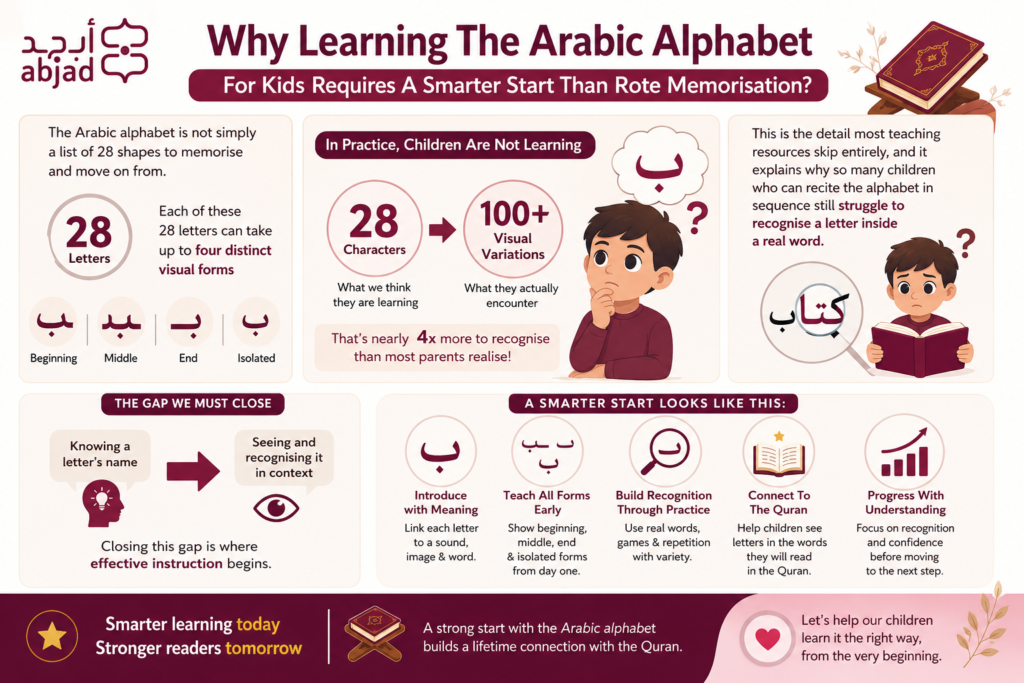
The Arabic alphabet is not simply a list of 28 shapes to memorise and move on from. Each of those 28 letters can take up to four distinct visual forms depending on where it appears at the beginning, middle, or end of a word, or in isolation. In practice, children are not learning 28 characters; they are encountering a writing system with over 100 distinct visual variations.
This is the detail most teaching resources skip entirely, and it explains why so many children who can recite the alphabet in sequence still struggle to recognise a letter inside a real word. Closing that gap — between knowing a letter’s name and seeing it in context — is where effective instruction begins.
For UAE families specifically, the stakes are high. Arabic is the language of the Quran, of Emirati heritage, of the national school curriculum, and of professional life. Starting well saves months of re-teaching further down the road.
A. What Makes The Arabic Script Genuinely Unique
Beyond direction, Arabic is inherently cursive: letters join one another, and those joins change the shape of every character in the sequence. Parents who search for guidance on how to read Arabic script in the UAE are often surprised to discover that this multi-form nature is the language’s defining visual challenge.
Consider the letter ب (Ba). In isolation, it looks one way. At the beginning of a word, another. In the middle, a third. At the end, a fourth. Multiply this across all 28 letters and visual fluency — not memorisation — becomes the real goal.
The practical implication: introduce letters in all their word positions from early on, rather than teaching isolated shapes and treating connected forms as advanced material.
B. Why Does the Hija’i Sequence Make Pedagogical Sense?
The Arabic alphabetical order most people recognise today — where ب، ت، ث share a single base shape distinguished only by dots — was established by the grammarian Nasr ibn Asim al-Laythi and is called the hija’i arrangement.
It groups letters by visual similarity, and this is deliberate: letters that look alike are presented together, requiring children to distinguish them by their dot patterns rather than their base structure.
This grouping is a genuine teaching tool. Introducing ب، ت، ث as a family — one base shape, three dot configurations — builds the visual discrimination skill that reading requires.
At Abjad Institute, early instruction follows a structured, sequenced curriculum built around exactly this principle — grouping letters by form so children build discrimination skills from their very first lesson. Explore Arabic Qaida for Kids course to see how this approach is structured.
Watch Our Classes in Action
Curious what a real session looks like? Take a peek inside our interactive classrooms and see how our expert instructors bring the Arabic language to life. Watch a sample lesson below!
Begin Your Arabic Journey in the UAE
Join Abjad Institute for a professional and immersive Arabic language experience tailored to your goals.
Book Your Free TrialStart learning Arabic alphabet now with first session free
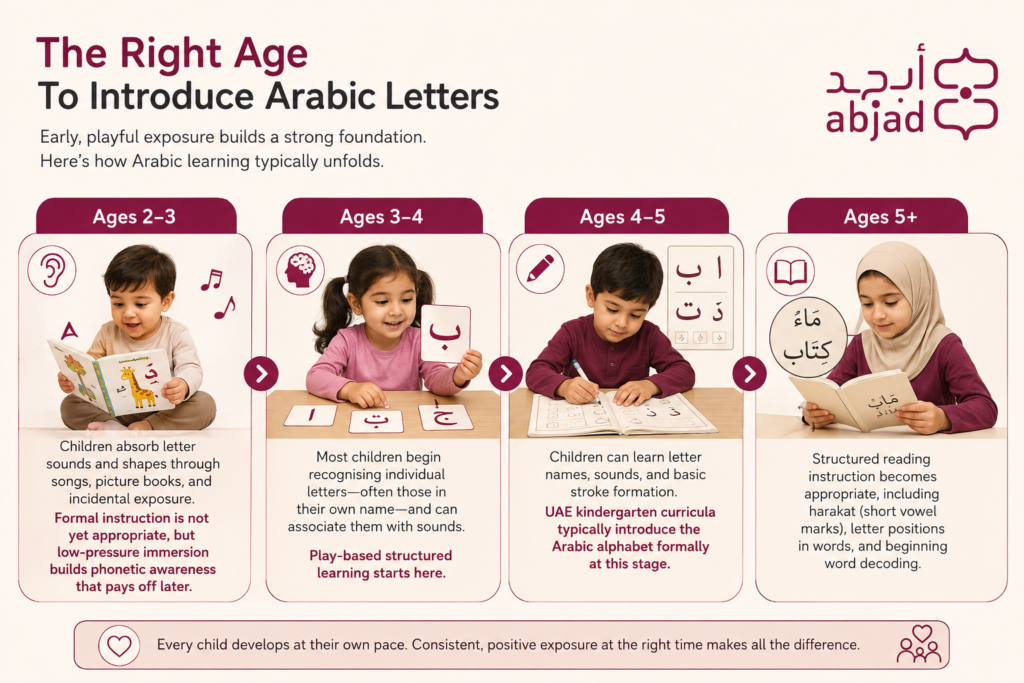
The Right Age To Introduce Arabic Letters
One of the most common questions UAE parents ask is when to begin Arabic alphabet instruction. The answer is less about a fixed age than it is about developmental readiness. The research consistently shows that early, playful exposure outperforms late, pressured instruction by a significant margin.
Here is how the developmental picture typically unfolds for children in the UAE:
- Ages 2–3: Children absorb letter sounds and shapes through songs, picture books, and incidental exposure. Formal instruction is not yet appropriate, but low-pressure immersion builds phonetic awareness that pays off considerably later.
- Ages 3–4: Most children begin recognising individual letters — often those in their own name — and can associate them with sounds. Play-based structured learning starts here.
- Ages 4–5: Children can learn letter names, sounds, and basic stroke formation. UAE kindergarten curricula typically introduce the Arabic alphabet formally at this stage.
- Ages 5 and above: Structured reading instruction becomes appropriate, including harakat (short vowel marks), letter positions in words, and beginning word decoding.
A. Ages 3 to 4 — Learning Through the Body Before the Page
At this age, multi-sensory engagement produces results that worksheets simply cannot match. A three-year-old asked to trace letters repeatedly will disengage within minutes. The same child asked to press playdough into the shape of ب, or trace م in a sand tray, will stay absorbed — and retain it far longer.
Three practical activities with strong track records at this age:
- Playdough modelling: forming the curves and dots of each letter with their hands builds motor memory alongside visual recognition simultaneously
- Sand tray writing: tracing letters with a finger in a shallow tray of sand engages touch, movement, and sight at the same moment
- Letter hunts: hiding letter cards around a room and asking children to find a specific one turns reading readiness into an actual game
The common thread across all three: multiple senses engaged simultaneously create stronger, more durable memory traces than visual exposure alone. A child who has shaped the letter ف with their fingers has a physical memory of it, not just a visual one.
Read also:Fun Ways for Kids to Learn Egyptian Arabic
B. Ages 5 And Above Move From Recognition To Active Reading
Once a child reliably recognises the 28 letters, the next layer is the harakat system — the short vowel markings that sit above and below letters and tell the reader how each syllable is pronounced. The three core marks are the fatha (ـَ), damma (ـُ), and kasra (ـِ), producing the vowel sounds /a/, /u/, and /i/ respectively.
A common and costly error at this stage is removing harakat too early. Children who learn to decode with full vowel markings and then lose them before consolidation tend to plateau and regress. UAE school curricula keep harakat in early readers for good reason — they scaffold decoding.
For children learning How To Read Arabic Letters In The UAE school setting who encounter difficulty specifically with vowel recognition, the issue is almost always insufficient practice with vocalised texts rather than a deeper learning difficulty.
Enroll Now in our Abjad Academy Course of Arabic Speaking

Proven Approaches That Make Learning Stick Without The Frustration
The most effective Arabic letter instruction is not necessarily the most intensive. What matters is whether the method links the abstract — a letter shape — to something concrete: a sound, an image, a movement, or a story. Methods that skip this link produce children who can perform the alphabet sequence on demand but cannot use it to read.
One practitioner observation that holds up consistently across UAE classrooms: rotating between three or four different activities outperforms relying on any single approach, even a genuinely engaging one.

A. Play and Sensory Activities That Build Real Recognition
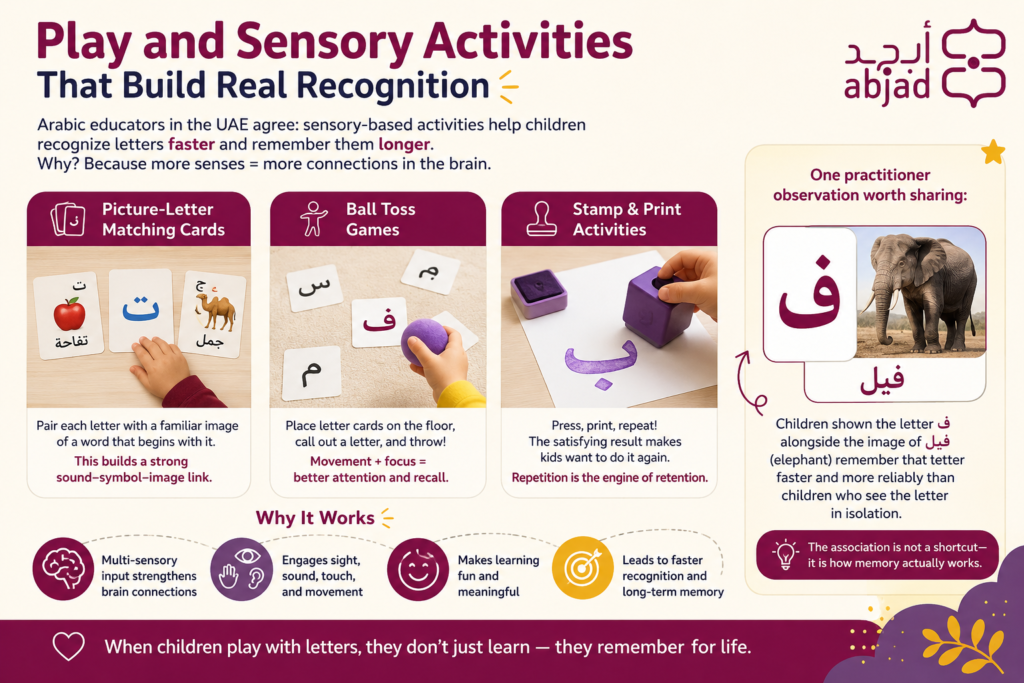
Arabic educators working with young children in the UAE consistently report that sensory-based activities produce faster and more durable letter recognition than paper-based methods alone. The neurological reason is straightforward: multi-sensory input creates more neural connections per piece of information, making retrieval easier later.
Activities with strong track records for Arabic letter learning:
- Picture-letter matching cards: pairing each letter with an image of a familiar word beginning with that letter creates a sound-symbol-image link — the image is not decoration, it is part of the memory structure
- Ball toss games: letter cards placed on the floor, with children throwing toward the one called out — physical movement reinforces attentional focus
- Stamp and print activities: pressing letter-shaped stamps produces a result children want to repeat, and repetition is the engine of retention
One practitioner observation worth sharing: children shown the letter ف alongside the image of a فيل (elephant) remember that letter faster and more reliably than children who see the letter in isolation. The association is not a shortcut, it is how memory actually works.
Read also: Fun Arabic Games For Kids
B. Songs, Stories, And The Power Of Rhythm In Arabic Letter Learning
Arabic has a rich tradition of educational songs and rhymes built around the alphabet, and the reason is straightforward. A short alphabet nasheed repeated daily for two weeks creates cumulative exposure that deliberate study sessions rarely replicate.
Story-based learning adds another layer. Anchoring each letter to a short narrative — a character named بلال who begins with ب, or a garden scene built around the letter ج — gives meaning to the symbol. Meaning is what separates a letter a child truly knows from one they can only recite.
For UAE families whose schedules or location make in-person classes difficult, exploring how to learn to read Arabic online for free can surface structured digital programmes with qualified teachers — a useful bridge toward or supplement to formal instruction rather than a permanent replacement.
Abjad Institute‘s Arabic course for kids integrates song-based, story-based, and activity-based learning into a structured curriculum designed specifically for young learners in the UAE context.
Book Your Kid’s Spot Before Camps Fill Up
From Learning The First Arabic Letter To Learning The Quran
It is the entry point to the Quran, to prayer, to Islamic scholarship, and to seventeen centuries of tradition recorded in this script. The Arabic of the Quran is Classical Arabic — fully vowelled, phonetically precise, and governed by the rules of tajweed (correct recitation). This distinction matters enormously for how alphabet instruction should be structured from the very beginning.
Quranic recitation demands a phonetic precision — particularly for the emphatic letters ص، ض، ط، ظ and the guttural letters ع، غ، ح، خ — that general literacy programmes do not always develop.
A. Tajweed Foundations Begin Earlier Than Most Parents Realise
Children who grow up hearing Arabic letters pronounced correctly — including the subtle distinctions between ت and ط, or between ذ and ز — develop an ear for these sounds that later formal tajweed instruction simply refines rather than creates from scratch.
Parents researching how to read Arabic Quran in the UAE for their children should prioritise finding a teacher or programme that models correct tajweed phonetics from the very first lesson — not as an added extra but as the default standard.
The phonetic habits formed at ages four and five are significantly more natural to maintain than those introduced at nine or ten, when other linguistic patterns are already established. The benefits of learning Quranic Arabic extend beyond religious practice. Children with strong Quranic Arabic foundations have been found to perform better in Modern Standard Arabic literacy as well.
Master the Language of the Quran with the first free session of our Quranic Arabic course
B. Making Arabic Visible in Daily UAE Life
The UAE’s multilingual environment offers an advantage for Arabic literacy development that many families underuse. Arabic appears everywhere — on road signs, product labels, restaurant menus, government buildings, and WhatsApp messages from grandparents — yet in many households, it passes by unnoticed.
Building a simple daily habit of pointing out Arabic letters in the environment costs nothing and yields consistent returns over time. Ask your child to find the first letter on a road sign, identify the sound made by the beginning of a favourite brand name, or tell you which letter a street name starts with.
This grounds classroom instruction in lived experience — one of the most durable drivers of long-term literacy. For children drawn to Arabic through its visual dimension, introducing them to how to read Arabic calligraphy can be a surprisingly effective gateway.
The geometric elegance of Arabic script captivates many children who resist more structured study, and the calligraphic focus on letter form deepens visual recognition in ways that standard instruction alone does not.
Take the first step to meet Our Arabic and Quran Dedicated & Experienced Teachers
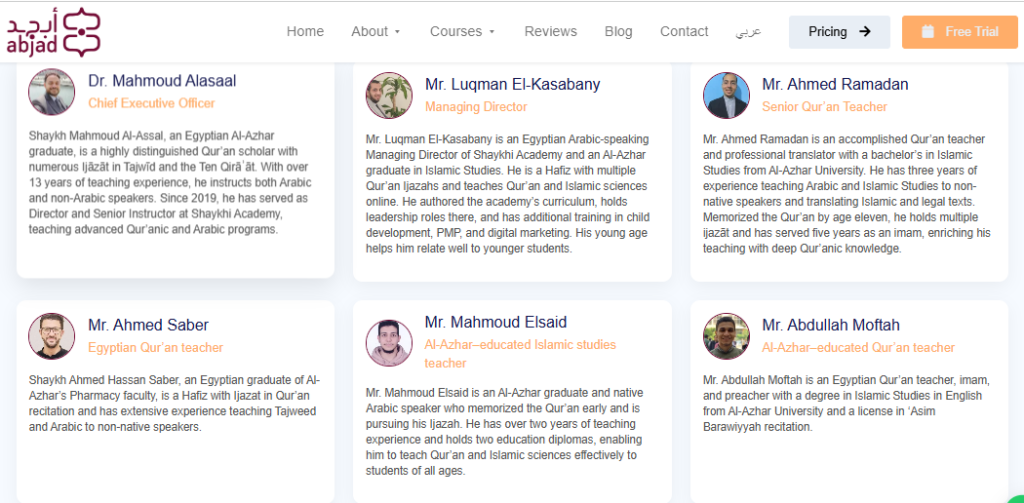
Inside Our Live Classes
Don’t just take our word for it—see for yourself! Click below to watch short clips from our live classes and meet the instructors who will guide your learning journey.
Begin Your Arabic Journey in the UAE
Join Abjad Institute for a professional and immersive Arabic language experience tailored to your goals.
Book Your Free TrialAbjad Institute Where UAE Families Build Lasting Arabic Literacy
Abjad Institute is a UAE-based Arabic language institute with a curriculum designed from the ground up for families living in this multilingual environment. Its teachers are specialists in Arabic literacy for children and its programmes run from kindergarten foundations all the way through to advanced classical and Quranic study.
Whether your child is starting from absolute zero, is a heritage speaker who understands Arabic but has never formally learned to read it, or is preparing specifically for Quranic study, Abjad has a structured pathway built around their needs.
Small class sizes, individualised progress tracking, and instruction anchored in how UAE children actually develop language make Abjad the first call for families who want results that last.
Discover Our Arabic Courses:
Discover Our Arabic Courses
- Arabic Course in the UAE
- Arabic Intensive Course
- Learn Arabic from Scratch Course
- Madinah Arabic Course
- Arabic Classes for Adults
- Arabic Classes for Beginners
- Self-Paced Arabic Course
- Basic Arabic Course
- Arabic Speaking Classes
- Learn to Write Arabic Course
- Arabic Grammar Course
- Learn Arabic Alphabet Course
Start your Arabic course at Abjad Institute today with a Free Trial

Conclusion
Teaching the Arabic alphabet to children is a task that rewards consistency and the right method far more than sheer effort. The 28 letters are not merely symbols — they are the gateway to reading, to the Quran, to Emirati culture, and to a language spoken by more than 420 million people worldwide.
For parents still working out the practical details — which programme to choose, how to sequence instruction, or when to move from recognition to word-level reading — finding guidance specific to how to read Arabic in the UAE context, rather than generic materials designed elsewhere, makes a meaningful difference in outcomes.
Once reading begins to consolidate, writing naturally follows. Understanding how to write in Arabic in the UAE — the correct stroke order, directionality, and the way letters join in continuous script — is best introduced through guided instruction from early on, because handwriting habits formed in childhood are stubbornly resistant to correction once established.
Frequently Asked Questions
When should children in the UAE start learning the Arabic alphabet?
Children are ready for playful, informal exposure to Arabic letters from around age three. Structured instruction, where children learn letter names, sounds, and their positions within words, is typically appropriate from age four or five, which aligns with UAE kindergarten expectations.
How many letters does the Arabic alphabet have?
The Arabic alphabet has 28 letters in the standard hija’i order, from ألف (Alef) to ياء (Ya). Each letter can appear in up to four distinct visual forms depending on its position within a word. Some scholars count the hamza as a 29th independent letter, though 28 is the count used in most educational settings in the UAE and across the Arab world.
How long does it take a child to learn to read Arabic?
With consistent daily practice, most children aged four to five can recognise all 28 letters within three to six months. Progressing from letter recognition to basic reading fluency — including short vowel marks and word decoding — typically takes a further six to twelve months.
Is Quranic Arabic different from standard Arabic literacy?
The letters are the same, but the phonetic precision expected in Quranic recitation is considerably higher than in general Arabic literacy. Children whose goal is Quranic reading benefit from starting with a Quranic-oriented programme such as the Qaida Nourania from the very beginning, building phonetic accuracy from the first lesson rather than attempting to adjust habits acquired through a different approach.
Can children learn the Arabic alphabet effectively through online programmes?
Yes, particularly when those programmes are delivered by qualified human teachers rather than self-directed apps. Online instruction works well both as a primary format and as a supplement to in-person classes, and the range of structured options has grown considerably. The key criterion is teacher quality and structured progression, not platform.
What is the most effective method for teaching young children Arabic letters?
Multi-sensory, play-based approaches — combining sound, movement, and visual input — consistently outperform worksheet-based memorisation for children under six. The evidence from Arabic literacy educators in the UAE points clearly toward rotating between songs, sensory activities, and matching games rather than relying on any single method.




Leave a Reply