 Learn Arabic
Open any page of the Quran and you will meet a command within seconds — iqraʾ, udʿu, iʿdilū. The imperative verb in Arabic is not a decorative corner of grammar; it is the voice the language uses to instruct, advise, and call.
Yet it is also the verb that trips learners fastest. It changes shape without warning, drops letters you expected to stay, and never carries the case endings you spent weeks memorising.
At Abjad Academy, we teach this topic the way native grammarians did: one rule, one reason, one worked example — until the pattern becomes automatic rather than memorised.
By the end of this guide you will be able to build a command from any verb, parse it correctly, and recognise all four of its grammatical disguises.
Key Highlights of This Article:
- The precise definition of the command verb and why it is always indeclinable.
- The step-by-step method for deriving a command from the present tense.
- All four building cases, each with parsing (iʿrāb) examples.
- A practical Arabic imperative verbs list with full pronoun conjugation.
- The most common learner errors and how to avoid them.
What Is The Imperative Verb In Arabic?
The imperative verb in Arabic is a verb used to request that an action be performed after the moment of speaking — that is, in the future. It is one of the three divisions of the Arabic verb, alongside the past and the present.
The Grammatical Definition of the Arabic Imperative
Classical grammarians define it as ṭalab al-fiʿl ʿalā wajh al-istiʿlāʾ: requesting an action from a position of authority or seniority. The action must not already exist before the request is made.
Look at these examples: اكتبْ الدرسَ (write the lesson), أطعِمْ الفقيرَ (feed the poor), اشربْ الماءَ (drink the water). Each one asks for something not yet done.
The same root carries a wide semantic range beyond grammar — from amara (to command) to imārah (leadership).
Why the Imperative Verb Is Always Mabni
Unlike the present tense, the command verb never takes case endings. It is mabni — fixed — in every single situation, without exception.
This is a gift, not a burden. Instead of tracking nominative, accusative and jussive states, you only need to identify which of four fixed endings applies.
The rule that governs the choice is elegant: the imperative is built on whatever its present-tense counterpart is made jussive with. Master jussive markers, and you have mastered this verb.

How to Form the Arabic Imperative From the Present Tense
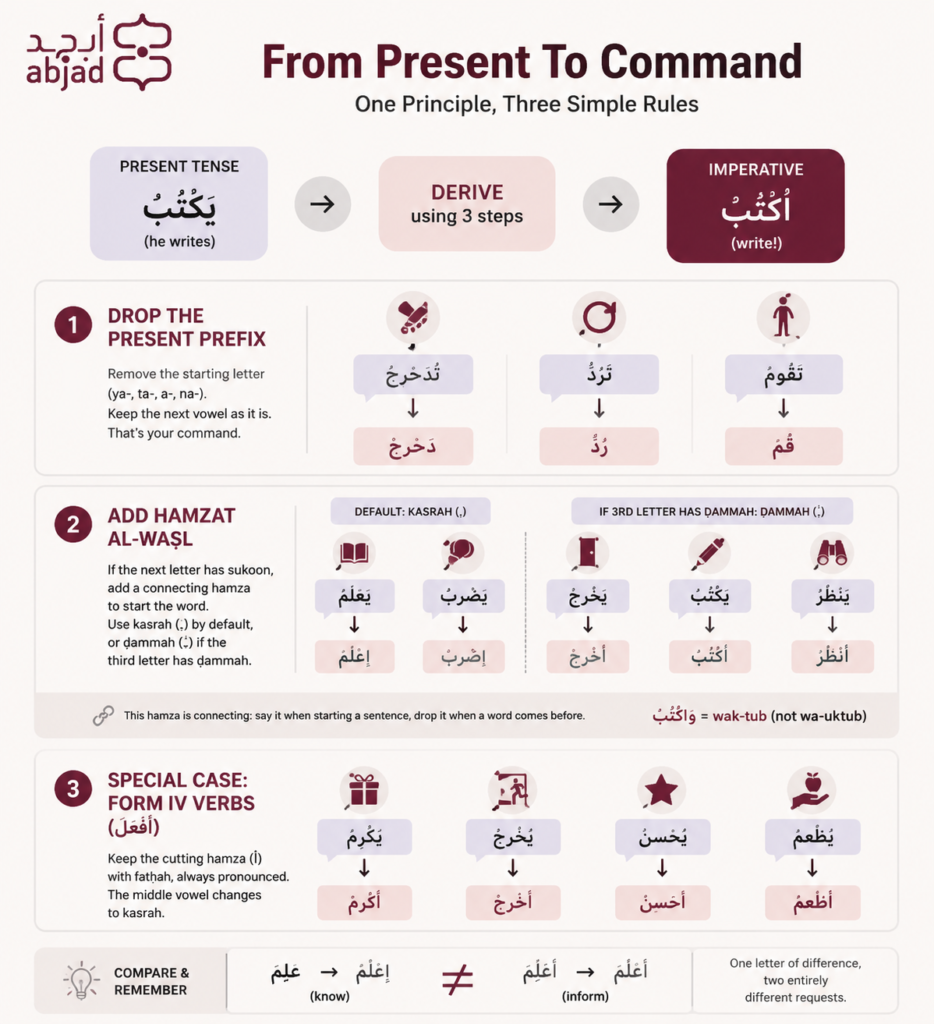
Every command in Arabic is derived from the present tense, because the present is the form that points to future time — and a command is always about the future. This single principle saves you from memorising a separate command form for every verb you meet.
The derivation is a fixed three-step procedure, and it works identically on sound verbs, weak verbs, and augmented patterns.
1. Remove The Present-Tense Prefix
Begin by removing the prefix letter (ya-, ta-, a-, na-), since that letter belongs to the present tense alone and carries no meaning in a command.
If the letter that follows is already vowelled, keep that vowel exactly as it is and stop — no addition is needed: تُدَحْرِجُ → دَحْرِجْ، تَرُدُّ → رُدَّ، تَقُومُ → قُمْ.
This is the shortest branch of the rule and covers most quadrilateral verbs, doubled verbs, and hollow verbs. Notice that the final ḍammah of the present tense disappears with it, because the command is indeclinable and cannot carry that ending.
A quick self-check: read the remaining word aloud. If you can pronounce it comfortably from the first letter, your command is complete.
2. Add Hamzat Al-Wasl When the Verb Starts With A Sukoon
If the letter after the prefix carries a sukoon, Arabic cannot begin the word with it — no Arabic word starts with a silent letter — so a connecting hamza (hamzat al-waṣl) is added as a launching pad.
This hamza takes a kasrah by default: عَلِمَ يَعْلَمُ → اِعْلَمْ، ضَرَبَ يَضْرِبُ → اِضْرِبْ، جَلَسَ يَجْلِسُ → اِجْلِسْ.
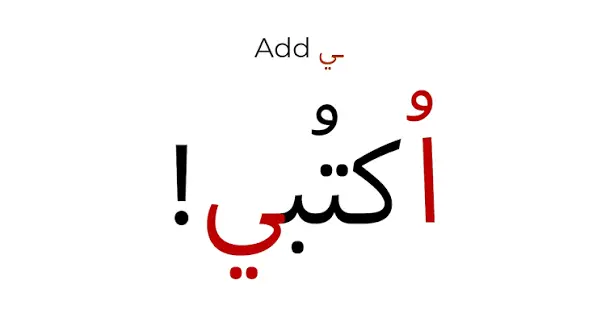
The one exception is when the third letter of the word carries a ḍammah; the hamza then follows suit for ease of pronunciation: خَرَجَ يَخْرُجُ → اُخْرُجْ، كَتَبَ يَكْتُبُ → اُكْتُبْ، نَظَرَ يَنْظُرُ → اُنْظُرْ.
Remember that this hamza is connecting, not cutting: it is pronounced when the word starts a sentence and dropped entirely when a word precedes it — وَاكْتُبْ is read wak-tub, not wa-uktub.
Three steps take three minutes to read and three weeks to master alone — or three intensive sessions with a tutor. Fast-track every verb rule in our Arabic Intensive Course in the UAE and stop rebuilding the same forms from scratch.
3. Form Iv Verbs (أَفْعَلَ) Imperatives and Hamzat Al-Qatʿ
Verbs of the pattern afʿala behave differently: they keep a cutting hamza (hamzat al-qaṭʿ) with a fatḥah, and it is pronounced in every position, whether the word opens the sentence or follows another word.
The middle vowel also shifts to a kasrah: أَكْرَمَ يُكْرِمُ → أَكْرِمْ، أَخْرَجَ يُخْرِجُ → أَخْرِجْ، أَحْسَنَ يُحْسِنُ → أَحْسِنْ، أَطْعَمَ يُطْعِمُ → أَطْعِمْ.
Learners routinely write اكرم with a connecting hamza here, which changes the verb from Form IV to a different pattern altogether and alters the meaning. A useful test: if the past tense begins with a vowelled hamza (أَ), the command does too.
Compare the two side by side to lock the distinction in: عَلِمَ → اِعْلَمْ (know) versus أَعْلَمَ → أَعْلِمْ (inform). One letter of difference, two entirely different requests.
If you have already worked through weak and doubled roots, our breakdown of Quranic Grammar – The Complete Guide to Understanding the Language of the Quran shows how these patterns behave across all three tenses.
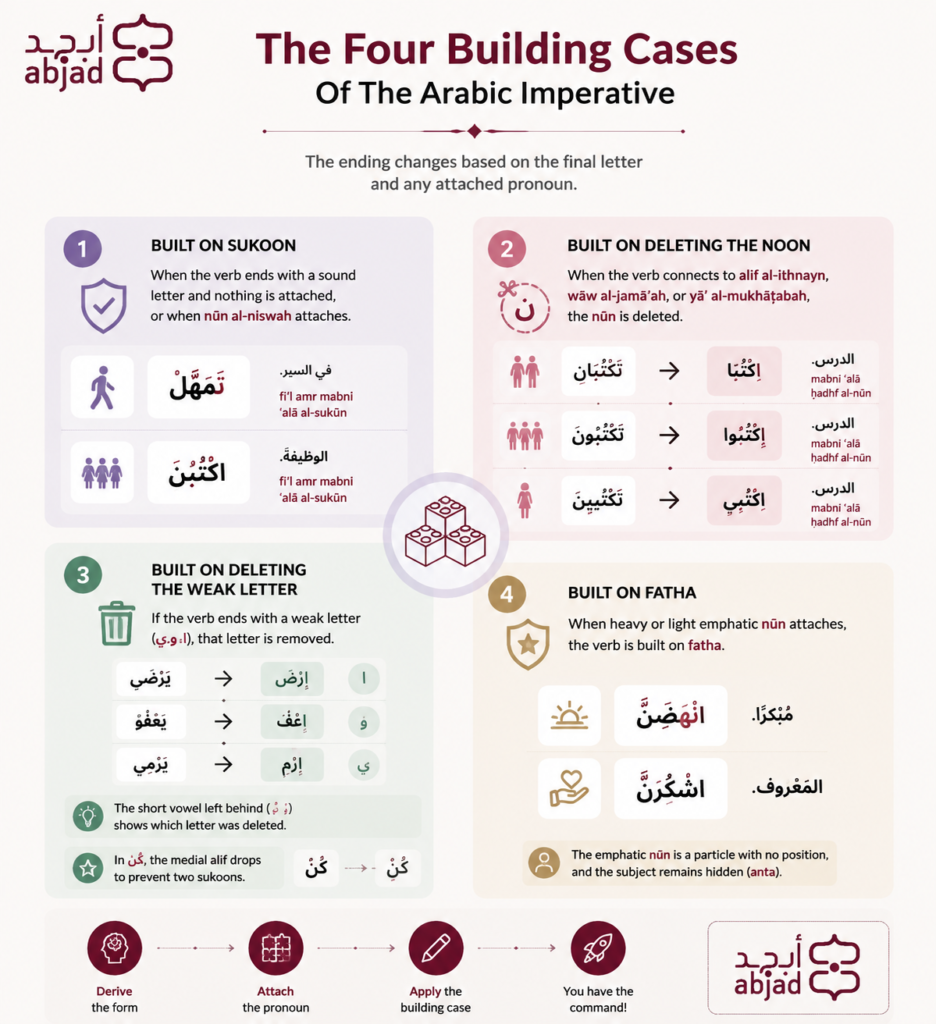
The Four Building Cases Of The Arabic Imperative Verb
Once the form is derived, you need its ending. Every imperative verb in Arabic is built on exactly one of four endings, decided entirely by the verb’s final letter and any attached pronoun.
1. Imperative Verbs Built On Sukoon
This applies when the verb has a sound final letter and nothing is attached to it: تمهّلْ في السير. Parsing: fiʿl amr mabni ʿalā al-sukūn.
It also applies when the feminine plural nūn al-niswah attaches directly: اكتبْنَ الوظيفةَ. Here the nūn is an attached pronoun in the place of the subject.
2. Imperative Verbs Built On Deleting The Noon
When the verb connects to the dual alif, the plural wāw, or the feminine singular yāʾ, the nūn of the present tense disappears:
- تكتبان → اكتُبَا الدرسَ (dual)
- تكتبون → اكتُبوا الدرسَ (masculine plural)
- تكتبين → اكتُبي الدرسَ (feminine singular)
In all three, the parsing is mabni ʿalā ḥadhf al-nūn, with the attached pronoun functioning as the subject.
3. Imperative Verbs Built On Deleting The Weak Letter
If the verb ends in a weak letter (ا، و، ي), that letter is removed: يرضى → ارضَ، يعفو → اعفُ، يرمي → ارمِ.
Notice the short vowel left behind — fatḥah, ḍammah, kasrah — which signals the deleted letter. A related adjustment happens in كُنْ, where the medial alif drops to prevent two consecutive sukoons.
Read also: How To Memorize Arabic Verb Forms? – Patterns, Examples, and Study Plan
4. Imperative Verbs Built On Fatha
When either the heavy or the light emphatic nūn attaches, the verb is built on fatḥah: انْهَضَنَّ مبكرًا، اشْكُرَنَّ المعروفَ.
The emphatic nūn is a particle with no grammatical position, and the subject remains an obligatorily hidden pronoun (anta).
A fuller treatment of these building cases is available on the Arabic Wikipedia entry for the command verb.
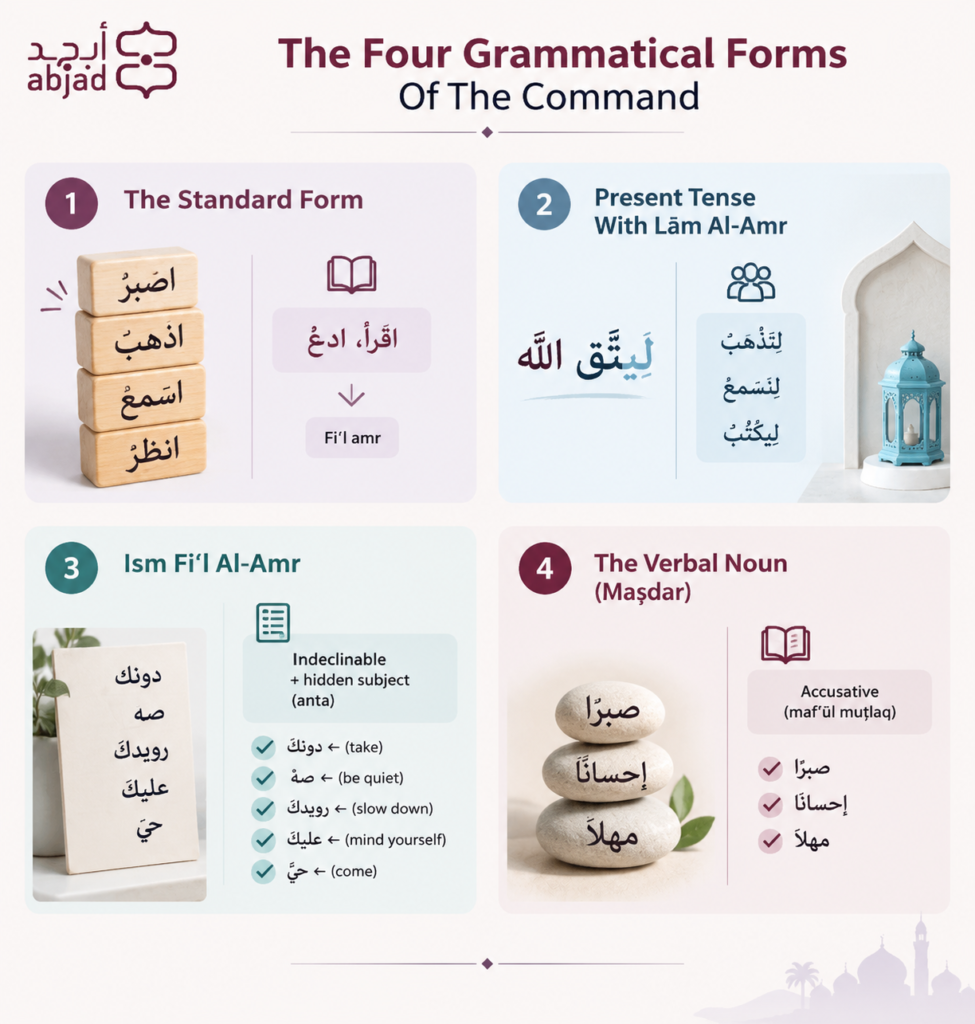
The Four Grammatical Forms Used to Express Commands in Arabic
A command is not always a command-shaped word. Arabic expresses instruction through four distinct constructions, and recognising them is essential for reading classical texts and Quranic verses accurately.
Miss one of these and you will misread the sentence entirely — treating an instruction as a description, or a noun as a stray object. Each form below carries the same meaning but a different structure and a different parsing.
1. The Standard Arabic Imperative Form
The direct ifʿal pattern is the original and by far the most frequent construction: اصبرْ، اذهبْ، اسمعْ، اُنظرْ.
This is the only one of the four that is a genuine command verb; the remaining three are substitutes that carry its meaning. Its parsing is always fiʿl amr mabni, followed by whichever of the four building endings applies.
You will find it dominating Quranic address: اقرأْ باسم ربك، اُدعُ إلى سبيل ربك بالحكمة. In udʿu, the weak wāw has been deleted, so it is built on deleting the weak letter.
Because this form is the default, make it your reference point — the other three are best learned by contrast with it.
2. Commands Using the Present Tense With Lām Al-Amr
A jussive particle lām attaches to the present tense and converts it into a command: وَلْيَتَّقِ اللهَ رَبَّهُ، لِتَذْهَبْ، لِنَسْمَعْ.
The lām is an indeclinable particle with no grammatical position, and the verb after it becomes jussive by its normal marker — sukoon, deleting the nūn, or deleting the weak letter, as in yattaqi above.
Its real value is that it reaches beyond the addressee. While the direct form speaks only to “you”, this construction issues commands to the absent third person and even to the speaker: لِيَكْتُبْ الطالبُ (let the student write), لِنَبْدَأْ الآن (let us begin now).
Note the vowel shift: the lām is normally kasrah-vowelled, but takes a sukoon after وَ، فَ، or ثُمَّ — hence walyattaqi, not wa-liyattaqi.
3. Ism Fiʿl Al-Amr as a Command Form
A fixed noun carrying the meaning of a command, without being a verb at all: دونكَ الأوراقَ (meaning “take”), صهْ (be quiet), رويدكَ (slow down), عليكَ نفسَك (mind yourself), حَيَّ على الصلاة (come to prayer).
It is indeclinable in every position, its subject is an obligatorily hidden pronoun (anta), and it can take a direct object exactly as a real verb does — dūnaka al-awrāqa parses al-awrāqa as an accusative object.
These words are compact and emphatic, which is why they cluster in proverbs, the call to prayer, hadith, and classical poetry. Learners often mistake them for prepositions or adverbs and lose the sentence’s meaning.
The clearest test is substitution: if you can replace the word with a real command verb and the sentence still works, it is an ism fiʿl amr.
Watch Our Classes in Action
Curious what a real session looks like? Take a peek inside our interactive classrooms and see how our expert instructors bring the Arabic language to life. Watch a sample lesson below!
Begin Your Arabic Journey in the UAE
Join Abjad Institute for a professional and immersive Arabic language experience tailored to your goals.
Book Your Free Trial4. Using the Maṣdar to Express a Command
A verbal noun standing in for its verb and delivering the same instruction: صبرًا in place of iṣbir, إحسانًا in place of aḥsin, مهلًا in place of tamahhal.
Grammatically, the maṣdar is accusative because the verb it replaces has been deleted, so it is parsed as mafʿūl muṭlaq for a suppressed verb — which is precisely why it always appears with a fatḥah or tanwīn fatḥ.
The effect is intensity and brevity. صبرًا آل ياسر is far more forceful than a plain iṣbirū, which is why this form appears at moments of high emotional weight in speech and scripture.
Understanding this requires solid footing in noun cases and vowel endings — our guide to How To Read Arabic Without Harakat In The UAE covers exactly that ground.
Read also: Irregular Verbs In Arabic – Types, Rules, and Conjugation Patterns
Arabic Imperative Verbs and Pronoun Conjugation
The imperative verb in Arabic exists only for the addressee. It is never formed for the speaker (anā, naḥnu) or the absent third person (huwa, hiya, hum).
How Imperative Verbs Change Across Addressee Pronouns
The table below shows the verb دخل (to enter) built for each of the five addressee pronouns, so you can see exactly how the ending shifts as the attached pronoun changes.
| Pronoun | Command Form |
| أنتَ | اُدخُلْ |
| أنتِ | اُدخُلي |
| أنتما | اُدخُلا |
| أنتم | اُدخُلوا |
| أنتنَّ | اُدخُلْنَ |
Common Arabic Imperative Verbs to Learn
Start with commands you will actually use in speech, prayer, and reading:
- اكتبْ (write) · اقرأْ (read) · اسمعْ (listen) · انظرْ (look)
- افتحْ (open) · اغلقْ (close) · اجلسْ (sit) · قمْ (stand)
- خذْ (take) · ضعْ (put) · قلْ (say) · كنْ (be)
- ادعُ (call/supplicate) · اتقِ (fear God) · اصبرْ (be patient)
The Rare One-Letter Imperative Verbs in Arabic
Arabic contains around twenty commands reduced to a single letter, nearly all kasrah-vowelled: عِ (be aware), قِ (protect), فِ (fulfil), شِ (embroider), لِ (govern).
The sole exception is رَ (see), which carries a fatḥah. These are rare in speech but appear in classical poetry and lexicons.
A list you can read is vocabulary; a list you can command is fluency. Turn these verbs into real conversation with Abjad Academy’s Arabic Speaking Classes in the UAE, taught one-to-one by qualified native teachers.

Building a working Arabic imperative verbs list is far more effective than memorising isolated tables — pair it with our Classical Arabic Course and Modern Standard Arabic Course.
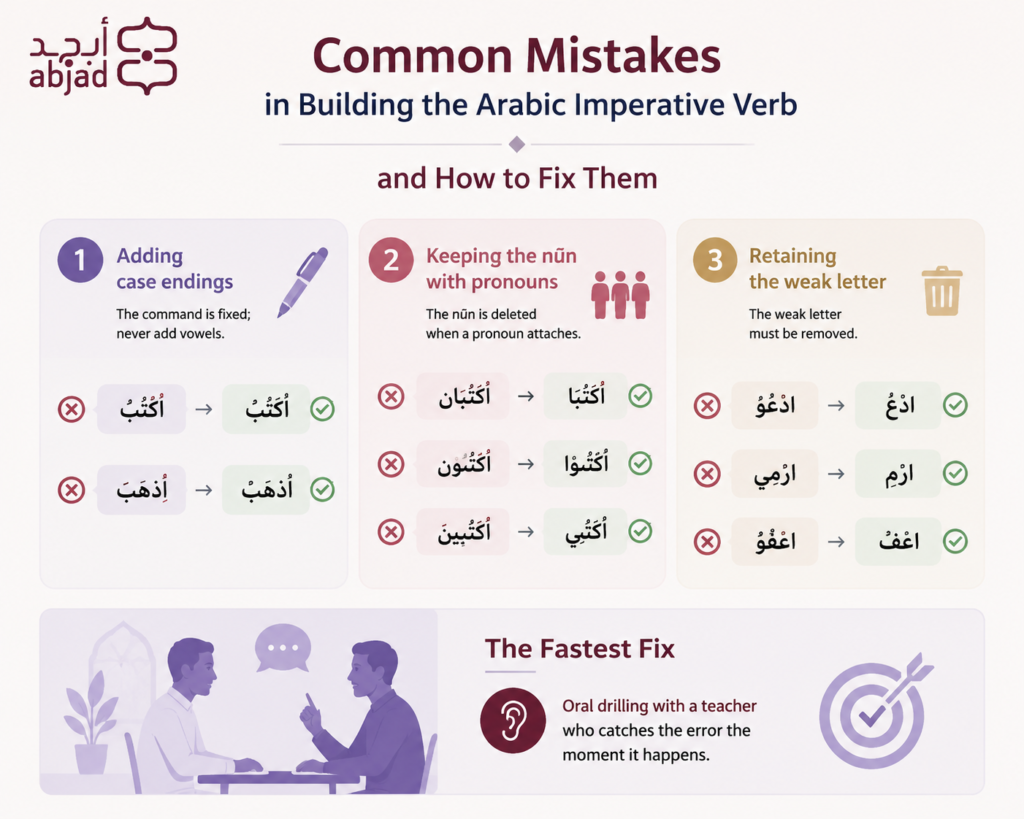
Common Arabic Imperative Verb Mistakes and How to Fix Them
Most errors with the imperative verb in Arabic come from three habits, and each has a quick fix.
- Adding case endings. The command is fixed; never write اكتبُ or اكتبَ without cause.
- Keeping the nūn with plural or feminine pronouns: اكتبوان is always wrong.
- Retaining the weak letter: it is ادعُ, never ادعو, and ارمِ, never ارمي.
The fastest correction method is oral drilling with a teacher who catches the error the moment it happens.
Read also: Arabic Hollow Verbs Guide For Arabic Learners In The UAE
Inside Our Live Classes
Don’t just take our word for it—see for yourself! Click below to watch short clips from our live classes and meet the instructors who will guide your learning journey.
Begin Your Arabic Journey in the UAE
Join Abjad Institute for a professional and immersive Arabic language experience tailored to your goals.
Book Your Free TrialHow Abjad Academy Helps You Master Arabic Grammar
Grammar rules are easy to read and hard to internalise. Abjad Academy exists to close that gap with structured, personal, application-focused instruction.
1. One-To-One Certified Teachers
Every class is private and live, with native-speaking, ijazah-holding instructors. Your errors are corrected instantly rather than reinforced silently over months of self-study.
Lessons are scheduled around your timezone and pace, whether you are a complete beginner or refining advanced parsing.

2. A Structured Grammar Path
Our Arabic Grammar Course in the UAE moves in a deliberate sequence — word types, verb tenses, building and inflection, then sentence analysis — so nothing arrives before you are ready for it.
Learners who want broader fluency alongside grammar can combine it with our Best Arabic Course in the UAE.

3. Quran-Based Application
Because commands dominate Quranic discourse, our Quranic Arabic courses applies every rule directly to verses you already recite.
The result is comprehension, not translation: you understand aqīmū al-ṣalāh as a plural command built on deleting the nūn — instantly, while you read.

Read also: How to Learn Arabic? A Step-by-Step Guide for UAE Residents
Conclusion
The command verb is defined by a request for future action, derived from the present tense by dropping its prefix, and built on one of four fixed endings: sukoon, deleted nūn, deleted weak letter, or fatḥah.
It appears in four constructions — the direct form, the present with lām al-amr, ism fiʿl al-amr, and the substitute verbal noun — and is conjugated only for the five addressee pronouns.
The ultimate takeaway is this: the imperative verb in Arabic is the most predictable verb in the language once you stop memorising forms and start reading their reasons.
Start Speaking Arabic In Commands, Not Guesses!
You have the complete rule set. What turns rules into fluency is guided, corrected, consistent practice with someone who knows exactly where learners stumble.
Abjad Academy offers a free trial class with a certified native teacher — no commitment, no payment details, just a real lesson in which you build, parse, and pronounce Arabic commands yourself.
Explore our list of courses here:
- Learn to Write Arabic Course in the UAE
- Teen Arabic Summer Course in the UAE
- Emirati Arabic Course in the UAE
- Classical Arabic Course in the UAE
- Arabic Intensive Course in the UAE
- Self-Paced Arabic Course in the UAE
Choose your track today: the Arabic Grammar Course for systematic mastery, or the Quranic Arabic Course to apply every rule directly to the Book. Book your free trial class with Abjad Academy now.

Frequently Asked Questions
Is The Imperative Verb In Arabic Ever Declinable?
No, it is indeclinable in every case, with only its ending changing according to four fixed rules. Abjad Academy’s grammar teachers drill these four cases until parsing becomes instant.
How Do I Know Whether To Use A Connecting Or Cutting Hamza?
Verbs of the afʿala pattern take a cutting hamza with fatḥah; all others take a connecting hamza. Our tutors correct this distinction live, which is far faster than self-review.
Can Commands Be Formed For “He” Or “We”?
No, direct commands exist only for the addressee, though lām al-amr expresses indirect commands for others. Abjad Academy’s structured lessons cover both constructions with Quranic examples.
What Is The Fastest Way To Memorise An Arabic Imperative Verbs List?
Learn verbs in context through recitation and conversation rather than isolated tables. Abjad Academy builds vocabulary through applied Quranic and conversational practice.
Do I Need Grammar To Understand The Quran?
Yes, most Quranic instruction comes in command form, and misreading the ending changes the meaning. Our Quranic Arabic Course connects every grammar rule to verses you already recite.
Are The Classes Suitable For Complete Beginners?
Absolutely, lessons start from letters and word types and progress at your own pace. Abjad Academy assigns each student a teacher matched to their exact level and goals.
Related Articles
Learn Arabic






Leave a Reply