 Learn Arabic

Walk through any street in Dubai or Abu Dhabi and Arabic is everywhere — on road signs, government buildings, school uniforms, restaurant menus, and metro stations. For many residents and students in the UAE, reading that script feels both urgent and intimidating. The question comes up constantly: how hard is it to read Arabic in the UAE, really?
The honest answer is this: Arabic reading has specific, identifiable challenges — but the UAE is one of the best places on earth to work through them. The language surrounds you daily, which means every challenge in this list also comes with a real-world practice opportunity right outside your front door.
1. Arabic Uses a Completely Different Alphabet
The very first challenge when learning to read Arabic in the UAE is the script itself — and it starts with a clean break from everything familiar.
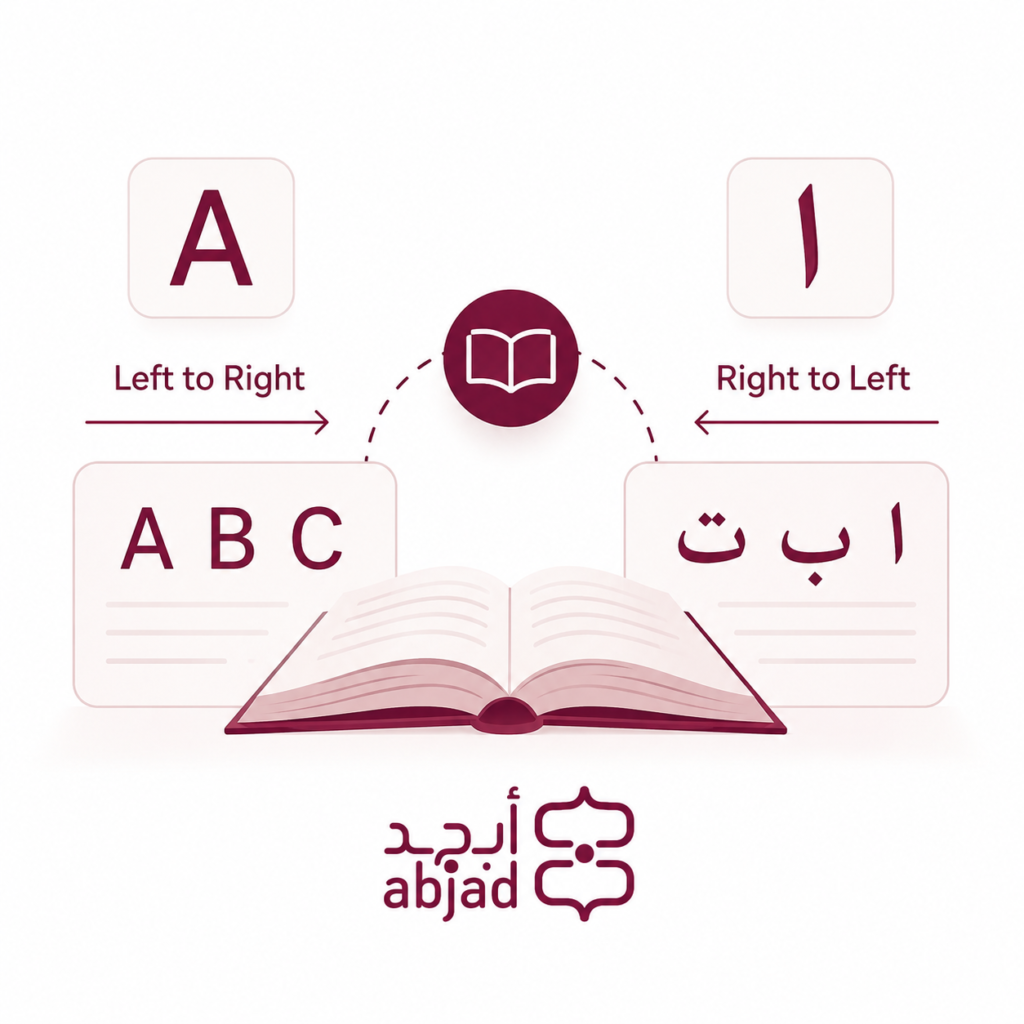
Arabic uses its own alphabet of 28 letters, entirely unrelated to the Latin alphabet used by English, French, and most European languages. There are no shared letters, no visual borrowings, and no phonetic shortcuts. Every single character must be learned from scratch, and the script runs right to left — the opposite direction to English.
For UAE residents surrounded by bilingual signage, this contrast is visible everywhere. Road signs display Arabic and English side by side, which helps with orientation, but it does not shorten the learning process.
Here is what new readers are working with from day one:
| Feature | English Alphabet | Arabic Alphabet |
| Number of letters | 26 | 28 |
| Reading direction | Left to right | Right to left |
| Shared letters with Latin script | — | None |
| Letters connect in writing | No | Yes (most letters) |
| Visual forms per letter | 1 | Up to 4 |
The good news: 28 letters is a manageable starting point. With 15–20 minutes of daily practice, most learners recognise all 28 letters within three to four weeks. The Arabic courses at Abjad Institute begin exactly here — building confident letter recognition before any reading practice begins.
Start Your Arabic Learning Journey with a FREE Trial Class in the UAE.
2. Letters Change Shape Depending on Their Position in the Word
Even after you learn all 28 letters, Arabic adds a layer that surprises most new readers.
Each Arabic letter has up to four different visual forms: isolated, initial (start of a word), medial (middle of a word), and final (end of a word). The letter ع, for example, looks noticeably different depending on where it sits. So does ف, ك, and most others.
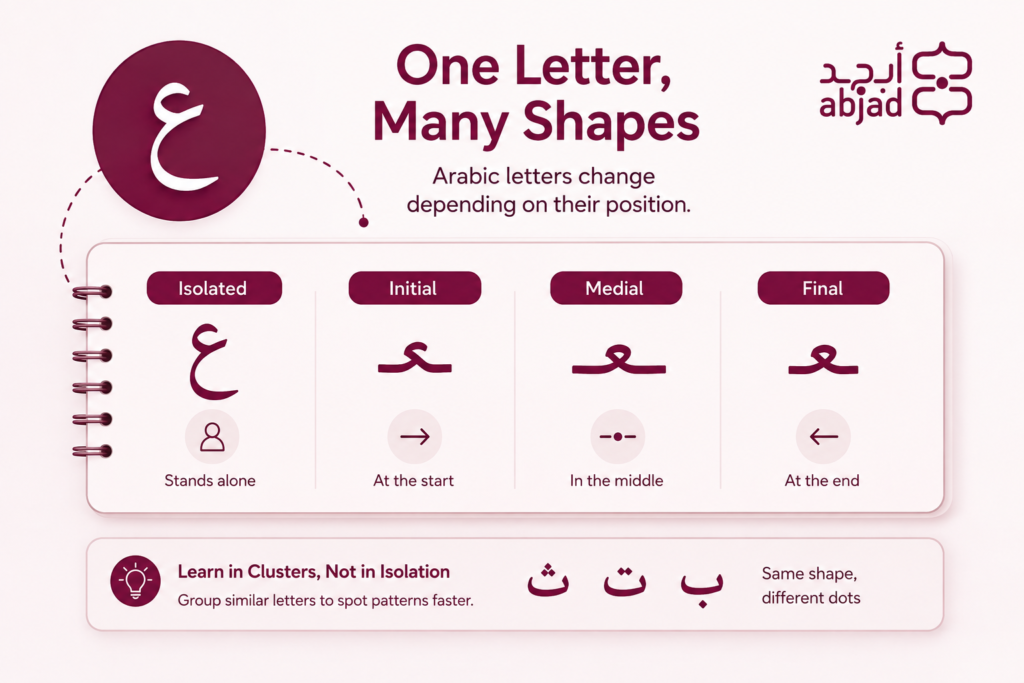
This means that learning 28 letters in isolation only gives you a quarter of the reading picture. You effectively need to recognise up to four versions of each letter to read connected text — the kind that appears on every road sign, official document, and building name across the UAE.
The most effective approach is to learn letters in connected clusters from the beginning, not in isolation. Grouping similar-letter families — like ب، ت، ث (which share the same body shape and differ only in dots) — builds pattern recognition faster than rote memorisation letter by letter.
3. Most Arabic Text You See in the UAE Has No Vowel Markings
This is the challenge that most Arabic courses and apps fail to mention early enough — and it is the one that surprises learners most sharply once they encounter real UAE text.
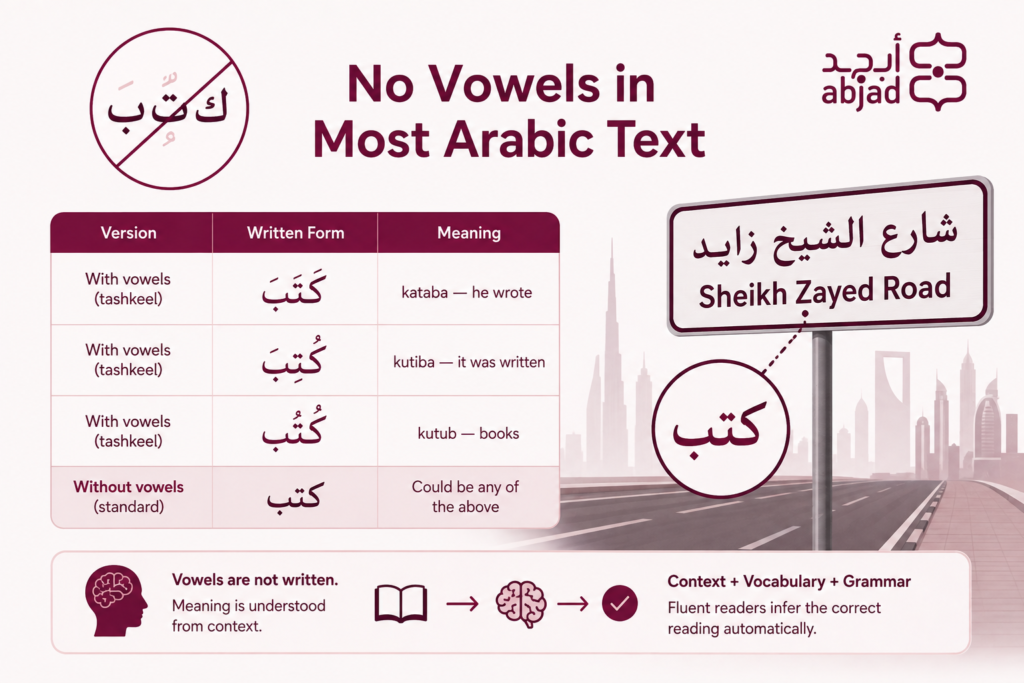
Written Arabic normally omits short vowels. The small diacritical marks called harakat or tashkeel — which sit above and below letters to indicate vowel sounds — appear in the Quran, beginner books, and some educational materials. They do not appear on road signs, government forms, restaurant menus, newspaper headlines, or most everyday written text anywhere in the UAE.
To illustrate the difference:
| Version | Written Form | Meaning |
| With vowels (tashkeel) | كَتَبَ | kataba — he wrote |
| With vowels (tashkeel) | كُتِبَ | kutiba — it was written |
| With vowels (tashkeel) | كُتُب | kutub — books |
| Without vowels (standard) | كتب | Could be any of the above |
A fluent reader infers the correct reading from context, vocabulary, and grammar — simultaneously, while reading. A beginner cannot do this yet.
In practical UAE terms: you can recognise every letter on a road sign perfectly and still be unable to read it correctly, because the vowels that make the word pronounceable are not written there. This is how adult Arabic literacy works — which is why reading fluency cannot be separated from language learning itself.
If you’re still wondering how hard it is to read Arabic in the UAE, the next challenges explain why many beginners continue to struggle even after they’ve learned the alphabet and understand basic reading rules.
Read Also: Is It Compulsory to Read Quran in Arabic?
4. Some Letters Look Almost Identical and Are Easy to Confuse
Arabic has several letter groups that share the same base shape and differ only in the number or position of small dots above or below them.
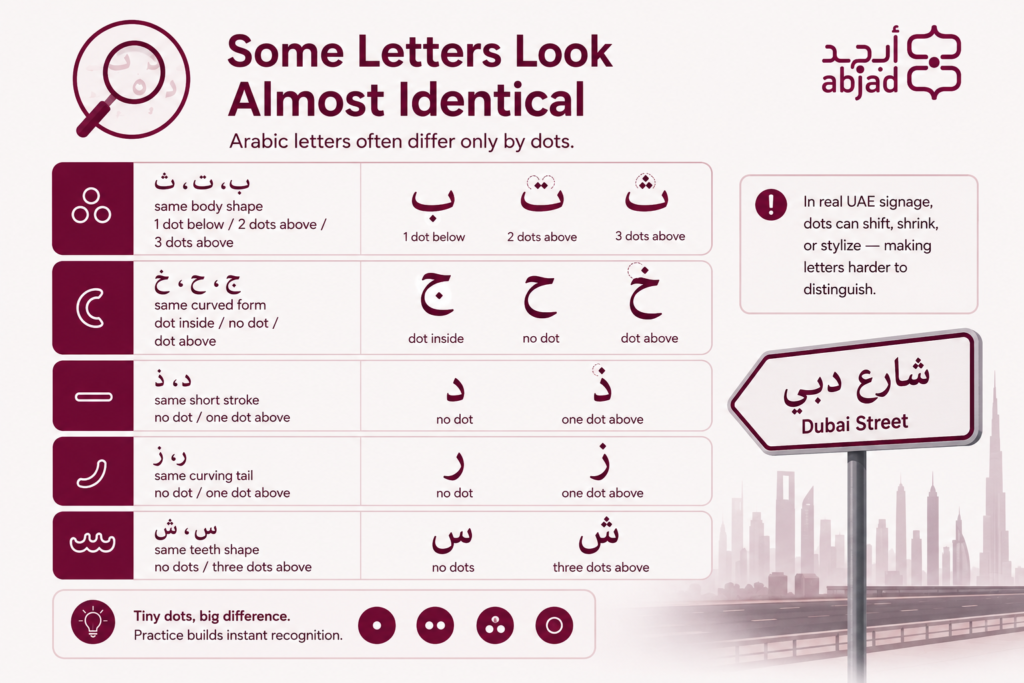
The most commonly confused groups for new readers in the UAE:
- ب، ت، ث — same body shape, 1 dot below / 2 dots above / 3 dots above
- ج، ح، خ — same curved form, dot inside / no dot / dot above
- د، ذ — same short stroke, no dot / one dot above
- ر، ز — same curving tail, no dot / one dot above
- س، ش — same teeth shape, no dots / three dots above
In slow, carefully printed text, these differences are clear. In real UAE signage — which uses various fonts, sizes, and calligraphic styles — the dots sometimes shift, shrink, or stylize in ways that genuinely obscure which letter is which.
The remedy is not memorising the dot rules in isolation. It is building enough reading volume that your eye stops consciously counting dots and begins recognising letter shapes as whole units — the same way a fluent English reader doesn’t decode individual letters in the word “the” each time they see it. The intensive Arabic programme at Abjad Institute builds this automaticity through high-volume reading practice from early stages.
Join the Arabic Intensive Course in the UAE with a FREE Trial Class.
Read Also: How To Read Arabic In English Letters? A Step-By-Step Guide For Beginners
Watch Our Classes in Action
Curious what a real session looks like? Take a peek inside our interactive classrooms and see how our expert instructors bring the Arabic language to life. Watch a sample lesson below!
Begin Your Arabic Journey in the UAE
Join Abjad Institute for a professional and immersive Arabic language experience tailored to your goals.
Book Your Free Trial5. Printed Fonts and Handwritten Arabic Look Very Different
In English, printed text and handwriting are visually close enough that a reader can move between them without difficulty. In Arabic, the gap is significant — and in the UAE, you encounter both constantly.
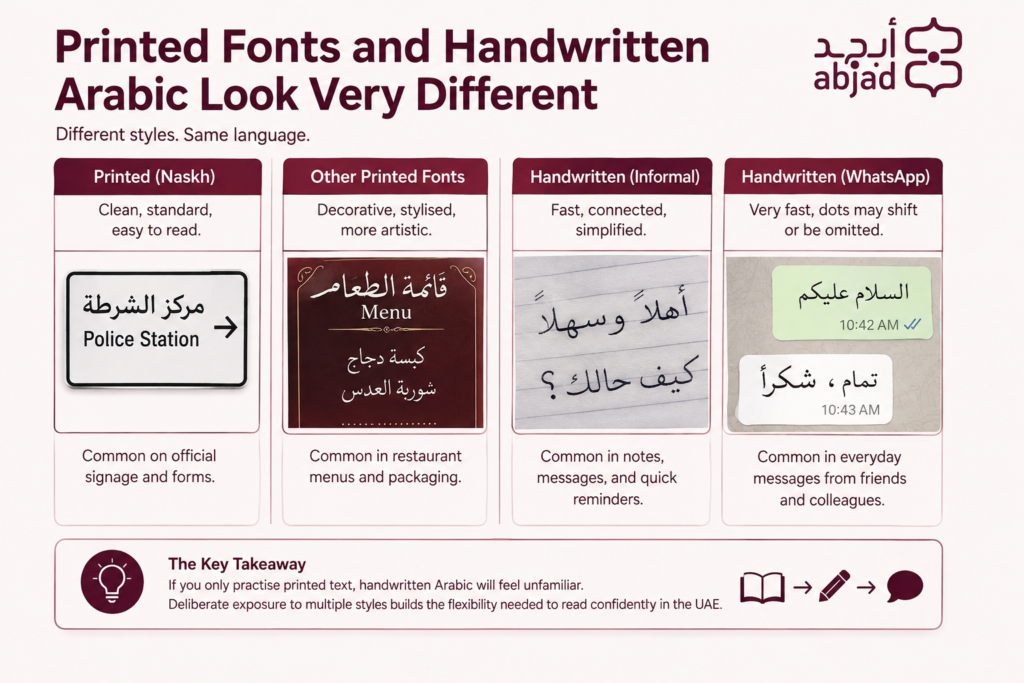
Printed Arabic on official signage typically uses clean Naskh typeface. Metro station signs across Dubai use a standardised font that is relatively readable for learners. But menus in local restaurants may use decorative Diwani or Thuluth calligraphy. WhatsApp messages and informal notes from UAE colleagues often use fast, connected handwriting with letters simplified, dotted differently, or sometimes omitted.
A learner who has only practised reading printed text will find handwritten Arabic — even basic notes — genuinely difficult to decode. This is not a sign of failure; it is a known and predictable gap in Arabic literacy development that every learner must bridge deliberately.
The solution is deliberate exposure to multiple styles. Reading UAE government notices, food packaging labels, children’s storybooks, and informal messages in parallel builds the visual flexibility that single-font practice cannot.
Read also: Ways to Help UAE Kids Learn to Read Arabic
6. Written Arabic in the UAE Is Formal — But People Speak Emirati Dialect
This challenge is unique to the UAE context and affects learners here more sharply than in many other Arabic-learning environments.
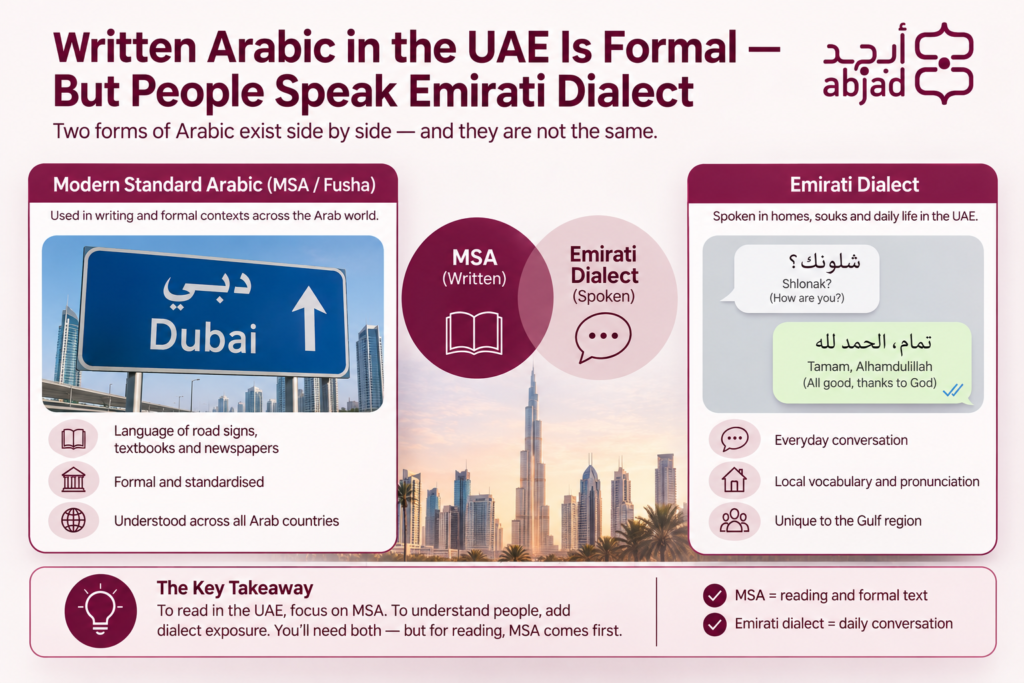
Written Arabic — on road signs, in textbooks, in government communications, in newspapers like Al Ittihad — is Modern Standard Arabic (MSA), also called Fusha. This is the formal, standardised register of the language used across the Arab world in writing and formal speech.
The Arabic spoken daily in Emirati homes, souks, and offices is Gulf Arabic, specifically the Emirati dialect. It differs from MSA in vocabulary, certain grammar patterns, and pronunciation — sometimes substantially. A learner who studies MSA to read formal text will understand written signs but may find the conversations happening around them in a Dubai market difficult to follow. A learner who picks up spoken Emirati dialect first may struggle to read the formal Arabic on the same street’s signage.
This coexistence of two distinct forms — called diglossia — is a real feature of daily life in the UAE and creates a genuine split that most beginners are not warned about. Knowing which form you need first, and why, saves months of misdirected effort. For most students and professionals in the UAE, MSA reading ability is the practical priority. For social integration and daily conversation, dialect exposure matters alongside it.
Read Also: How to Read Arabic Books?- A Step-by-Step Guide for Beginners
7. Reading Speed and Fluency Take Time to Build After the Alphabet
The final challenge is one of patience — and it applies even to learners who have done everything correctly.
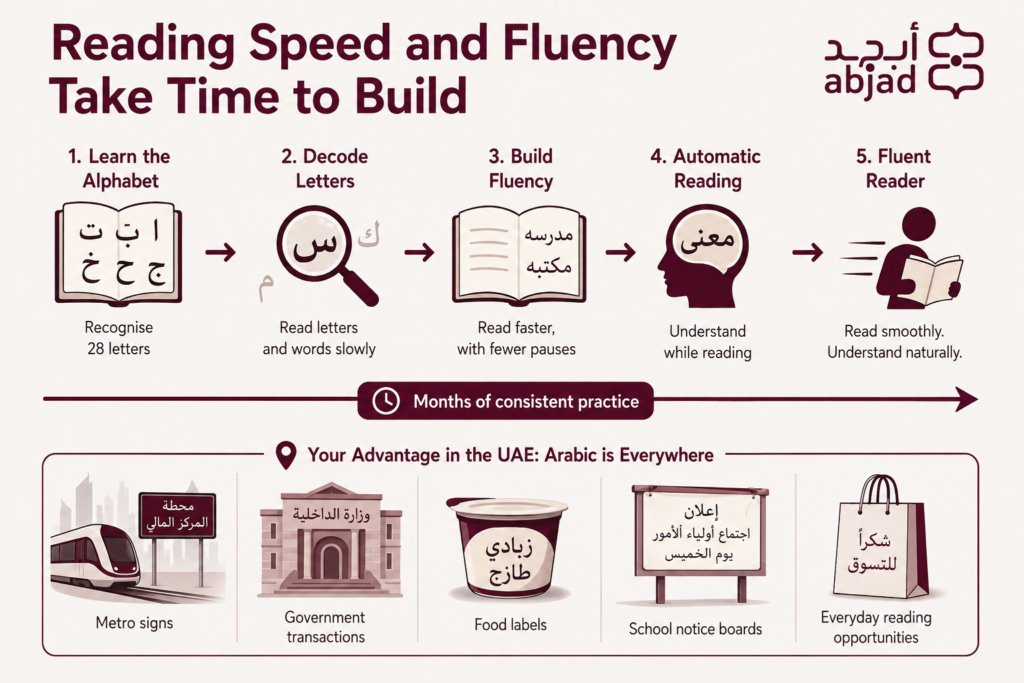
Knowing the Arabic alphabet and being able to decode letters is not the same as reading Arabic fluently. Fluency means reading at a pace where comprehension happens automatically — where you are processing meaning, not consciously identifying letters. That level of automaticity takes sustained reading practice, measured in months, not weeks.
UAE residents have a real advantage here that learners in non-Arabic environments do not: Arabic reading material is embedded in daily life. Every metro journey, every government transaction, every food label, every school notice board is an opportunity to accumulate reading volume. That daily ambient exposure — if used deliberately — compresses the timeline significantly compared to studying Arabic without living among it.Children enrolled in Abjad Institute’s kids Arabic conversation course develop this visual flexibility early, which prevents the confusion that delays so many self-taught learners.
Help Your Child Start Speaking Arabic with a FREE Trial Class in the UAE.
Inside Our Live Classes
Don’t just take our word for it—see for yourself! Click below to watch short clips from our live classes and meet the instructors who will guide your learning journey.
Start Reading Arabic in the UAE with the Right Foundation
So, how hard is it to read Arabic in the UAE? The seven challenges above are real, but none of them is permanent. With structured instruction and daily exposure, learners steadily overcome each obstacle — but none of them is permanent, and the UAE environment actively works in your favour. Arabic is on the walls, the roads, the screens, and the conversations around you every single day.
What makes the difference between learners who progress and those who plateau is structured instruction that addresses each challenge in sequence: script first, then connected letters, then unvoweled reading, then fluency through volume.
Abjad Institute offers Arabic courses in the UAE built around exactly this progression — for children, for adults, and for learners who need intensive programmes to reach functional literacy faster.
Start Your Arabic Reading Journey with Abjad Institute →
Discover Our Arabic Courses
- Arabic Classes for Beginners
- Self-Paced Arabic Course
- Basic Arabic Course
- Arabic Speaking Classes
- Learn to Write Arabic Course
- Arabic Grammar Course
- Learn Arabic Alphabet Course
- Gulf Arabic Course
- Learn Saudi Arabic
- Business Arabic Course UAE
- Arabic Language Classes for Professionals in UAE
- Quranic Arabic Course
Begin Your Arabic Journey in the UAE
Join Abjad Institute for a professional and immersive Arabic language experience tailored to your goals.
Book Your Free Trial
Conclusion
Reading Arabic in the UAE presents seven compounding challenges: a completely new alphabet, letters that change shape by position, the absence of vowel markings in everyday text, visually similar letter groups, the gap between print and handwriting, the split between formal written Arabic and spoken Emirati dialect, and the extended time required to build genuine reading speed.
The UAE context makes each of these challenges more navigable than anywhere else — Arabic is not a classroom subject here, it is the city around you. With structured support and consistent exposure, every one of these barriers becomes a skill, not a wall.
Read Also: How to Read Arabic Without Vowels?
Frequently Asked Questions
How Hard Is It to Read Arabic in the UAE?
Reading Arabic in the UAE is challenging at first because learners must master a new alphabet, recognize letters in different positions, read text without vowel markings, and adapt to both Modern Standard Arabic and Emirati dialect. However, daily exposure to Arabic on signs, menus, and official documents makes the UAE one of the best environments for developing reading fluency.
How hard is it to read Arabic if you only speak English?
Arabic reading is genuinely challenging for English speakers because the script, direction, and vowel system are all unfamiliar. Most learners reach basic letter recognition within a few weeks, but reading unvoweled text fluently — the standard in UAE daily life — takes six months to a year of structured practice.
Can I learn to read Arabic just by living in the UAE?
Living in the UAE gives you constant exposure to Arabic script, which is a significant advantage. But exposure alone does not teach you the rules of letter positions, vowel inference, or grammar that fluent reading requires. Structured instruction alongside daily exposure produces far faster results than either alone.
Is reading Arabic harder than speaking it?
For most beginners in the UAE, reading is harder than speaking in the early stages because written Arabic removes vowels, requiring background knowledge to decode correctly. Speaking can develop through daily interaction. Both skills deepen faster when developed together rather than separately.
What is the difference between written Arabic and Emirati dialect?
Written Arabic in the UAE uses Modern Standard Arabic (MSA) — the formal register used in education, news, and official documents across all Arab countries. Emirati dialect is the spoken form used in everyday conversation. The two differ in vocabulary, some grammar, and pronunciation. Most UAE signage and formal reading material uses MSA.
How long does it take a child to start reading Arabic in the UAE?
Children who begin structured Arabic reading instruction at age five or six typically achieve basic reading fluency within one academic year. Children starting later with no prior exposure may take a full year to reach confident letter reading. Consistent short daily practice — even 15 minutes — produces better results than longer, irregular sessions.
Does the UAE environment help with learning to read Arabic?
Yes, significantly. The UAE is one of the few places where Arabic script surrounds learners in daily life — road signs, metro stations, food packaging, official communications, and school materials all provide organic reading practice. This ambient exposure, combined with formal instruction, compresses the learning timeline meaningfully compared to studying Arabic in a non-Arabic environment.





Leave a Reply