 Learn Arabic
Picking up a newspaper in Dubai and finding yourself staring at text that seems to begin where a page should end is a peculiarly common experience for newcomers to the UAE.
Street signs, shop fronts, restaurant menus, government forms — Arabic is everywhere in the Emirates, and for speakers of English or any other left-to-right language, the flow of the script can feel genuinely disorienting at first.
So does Arabic read right to left? Yes — completely, consistently, and without exception (with one small numeric curiosity we’ll get to shortly). Understanding why does Arabic read right to left letters, how it shapes the letters themselves, and what that means for anyone learning Arabic in the UAE opens up the logic of one of the world’s most widely spoken languages.
What you’ll learn in this article:
- The definitive, detailed answer to whether Arabic reads right to left.
- The historical reasons behind the direction — traced to how ancient scribes physically worked.
- Which languages around the world share the right-to-left system, and why?
- How the direction is built into the design of Arabic letters?
- Practical guidance for UAE residents adjusting to reading Arabic script.
Read also: How to Read Arabic Calligraphy? — A Complete Guide
Does Arabic Read Right To Left And Why Does It Matter For Arabic Reading?
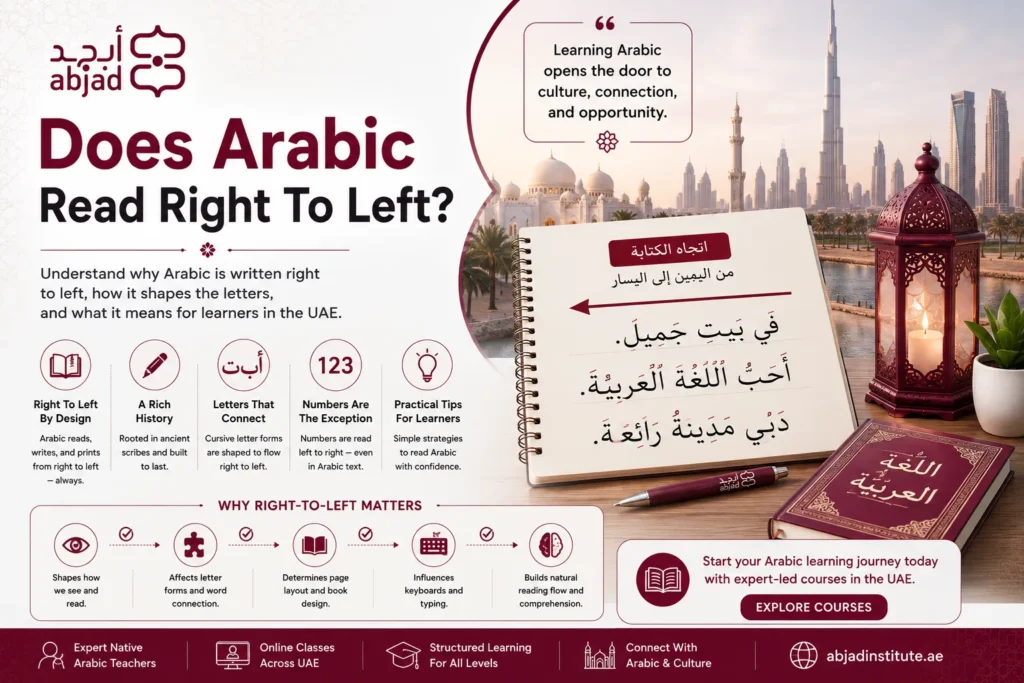
Arabic reads, writes, and prints from right to left across every dialect, every country, and every written form from the formal Modern Standard Arabic used in official UAE documents to the classical Arabic of centuries-old manuscripts.
The direction shapes far more than where your eye starts on a page. It affects the shape of individual letters, the way words are constructed, how pages are bound, and how Arabic keyboards are laid out. Getting comfortable with right-to-left is not merely a habit adjustment; it is the foundation of Arabic literacy.
Begin your child’s journey in beginner Arabic for kids course with first session free

A. What Right-To-Left Writing Means For Arabic Letters In Practice?
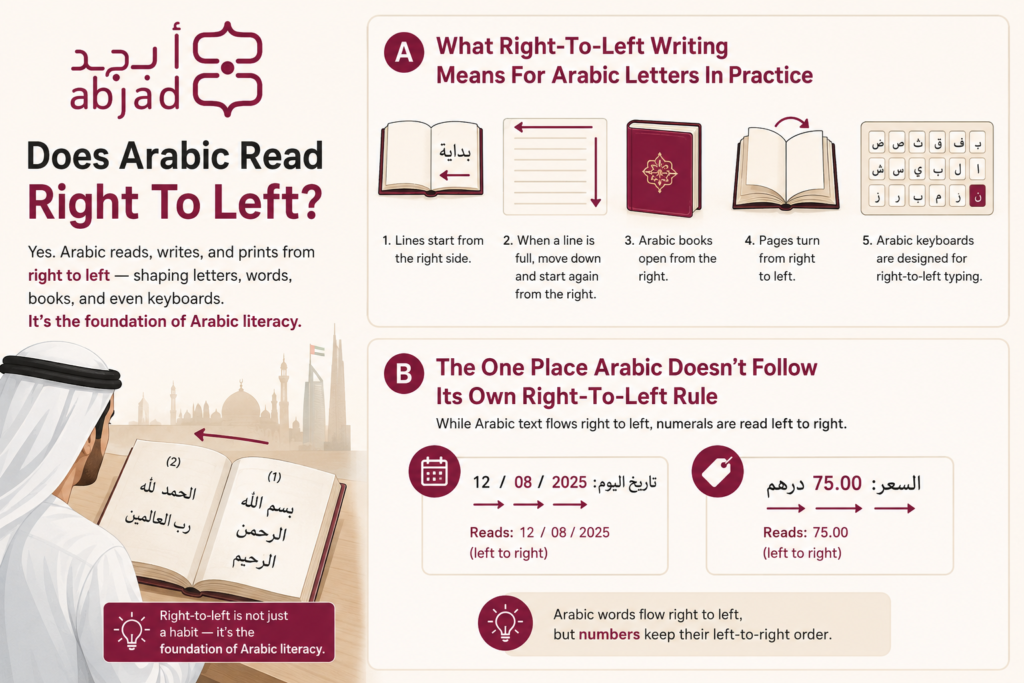
A line of Arabic text begins at the right margin of the page and flows toward the left. When the line is full, the writer moves down and begins the next line again from the right. An Arabic book opens from the right and pages turn toward the left — so what an English reader would call the “back cover” is what an Arabic reader encounters first.
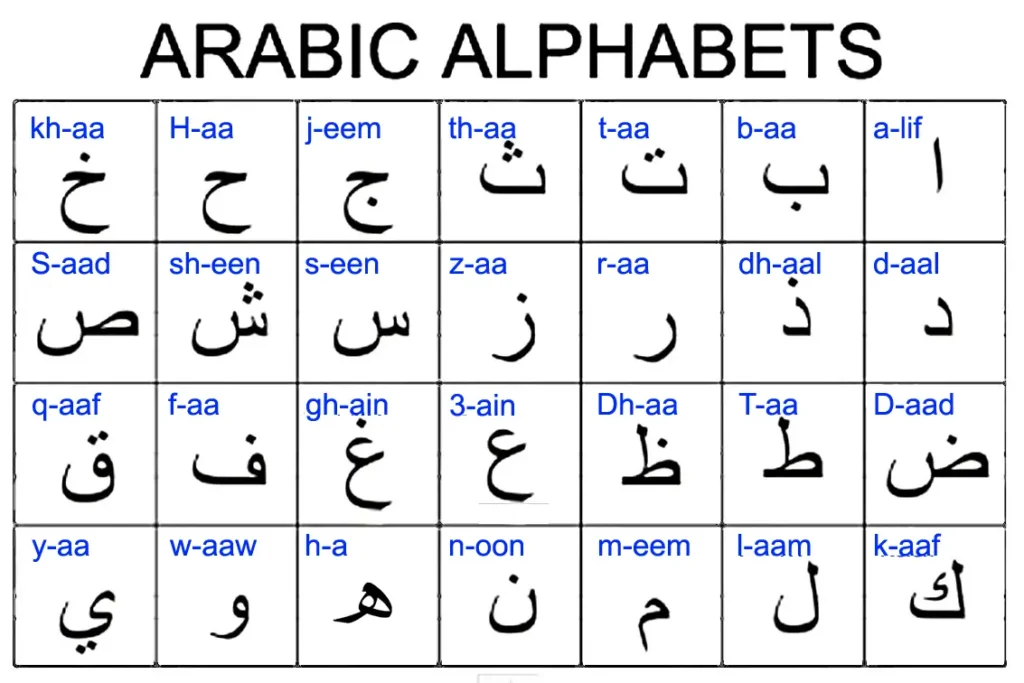
Each of the 28 letters takes up to four different positional forms depending on whether it appears at the start, middle, or end of a word, or standing alone. This is one reason why learning how to read Arabic letters in the UAE involves more depth than memorising an alphabet — you’re learning a system where context shapes the visual appearance of every character.
For a new reader, one practical consequence is worth knowing early: you cannot skim from left to right and guess the meaning of an Arabic word from its first letters. Reading Arabic requires following the word all the way from its right-hand origin to its left-hand conclusion.
B. The One Place Arabic Doesn’t Follow Its Own Right-To-Left Rule
There is a genuine exception that catches nearly every beginner off guard. While Arabic text flows right to left, numerals embedded within that text are read left to right. A date on a UAE government form, or a price tag in an Abu Dhabi shop, keeps its numbers in the familiar left-to-right order even when the surrounding words run the other way.
This is not a modern compromise. Arabic numerals were borrowed from a notational tradition that maintained its own direction, and the convention was never reversed. For UAE residents navigating everyday Arabic text, this means a sentence can contain two simultaneous reading directions. Once you know to expect it, it becomes a manageable quirk rather than a source of confusion.
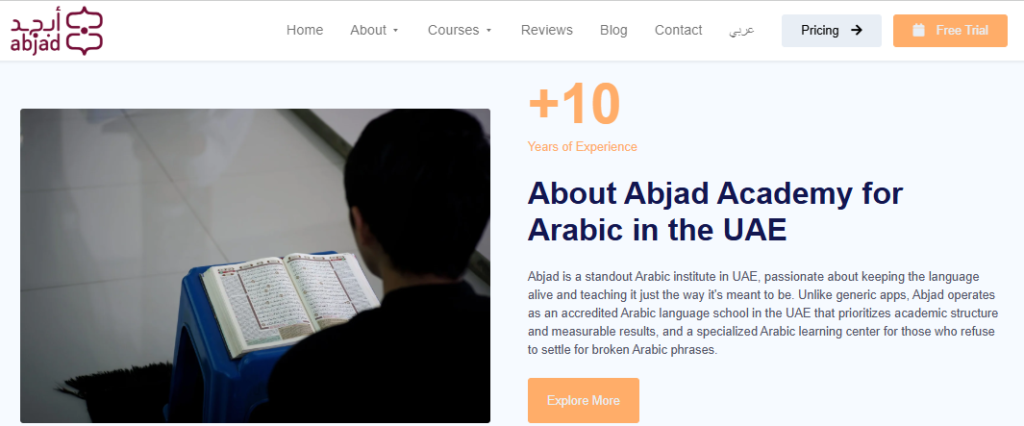
The Historical Reason Arabic Is Written From Right To Left
The direction of a language’s script is rarely accidental, and Arabic is no exception. Historians and linguists have studied why Arabic, Hebrew, Persian, Urdu, and several other languages flow right to left while Greek, Latin, and English do the opposite. The most widely accepted explanation points not to culture or religion, but to the specific tools scribes were using thousands of years ago.
This history illuminates something important: the right-to-left direction in Arabic is not arbitrary. It emerged from concrete physical conditions, and the shape of Arabic letters was designed — over centuries — to work with that direction rather than against it.
Read also: Basic Arabic Reading Practice In The UAE – 10 Proven Methods
A. Why Are Arabic Letters Built To Flow From Right To Left?
The case for right-to-left Arabic is not only historical — it is structural. Arabic is a cursive script by design: its letters connect to each other within a word, and the connection points in most Arabic letters are on their left side. Each letter, as it is written, reaches out toward the left to join the next character in the sequence.
Attempting to write Arabic from left to right fights the natural direction of the strokes. The letter forms resist it. This is why teachers working with students exploring how to read Arabic script in the UAE will often observe that accepting the direction feels awkward for a week and natural by the second.
B. The Stone, The Chisel, And The Birth Of A Writing Direction
In the ancient Middle East, where the Semitic scripts that gave rise to Arabic first developed, writing meant carving symbols into stone, clay, and rock. Scribes held a chisel in their left hand and a hammer in their right, the dominant hand drove the tool, while the left guided the chisel against the surface. With this configuration, moving right to left was the most natural and controlled direction of carving.
The working hand never passed over already-carved letters, keeping sight lines clear. When pen and ink eventually replaced chisel and stone — a transition driven largely by Egyptian innovation with papyrus and reed pens — Arabic scribes carried the established direction with them. The pen followed where the chisel had led, and a convention that began in stone became permanent in script.
Don’t Let Language Be a Barrier and start your FREE Trial in Basic Arabic Course today

How Many Languages Read Right To Left? Arabic Belongs To A Well-Established Tradition
Arabic is the most widely spoken right-to-left language in the world, with over 400 million native speakers across more than 25 countries — including the UAE, where Arabic is the official state language.
But right-to-left writing is not unique to Arabic: it belongs to a family of languages connected by shared roots in ancient Semitic script systems.
Linguists count approximately 12 to 15 major right-to-left languages. When regional dialects and languages that use Arabic-derived scripts are included, the total rises into the dozens.
Read also: Is It Compulsory to Read Quran in Arabic?
Watch Our Classes in Action
Curious what a real session looks like? Take a peek inside our interactive classrooms and see how our expert instructors bring the Arabic language to life. Watch a sample lesson below!
Begin Your Arabic Journey in the UAE
Join Abjad Institute for a professional and immersive Arabic language experience tailored to your goals.
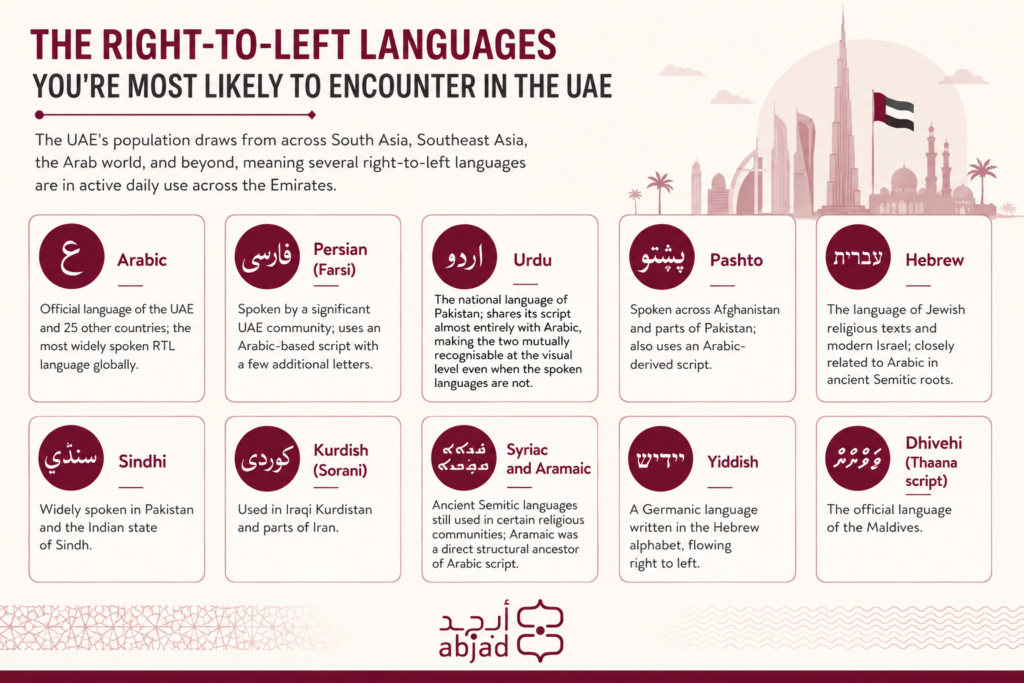
Book Your Free TrialA. The Right-To-Left Languages You’re Most Likely To Encounter In The UAE
The UAE’s population draws from across South Asia, Southeast Asia, the Arab world, and beyond, meaning several right-to-left languages are in active daily use across the Emirates:
- Arabic — official language of the UAE and 25 other countries; the most widely spoken RTL language globally.
- Persian (Farsi) — spoken by a significant UAE community; uses an Arabic-based script with a few additional letters.
- Urdu — the national language of Pakistan; shares its script almost entirely with Arabic, making the two mutually recognisable at the visual level even when the spoken languages are not.
- Pashto — spoken across Afghanistan and parts of Pakistan; also uses an Arabic-derived script.
- Hebrew — the language of Jewish religious texts and modern Israel; closely related to Arabic in ancient Semitic roots.
- Sindhi — widely spoken in Pakistan and the Indian state of Sindh.
- Kurdish (Sorani) — used in Iraqi Kurdistan and parts of Iran.
- Syriac and Aramaic — ancient Semitic languages still used in certain religious communities; Aramaic was a direct structural ancestor of Arabic script.
- Yiddish — a Germanic language written in the Hebrew alphabet, flowing right to left.
- Dhivehi (Thaana script) — the official language of the Maldives.
B. What These Languages Share Beneath The Surface?
Nearly every right-to-left language in current use belongs to the Semitic language family or borrows its script from one. The Aramaic alphabet — among the oldest continuously used writing systems on record — is a common ancestor of both the Arabic and Hebrew scripts. This shared origin explains why their directionality is identical even though the languages themselves evolved in quite different directions.
For UAE residents who read Urdu, this shared ancestry carries a tangible benefit: learning to read Arabic script opens partial access to Urdu, Persian, Pashto, and Sindhi texts. A single literacy investment unlocks multiple right-to-left reading systems.
Start Your Arabic Course for Beginners UAE Today
What Do You Need To Learn To Read Arabic From Right To Left In The UAE?
For residents exploring how to read Arabic in the UAE, the starting point is always the same: accept the direction actively and begin where Arabic itself begins — at the right margin of the page. From that anchor point, the script’s internal logic unfolds.
A common question is how long does it take to learn to read Arabic at a functional level. For most learners, recognising all 28 letters in their various positional forms takes four to six weeks of consistent daily practice. The directional adjustment, specifically, resolves within the first few weeks — well ahead of the deeper fluency milestones.
Take the first step to meet Our Arabic and Quran Dedicated & Experienced Teachers
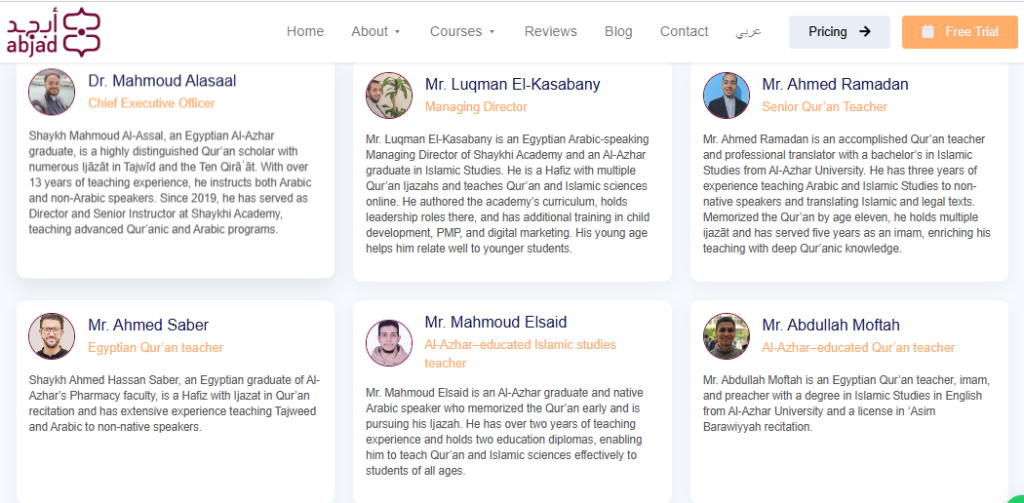
Inside Our Live Classes
Don’t just take our word for it—see for yourself! Click below to watch short clips from our live classes and meet the instructors who will guide your learning journey.
Begin Your Arabic Journey in the UAE
Join Abjad Institute for a professional and immersive Arabic language experience tailored to your goals.
Book Your Free TrialBuild Real Arabic Fluency At Abjad Institute Where UAE Residents Begin Learning
Abjad Institute is one of the UAE’s most trusted Arabic language academies, offering teacher-led courses designed for the full range of learners the Emirates brings together.
Whether you’re an expatriate building practical Arabic for daily life, a parent enrolling a child, a professional adding Arabic to your credentials, or a student pursuing Quranic or classical Arabic studies, Abjad has a structured path built specifically for your goal.
What sets Abjad apart is its grounding in the UAE’s multilingual context. Instructors understand what it means to learn Arabic as an English speaker in Dubai or Abu Dhabi — the pace, the challenges, and the moments where a good teacher makes the difference between confusion and clarity.
Discover Our Arabic Courses:
- Arabic Qaida for Kids
- Arabic Grammar for Kids
- Teen Arabic Summer Course
- Arabic Kids Camps
- UAE Kindergarten Arabic Classes
- Modern Standard Arabic Course
- Arabic Course for Kids
- Arabic Conversation for Kids
- Fusha Arabic Course
- Classical Arabic Course
- Emirati Arabic Course
- Gulf Arabic Course
- Learn Saudi Arabic
- Business Arabic Course UAE
- Arabic Language Classes for Professionals in UAE
Start your Arabic course at Abjad Institute today with a Free Trial and begin reading the Arabic that actually surrounds you in the UAE — without waiting for harakat that will never appear.

Begin Your Arabic Journey in the UAE
Join Abjad Institute for a professional and immersive Arabic language experience tailored to your goals.
Book Your Free TrialConclusion
Why does Arabic read right to left? For reasons that trace back several thousand years. The direction originated in the physical practice of carving Semitic scripts into stone, where right-to-left movement was the most natural and controlled path for a right-handed scribe holding a hammer and chisel.
When pen and papyrus eventually replaced chisel and rock, the direction didn’t change — it had already been built into the shapes of the letters themselves. Arabic belongs to a family of approximately 12 to 15 major right-to-left languages — including Hebrew, Persian, Urdu, and Pashto — most sharing ancestry in ancient Semitic script systems.
In the UAE, where several of these languages coexist in daily life, Arabic’s right-to-left direction is part of a broader linguistic heritage that connects writing traditions across centuries and continents.
For anyone living in the Emirates who wants to read street signs with confidence, engage with Emirati culture, navigate official documents, or study the Quran in its original form, learning to read right to left is the first essential step.
Frequently Asked Questions
Does Arabic always read right to left, or are there exceptions?
Arabic text always reads right to left. The only consistent internal exception involves numerals: Arabic-Indic numbers embedded within Arabic text are conventionally read left to right, even when the surrounding words flow the other way. Every other element — letters, words, sentences, and full paragraphs — follows the right-to-left direction without variation.
Why does Arabic read right to left while English reads the opposite way?
The difference traces to the tools used when each script was first developed. Arabic descends from Semitic scripts carved into stone with a hammer and chisel, where right-to-left was the most natural direction for a right-handed scribe.
English descends from Greek and Latin scripts that evolved when ink and parchment became widespread — writing left to right kept a right-handed writer’s hand from smearing fresh ink across already-written text.
How many languages in the world read right to left?
There are approximately 12 to 15 major right-to-left languages, including Arabic, Hebrew, Persian, Urdu, Pashto, Sindhi, Kurdish (Sorani), Yiddish, Syriac, Aramaic, and Dhivehi. The total rises considerably when regional dialects and languages using Arabic-derived scripts are included, potentially reaching several dozen writing systems worldwide.
Is it difficult for English speakers in the UAE to adjust to right-to-left Arabic?
The directional shift is a genuine adjustment but not an insurmountable one. Most adult learners find the right-to-left orientation begins to feel automatic within three to four weeks of daily reading practice — even informal practice with signs and labels. Children, particularly those under ten, adapt faster still and tend to manage both directions simultaneously without difficulty.
What is the best starting point for reading Arabic in the UAE?
Begin with the Quranic Arabic alphabet — the 28 letters and their four positional forms (isolated, initial, medial, and final). Practising with real-world text found throughout the UAE, from road signs to food packaging, builds directional habit alongside letter recognition.
Short daily exposure to genuine Arabic text accelerates the transition far more effectively than longer, less frequent study sessions.
What are the benefits of studying Quranic Arabic alongside modern Arabic?
The benefits of learning Quranic Arabic include phonetic precision, since Quranic texts retain full vowel markings (harakat) that are normally omitted in everyday Arabic writing. This makes it easier to learn correct pronunciation from the outset.
It also deepens engagement with classical texts, the historical development of Arabic grammar, and the rich literary and theological tradition that has shaped Arabic-speaking cultures for over fourteen centuries.





Leave a Reply