 Learn Arabic
Arabic learning rarely sticks when it feels like a chore. UAE parents and teachers who work with young children notice the same pattern again and again: a child who sits through a traditional letter-drilling session forgets half of it by morning, while a child who played a word-fishing game the night before can recall every word they caught three weeks later. The difference is not intelligence — it is engagement.
Arabic games for kids change the emotional experience of the language entirely. When the Arabic alphabet becomes a playground, children stop seeing it as a school subject and start treating it as something that belongs to them — a tool they actually want to use.
From recognising words on a Dubai street sign to following Friday sermon vocabulary, and from deciphering shop names in Abu Dhabi to appreciating how to read Arabic calligraphy on public art, the everyday Arabic literacy skills UAE children need are built quietly, through consistent and low-pressure exposure. Games are the most reliable engine of that exposure.
This guide covers 10 Arabic language games that work across different ages and learning stages — physical home activities, free digital platforms, and structured tools UAE families are using right now.
Book Your Kid’s Spot Before Camps Fill Up

1. Letter Sorting Is One Of The Most Arabic Games For Kids That Actually Stick
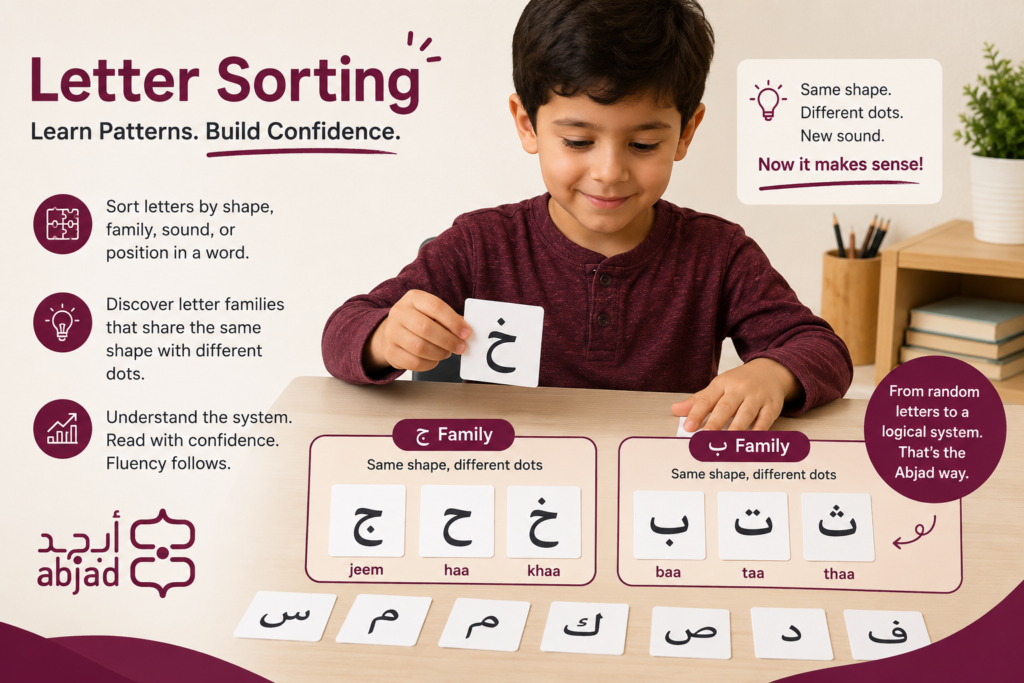
Letter sorting is deceptively simple and highly effective. Write individual Arabic letters on small cards or sticky notes, then ask the child to sort them into groups — by shape, family, by sound, or by their position within a word. The real learning happens when children encounter the letter families that share a base shape and differ only by dot position: ج، ح، خ are one family; ب، ت، ث are another.
Sorting these groups teaches children that the Arabic writing system is logical rather than arbitrary. A child who understands that خ is simply ح with a dot above it stops seeing the alphabet as 28 unrelated symbols and starts navigating it as a manageable system of patterns. That shift is transformative for reading fluency.
Children who grasp letter families find it significantly easier to read Arabic text independently. Understanding how to read Arabic letters in the UAE context becomes far less daunting once a child realises that most letters they encounter are variations of shapes they have already learned to sort.
Practical tip: Write letters on different-coloured cards for each family. The colour coding gives visual learners an extra layer of pattern recognition without making the session feel like a lesson.
2. Clay Sculpting Which Builds Memory That Lasts
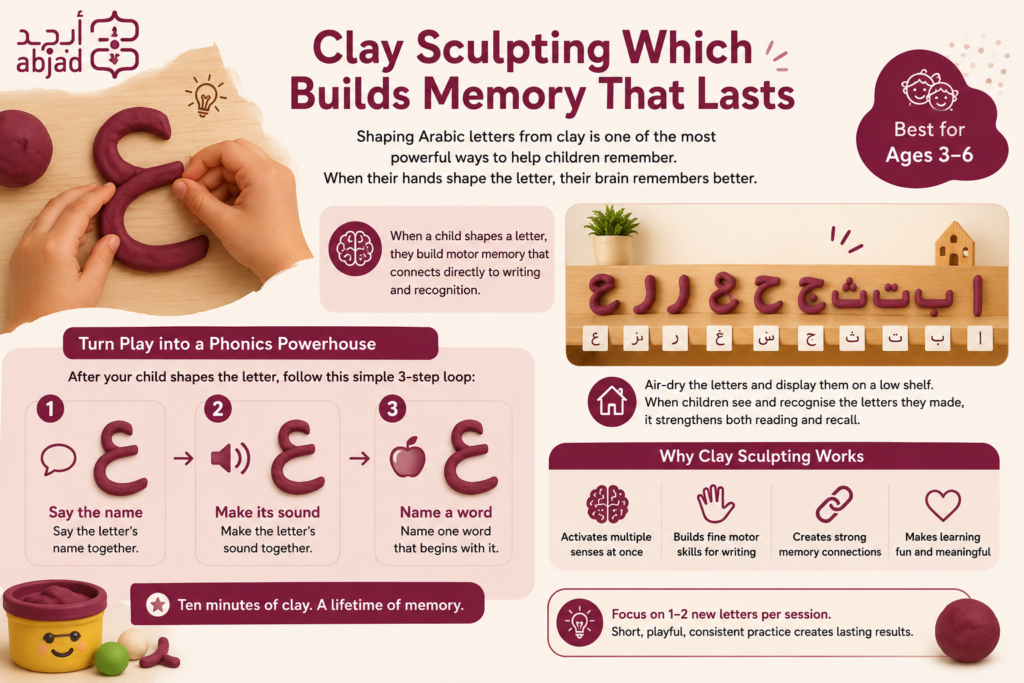
Shaping Arabic letters from clay or playdough is not a craft activity with a thin educational coating — it is one of the most neurologically grounded techniques for teaching letter forms. When a child physically pushes clay into the curve of a ع or the angular stroke of a ر, they build motor memory that connects directly to the act of writing. That physical trace stays with them in a way that visual memorisation alone rarely does.
This activity suits children aged 3 to 6 best. Keep each session focused on one or two new letters. After the child has shaped the letter, follow a three-step sequence: say the letter’s name, make its sound, and name one word that begins with it. That three-part loop turns a ten-minute craft session into a complete phonics unit without announcing that fact to the child.
UAE families can extend this activity by air-drying the sculpted letters and displaying them on a low shelf. When the child later reads a word and recognises a letter from their collection, the connection between the physical object and the written symbol reinforces both reading and recall simultaneously — a feedback loop that traditional flashcards cannot replicate.
3. Word Fishing Through Hook A Word And Build A Sentence To Keep It
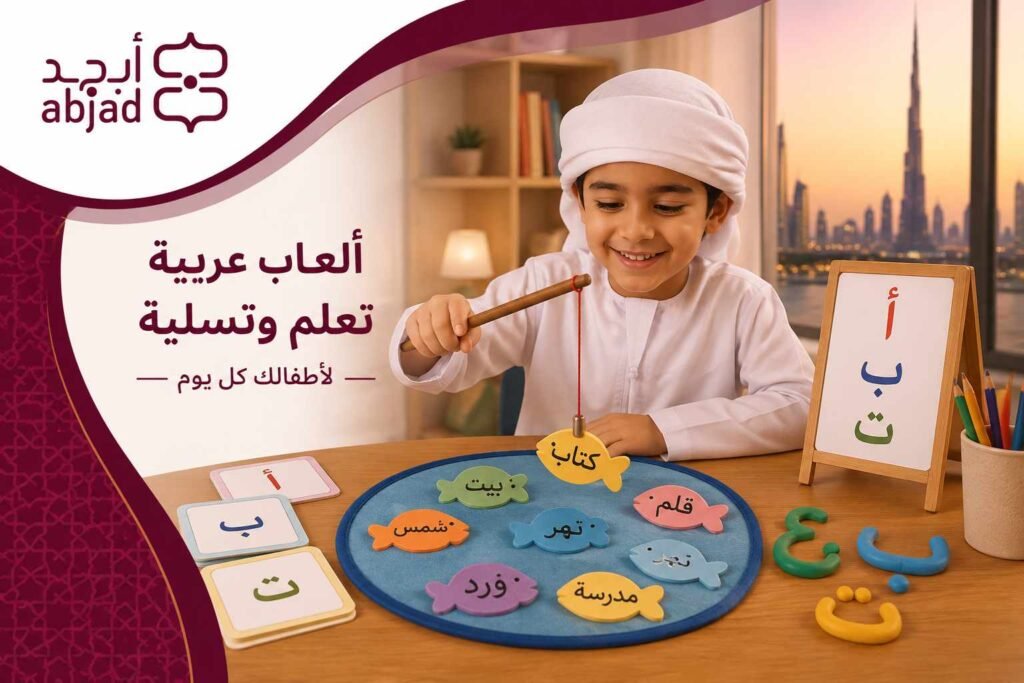
Word fishing turns Arabic vocabulary review into competitive sport. Write Arabic words on small card fish, attach a paper clip to each one, and make a simple fishing rod from a stick and string with a small magnet at the end. Players take turns fishing, and the rule is clean: you must use the word you catch correctly in an Arabic sentence to keep it. The player with the most fish wins.
This game practises two skills simultaneously — rapid word recognition and spontaneous sentence production. For children in UAE schools who are learning to construct grammatically correct Arabic sentences, word fishing provides exactly the kind of pressure-free output practice that builds spoken fluency.
Understanding how to write in Arabic in the UAE correctly — putting subject, verb, and object in their proper places — comes from repeated, low-stakes production of this kind, not from copying sentences from a textbook.
A classroom-tested variation: write sentence fragments on the fish — a subject on one card, a verb on another, an object on a third. Children catch and assemble their fragments into complete sentences without knowing in advance what they will build. The element of surprise keeps energy high and turns a grammar exercise into a game without the players realising it.
Watch Our Classes in Action
Curious what a real session looks like? Take a peek inside our interactive classrooms and see how our expert instructors bring the Arabic language to life. Watch a sample lesson below!
Begin Your Arabic Journey in the UAE
Join Abjad Institute for a professional and immersive Arabic language experience tailored to your goals.
Book Your Free TrialStart reading and writing Arabic with a FREE trial class

4. 3asafeer One Platform For Arabic Stories and Interactive Games
The 3asafeer platform (3asafeer.com) is one of the most widely used Arabic educational resources for children across the Arab world, and it is free to access. It combines interactive games with illustrated stories; a combination that gives children a reason to keep engaging with Arabic text beyond the recognition level.
Among the most useful activities on 3asafeer for UAE children is the “lost letters” game, where a child must identify the correct missing letter to restore a word; a skill that feeds directly into reading fluency. The platform also includes puzzle activities, creative tools, and quick-fire competitive games that suit a range of ages from preschool through primary.
For parents who want structured daily Arabic input without preparing physical materials every evening, the platform’s mobile-friendly design makes it a practical learn to read Arabic app equivalent. A 15-minute session after school requires no setup and no cleanup — a meaningful advantage in a busy UAE household.
If your child is ready for structured instruction alongside these games, Abjad Institute‘s Arabic Qaida for Kids and Beginner Arabic for Kids courses offer expert-guided progression from the alphabet through to reading — precisely the structured component that platforms like 3asafeer complement rather than replace.
Learn Quranic Arabic from the Basics at Abjad Institute in the UAE
5. Fun Arabic Games One Of The Free Hubs That Covers the Whole Curriculum
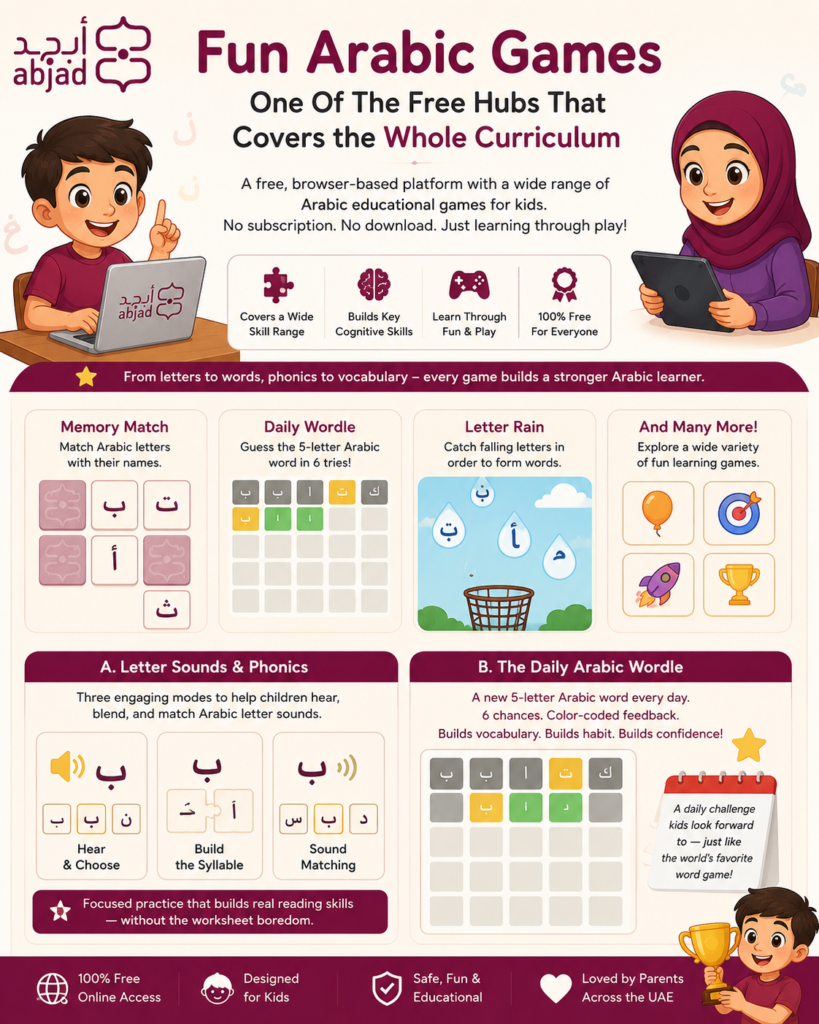
Fun Arabic Games is a browser-based platform offering a broad range of Arabic educational games without a subscription or download. For UAE families looking for how to learn to read Arabic online for free, this is one of the most comprehensive free resources currently available in Arabic for children. The site covers a wide skill range.
Each game targets a distinct cognitive skill, so children who play across the library are covering significantly more ground than any single activity could provide. It includes memory matching between Arabic letters and their names, a daily Arabic Wordle-style word-guessing challenge, letter rain, where players catch falling Arabic letters in sequence to form words.
Also players enjoy interactive stories with fill-in-the-blank activities, word builder exercises, and grammar sorting games covering sun and moon letters, gender classification, and pronoun selection.
Read also: Quranic Grammar: The Complete Guide to Understanding the Language of the Quran
A. Letter Sounds and Phonics Of Arabic Alphabet
The phonics section on Fun Arabic Games presents Arabic letters with three practice modes: hear and choose, build the syllable, and sound matching. For children who can name letters but have not yet learned to blend them into words, this section offers the focused drilling that reading instruction requires — without the repetitive feel of a worksheet.
A detail worth noting: the phonics games include the full set of Arabic letter sounds as they appear in formal reading contexts. Regular practice with these games builds familiarity with the Quranic Arabic alphabet, the precise phonemes and vowel markers used in Quran recitation, giving children a strong phonics foundation that supports Quran reading readiness alongside standard school Arabic progress.
B. The Daily Arabic Wordle
The daily word challenge presents a new five-letter Arabic word each day, and players have six attempts to guess it with colour-coded letter feedback after each attempt. It is one of the most cleverly designed vocabulary tools on the site because it generates a natural daily habit, children return to it voluntarily, without being prompted, for the same reason adults worldwide are addicted to the English version.
That self-motivated daily return produces consistent vocabulary exposure over time, which is precisely the kind of cumulative gain that games deliver better than formal study sessions.
Read also: What is the best app for learning Arabic for kids?
6. Wordwall Classroom-Quality Arabic Games at Home
Wordwall was built for teachers, but UAE parents have adopted it with equal enthusiasm. The platform hosts thousands of community-made Arabic language games across formats — spinning wheels, open-the-box challenges, matching pairs, balloon-popping quizzes, and timed competitive activities. A large portion of the game library is free to access.
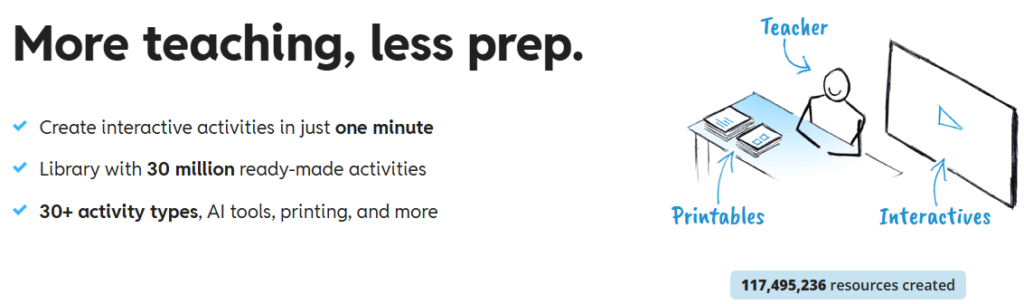
The practical advantage is speed: a parent can search for a specific Arabic vocabulary set — UAE landmarks, Ramadan vocabulary, classroom objects, school subjects — and find a ready-made game in under sixty seconds. For families working through a particular chapter of an Arabic school textbook, Wordwall almost always has a community-built game that matches the exact vocabulary list.
It is one of the most flexible and accessible platforms available for families who want to learn Arabic for kids without spending an hour preparing materials every evening. The timed competitive format suits children who respond well to performance pressure, and a ten-minute Wordwall session after dinner is one of the most efficient and low-effort Arabic practice formats a busy UAE family can realistically maintain five days a week.
Read also: Teaching The Arabic Alphabet For Kids
7. The Classic Card Game “Memory Match” Adapted For Arabic Vocabulary
Memory match is a game children already know how to play, which means all their cognitive energy goes into the language rather than the rules. The Arabic version pairs a letter card with an image whose name begins with that letter — ت paired with تفاحة, or ب paired with بيت — or matches Arabic words with their English equivalents, or pairs verbs with pictures showing the action.
The game requires sustained attention and working memory: flipping cards, holding multiple locations in mind, making correct connections under time pressure. These are precisely the cognitive skills that reading also demands.
For children learning how to read Arabic in the UAE as a heritage language memory match creates structured vocabulary exposure in a format that feels entirely voluntary. That absence of obligation is often what keeps reluctant learners engaged long enough for the learning to take root.
Advancing the game is simple: replace single-letter cards with full word cards and definition cards, or with sentence-and-picture pairs. The same format scales from toddler to upper primary level with nothing more than a different card deck.
Begin Your Kindergarten Arabic Path with a first session free Today

8. Word Builder Game In Which Your Child Drags Letters Into Position
Digital word builder games present a set of scrambled Arabic letters and ask a child to arrange them into the correct word. Some versions include a picture clue; others ask children to work from a written definition or an audio prompt.
The game appears simple but addresses a genuinely complex challenge in Arabic literacy: the fact that Arabic letters change shape depending on their position within a word.
The letter ك at the beginning of a word looks different from the ك at the end. A child who drags a letter into a slot and sees its form shift is learning that rule visually and kinetically — without a teacher needing to explain it explicitly. Playing with letter positions across dozens of words in a single session builds this awareness far more quickly than a rule-memorisation exercise would.
For children in UAE schools working on how to read Arabic script in the UAE in a formal classroom setting — understanding connected letters, recognising words in running text, reading without vocalisation marks — a word builder game at home provides exactly the kind of supplementary repetition that consolidates school instruction without duplicating the same exercise format they saw in class.
Start Learning Emirati Arabic at our Abjad Institute Today

9. The Spelling Challenge Through Hearing a Word, Writing It Right
Spelling in Arabic is genuinely difficult in a way that catches many children off-guard. Fully vocalized text — with all short vowel markers written in — is used in early readers and in Quran text; most adult Arabic writing omits these markers entirely, leaving the reader to supply the vowels from memory. A child who has only ever read vocalized text will struggle with standard Arabic print without substantial practice in spelling from audio.
The spelling challenge game on Fun Arabic Games plays an audio clip of an Arabic word, and the child types it correctly — short vowels, correct letters, and all. Missing a vowel requires listening again and trying a different approach; there is no penalty beyond the need to retry, which removes the anxiety that makes traditional spelling tests counterproductive for many children.
For beginners who sometimes rely on romanized Arabic as a reading support — falling back on how to read Arabic in English letters as a crutch rather than engaging directly with the script — moving toward correct Arabic spelling is a gradual process that consistent audio-to-text games accelerate significantly. The ear and the hand are trained together, which is precisely how literate readers of any language build automatic spelling.
Read also: Arabic Cartoons For Kids
10. Arabic Grammar Games
Grammar is where language learning most reliably stops being enjoyable. Arabic grammar — with its dual forms, broken plurals, gendered nouns, and sun and moon letter distinctions — becomes a source of significant frustration for children who encounter it through formal study alone. The right game changes that dynamic completely.
The grammar games on Fun Arabic Games include several well-designed activities that cover core UAE school curriculum content. The word type asks children to classify Arabic words as noun, verb, or particle — a distinction introduced in early primary Arabic.
The sentence kitchen asks players to connect subjects with correct predicates to build grammatically correct Arabic sentences. Each activity builds a grammatical instinct through repeated, low-stakes decision-making rather than rule memorisation.
Give Your Child the Gift of Mastering Arabic Grammar and let him start today
A. Gender Sorting, Is This Word مذكر or مؤنث?
The gender sorting game presents a stream of Arabic words and asks children to classify each as masculine or feminine. The core rule — that words ending in تاء مربوطة are typically feminine — is a grammar concept UAE curricula introduce in years two and three.
Sorting through forty words in a game session is faster, and measurably more effective, than reading the rule in a textbook and completing ten written examples. The pattern becomes instinctive through volume rather than explicit memorisation.
B. Sun and Moon Arabic Letters
The sun and moon letter distinction affects how ال (the definite article) is pronounced in spoken Arabic — a rule every Arabic reader needs to internalize to read text aloud correctly.
The sorting game on Fun Arabic Games presents words beginning with different letters and asks children to classify them, with immediate audio feedback on each answer. This is the most efficient introduction to that rule currently available in a game format.
Parents who want to understand how to read Arabic Quran in the UAE with accuracy will find that the grammar foundation these games build is exactly the starting point Quran reading instruction requires.
Between games at home and interactive platforms, Abjad Institute‘s Arabic Grammar for Kids course provides the structured instruction that closes the gap between game-level familiarity and classroom-level precision. Games create the pattern recognition; expert instruction creates the accuracy that school assessments require.
Read also: Arabic Practice Sheets and Exercises for Young Learners
Inside Our Live Classes
Don’t just take our word for it—see for yourself! Click below to watch short clips from our live classes and meet the instructors who will guide your learning journey.
Begin Your Arabic Journey in the UAE
Join Abjad Institute for a professional and immersive Arabic language experience tailored to your goals.
Book Your Free Trial
Arabic Language Learning at Abjad Institute
Games build enthusiasm and create daily Arabic habits. Structured instruction builds accuracy, grammatical precision, and the reading fluency that UAE school curricula require. The most effective Arabic learners combine both — and Abjad Institute is designed to provide the structured half of that equation, with courses spanning every age group, learning goal, and dialect need.
Abjad Institute is a UAE-based Arabic language school whose programmes for children range from alphabet foundations through to Arabic grammar, conversational fluency, and Quranic Arabic — all delivered in a format designed specifically for the UAE’s multilingual learner population, where heritage Arabic speakers, expat children, and non-Arab learners often study alongside one another.
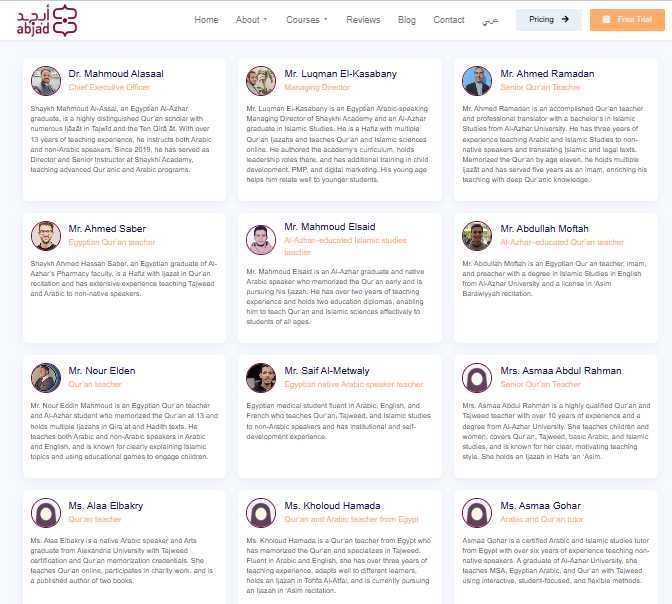
Meet our Arabic and Quran Dedicated Skilled teachers
Start Your Child’s Arabic Journey With Abjad Institute Today
Arabic fluency for children raised in the UAE does not happen by accident — it is built intentionally, one consistent session at a time. Abjad Institute‘s qualified instructors work with children from kindergarten age through adolescence, combining a structured curriculum with the kind of engaging, personalised delivery that keeps young learners motivated across months, not just a few sessions.
Discover Our Arabic Courses:
- Arabic Course in the UAE
- Arabic Intensive Course
- Learn Arabic from Scratch Course
- Madinah Arabic Course
- Arabic Classes for Adults
- Arabic Classes for Beginners
- Self-Paced Arabic Course
- Basic Arabic Course
- Arabic Speaking Classes
- Learn to Write Arabic Course
- Arabic Grammar Course
- Learn Arabic Alphabet Course
Book your FREE trial at Abjad Institute
Conclusion
Arabic games for kids work best as part of a broader learning system — not the only tool, but a powerful and consistent one. The ten games in this guide cover the full range of Arabic literacy skills a child in the UAE needs: letter recognition, phonics, spelling, vocabulary acquisition, grammar, and sentence production. Used regularly, they create the kind of daily Arabic exposure that formal instruction alone cannot realistically deliver.
The practical framework that emerges from this list is straightforward. Match the game to the child’s current output level, not just their age. Prioritise phonics games early, move toward vocabulary and grammar games as confidence grows, and use hands-on physical games alongside digital platforms rather than replacing one with the other.
For UAE families raising bilingual or multilingual children, the combination of game-based home practice and structured learning with a qualified Arabic instructor is the fastest reliable path to confident Arabic literacy. The games open the door; the instruction makes sure children walk all the way through it.
Frequently Asked Questions
What is the best Arabic game for kids under five years old?
Clay sculpting and letter sorting with coloured cards are the most effective activities for children aged three to five. Both connect the Arabic letter’s physical form to its name and sound without requiring a child to write, which suits the motor development stage of most young children. Keep sessions short and focus on one or two letters at a time.
Are there free Arabic games for kids available online in the UAE?
Yes. Fun Arabic Games (funarabicgames.com) and the 3asafeer platform (3asafeer.com) both offer extensive libraries of free Arabic language games for children, accessible through any browser without a subscription or download. Wordwall also provides a large library of community-made Arabic games at no cost.
How much time should a child spend on Arabic games each day?
Fifteen to twenty minutes of focused, game-based Arabic practice, done consistently on most school days, produces measurable vocabulary and phonics gains within four to six weeks. Short daily sessions outperform longer infrequent ones because they create regular retrieval practice, and retrieval practice is what moves language from short-term recognition to long-term fluency.
Do Arabic games help children with Quran reading specifically?
Yes, particularly phonics games and letter classification games. Accurate Quran recitation requires precise pronunciation of every Arabic phoneme and correct application of vowel markers, skills that depend on a strong phonics foundation. Grammar games covering sun and moon letter classification and vowel accuracy also contribute directly to Quran reading readiness, since these rules affect how Arabic text is read aloud.
Can Arabic games replace formal instruction for children in UAE schools?
Games accelerate and reinforce formal instruction but do not replace it. UAE school Arabic curricula include composition skills, complex grammar structures, and reading comprehension that require guided instruction to develop properly. Games are most effective as daily supplementary practice that keeps the language active between formal lessons and classroom instruction.
At what age should children in the UAE start learning Arabic through games?
Most Arabic language specialists recommend starting letter recognition and sound awareness games from age three, through play-based activities like clay sculpting and letter sorting. Formal reading instruction — blending letters into words — typically begins from age four to five, depending on the individual child’s readiness.




Leave a Reply