 Learn Arabic
You can learn Arabic grammar without paying a cent. A free Arabic grammar course is easy to find today. Arabic schools, universities, and long video series all offer one. Some even end with a free paper: a course card, or an old-style ijazah with a chain back to the author.
So, why do most people still fail? They join three courses at once. They finish none. And they still freeze at the first sentence they try to parse.
Therefore, we list the free Arabic grammar courses worth your time. We also show the order to study them in and the four quick checks, so you pick the right course before you spend a month on it.
What you will learn
- The best free Arabic grammar course options online right now.
- Four checks that tell a good free course from a wasted month.
- The book ladder: which grammar text to study first, second, and third.
- The study steps that make grammar stick.
- The one reason free grammar courses fail, and how to fix it.
What A Free Arabic Grammar Course Covers
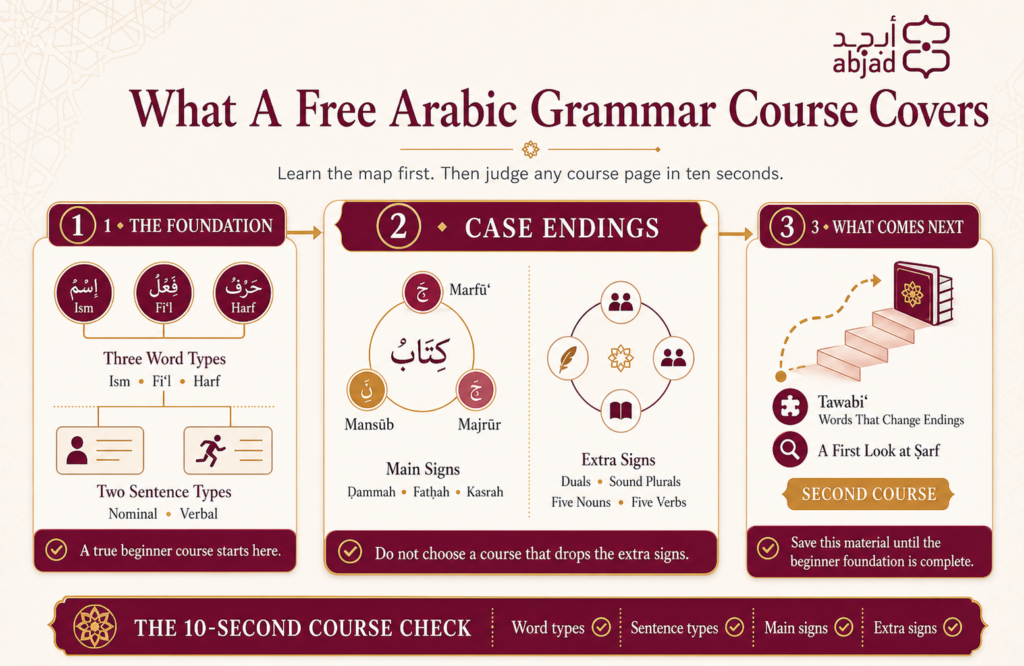
Nahw is Arabic grammar. It is the study of how the end of a word changes when its job in the sentence changes. Nearly every free course teaches the same core map. That map comes from the old grammar books, not from any one website.
Learn the map first. Then you can judge any course page in ten seconds.
1- Teaching Word Types And Sentence Types
Every Arabic word is one of three things: a noun (ism), a verb (fi’l), or a particle (harf). A noun names a person, a thing, or an idea. A verb tells you what happened, and when. A particle has no meaning on its own, but it changes the words around it, like fi (in) or min (from).
Every sentence is one of two types. It starts with a noun, or it starts with a verb. A noun sentence has two parts: the thing you talk about, and what you say about it. A verb sentence has the action first, then the doer, then the one it was done to.
Learn these two lists well, and half of grammar opens up. Every rule you meet later hangs on one of them. Test yourself on any short sentence: name each word type, then name the sentence type, before you look at a single ending.
A course that skips this is not a beginner course, whatever it calls itself. Ma’arif, Hosoun, and Asakeeb all start here.
2- Teaching The Three Case Groups: Marfu’, Mansub, and Majrur
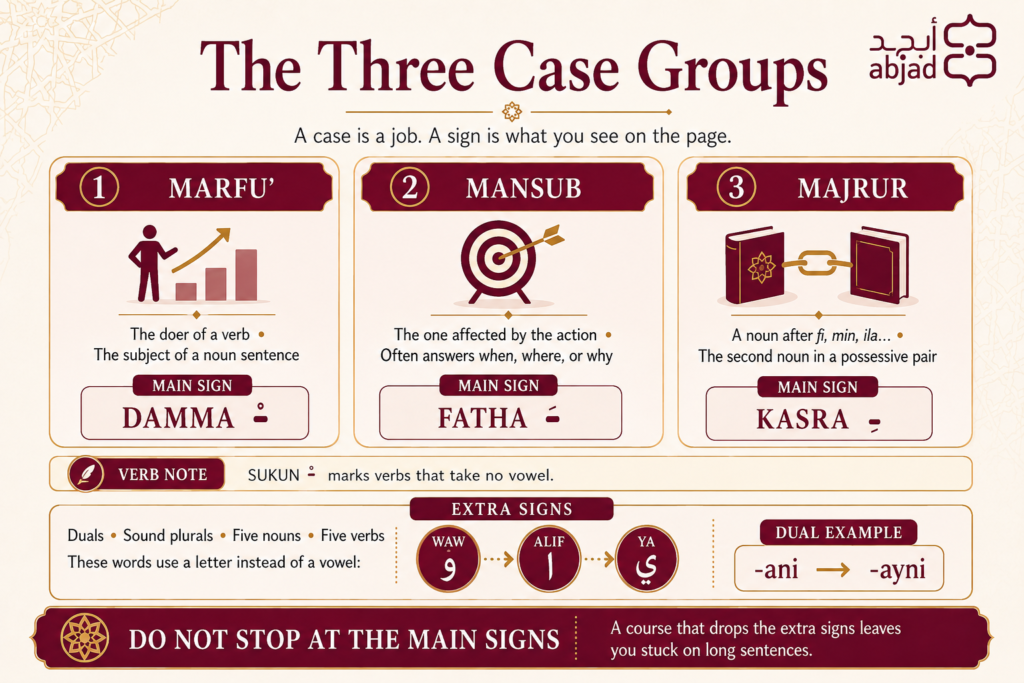
Next come the three case groups: marfu‘, mansub, and majrur. Then come the signs that mark them.
Each group is a job, not a shape.
- Marfu‘ covers the doer of a verb and the subject of a noun sentence.
- Mansub covers the one the action falls on, and most words that answer “when,” “where,” or “why.”
- Majrur covers any noun that comes after fi, min, ila, and the rest of that small set, plus the second half of a possessive pair.
The signs are what you see on the page. The four main ones are damma for marfu’, fatha for mansub, kasra for majrur, and sukun on verbs that take no vowel.
This is where most people get stuck. There are also extra signs, used by dual words, sound plurals, the five nouns, and the five verbs.
These words drop the vowel and use a letter instead, so waw, alif, or ya does the marking job. That is why a dual word ends in -ani in one line and -ayni in the next, with no vowel in sight.
Some free courses teach the main signs and drop the rest. That leaves you stuck on almost any long sentence.
3- Teaching Tawabi’, Kana and Inna, and Sarf
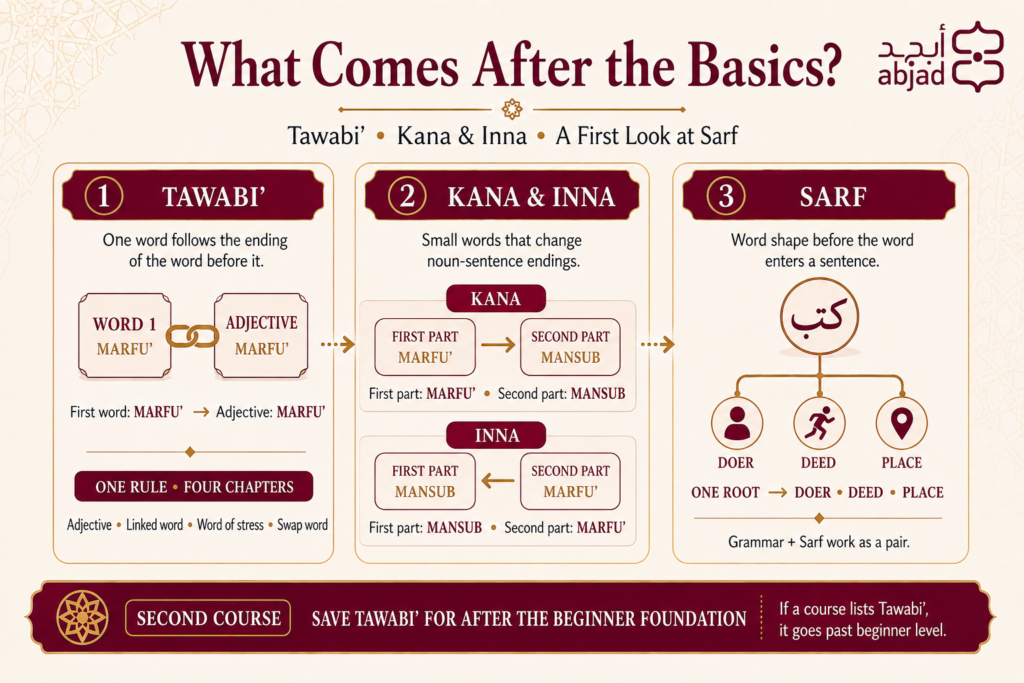
After the basics come the tawabi’, such as the adjective and the linked word. A tabi’ takes its ending from the word in front of it, so it always moves with that word. If the first word is marfu’, the adjective is marfu’ too.
This one rule covers four chapters at once: the adjective, the linked word, the word of stress, and the swap word.
Then come the words that change the endings of other words. Kana and its group lift the first part of a noun sentence and open the second. Inna and its group do the reverse. These small words are the reason a sentence you thought you knew suddenly ends in a different vowel.
Last comes a first look at sarf, which is word shape. Sarf deals with the word before it enters a sentence, so it shows you how one root gives you the doer, the deed, and the place. Grammar and sarf work as a pair, and a good course opens the door to both.
If a course lists tawabi’, it goes past beginner level. Save it for your second course, not your first.
Read also: Quranic Grammar: The Complete Guide to Understanding the Language of the Quran
The Best Free Arabic Grammar Course Options Online
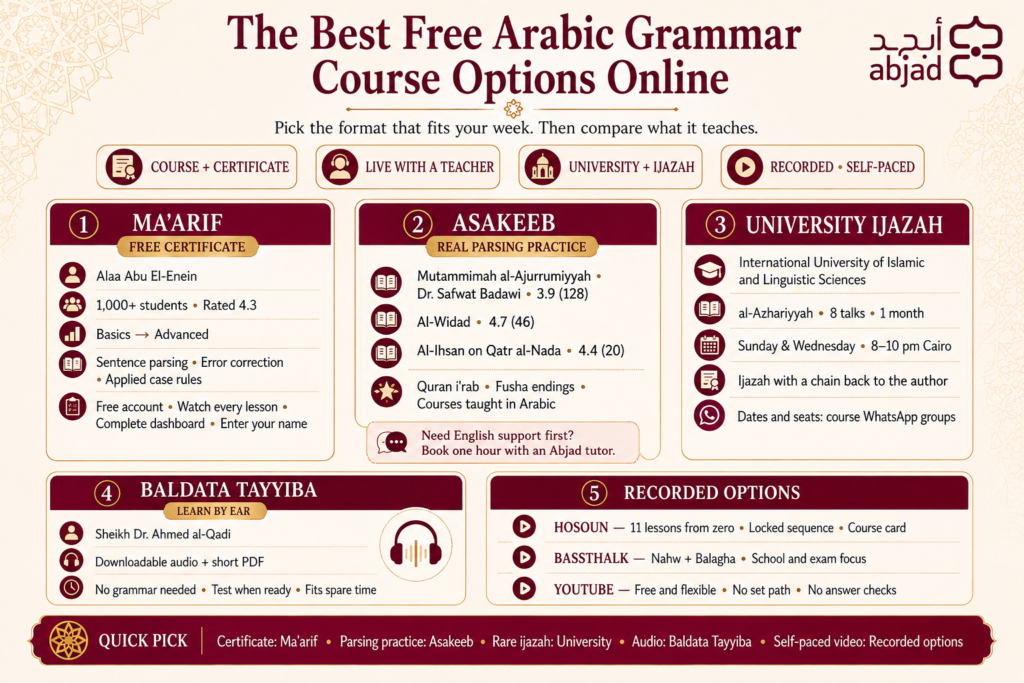
Free courses come in four shapes. Some give a course card. Some run live with a teacher. One runs through a university and ends with an ijazah. The rest are recorded videos you watch at your own pace. Pick the shape that fits your week first. Then compare what they teach.
1- Ma’arif: A Free Grammar Course With A Free Certificate
Ma’arif runs a free Arabic grammar course that takes you from the basics to an advanced level. The teacher is Alaa Abu El-Enein. More than 1,000 students have joined it, and it is rated 4.3.
Everything is free, including the certificate. You need four things: a free Ma’arif account, every lesson watched, your progress ticked off in your dashboard, and your name typed in when the site tells you the course is done. There are no fees at any step.
The course is built around doing, not just knowing. You learn to break a sentence into its parts, spot and fix grammar mistakes in writing, and apply the case rules to real lines of text.
2- Asakeeb: Free Courses Built On Real Parsing Practice
Pick Asakeeb if you want practice, not just lectures. Its Arabic section lists several free courses, and each one names its teacher.
The main course is Mutammimah al-Ajurrumiyyah with Dr. Safwat Badawi, rated 3.9 from 128 reviews. You do not just hear the rules. You parse real text, work through the i’rab of many Quran verses, and train to speak fusha with the right endings.
Two more courses sit beside it. Al-Widad on the Ajurrumiyyah is rated 4.7 from 46 reviews, and it suits new and mid-level students. Al-Ihsan on Qatr al-Nada by Ibn Hisham is rated 4.4 from 20 reviews, and it is the step above.
Not sure your ear can keep up with a class held only in Arabic? Sit with a teacher for one hour first and go through the same chapter in English. Abjad’s tutors do this with new students before they open a classic text. Read our students’ reviews before you book.
3- A Free University Nahw Course With an Ijazah
The International University of Islamic and Linguistic Sciences runs a free nahw course. The text is al-Azhariyyah in the sciences of Arabic by Imam Khalid al-Azhari.
The teacher is Prof. Dr. Muhammad Abd al-Azim Mahmoud Mabrouk, who teaches nahw, sarf, and ‘arud at the Faculty of Dar al-Ulum, Fayoum University.
The book is short, but it covers the whole map. It works through the types of speech, i’rab and bina’, the marfu’at, mansubat, and majrurat, the tawabi’, the governing words, and a closing glimpse of sarf. That means one month of study gives you the full frame of grammar, not a slice of it.
It runs online. There are eight talks in one month, on Sundays and Wednesdays, from 8 to 10 pm Cairo time. It is open to all ages and all levels, and to students from outside the university, anywhere in the world. Those who keep up get an ijazah with a chain back to the author of the book.
That last part is rare, and most paid courses cannot offer it. Intakes are announced on the university’s own page rather than on a fixed course page, so follow it and watch for the next round. Visit the university’s page here.
You may also like: How to Learn to Read Arabic Online for Free?
4- Baldata Tayyiba: A Free Audio Course With a Short Grammar Book
Baldata Tayyiba runs a basics of nahw course with Sheikh Dr. Ahmed al-Qadi. It sits inside the academy’s Arabic language diploma. It is built for people who need grammar to read faith texts the right way.
The setup is simple and smart. You get an audio file to download and a short book as a PDF, Qawa’id Mukhtasara fi al-Nahw al-‘Arabi. You take the test at the end when you feel ready. You need no grammar at all to start.
The course keeps its aim narrow, and that is its strength. You learn the basic jobs words do in a sentence, the rules of the noun sentence and the verb sentence, and how to parse simple lines, with examples drawn from the Quran and the Sunnah. It also flags the mistakes beginners make most often, and it names them, which is the fastest way to stop repeating them.
Audio plus a short book is the format that fits a bus ride. This is the one course here you can finish in spare time.
5- Hosoun, Bassthalk, and YouTube: Offer Free Recorded Courses for Beginners
Hosoun runs a recorded course that starts from zero. It has 11 lessons and is rated 5.0 on the platform. The lessons cover the three word types, the noun sentence and its two parts, the verb sentence and its parts, i’rab and bina’, and drills at the end of each stage.
Two things to know before you begin. First, you must create an account on Hosoun — without one, the lessons stay locked. Second, the videos open in order, so you cannot skip ahead. There is a free 21-minute intro video, so watch that first and see if the teacher’s style suits you. Finish all the lessons and the platform gives you an attendance certificate.
Bassthalk takes a different angle. Its free starter course in nahw and balagha with Muhammad Salah is written for first-year secondary students, so the examples follow the school syllabus. Choose it if you need grammar for exams rather than for classical texts.
YouTube covers what is left. There are full free series there, and short courses that squeeze the basics into a few hours. They cost nothing. But they follow no set order, and no one checks your answers.
Read also: Arabic Grammar Exercises That Actually Make You Better
Which Free Arabic Grammar Course Fits You
Seven free options sounds generous until you have to pick one. The table below lines them up on the four things that actually decide the fit: how the course is delivered, which text and level it teaches, what you hold at the end, and who it suits best.
Read down the last column first, find the row that describes you, then check the format against the time you really have each week.
| Platform | Format | Text and level | Course card | Best for |
| Ma’arif | Recorded, own pace | Basics to strong | Free card | Learners who want proof they finished |
| Asakeeb | Live and recorded | Ajurrumiyyah, Mutammimah, Qatr al-Nada | Varies | Real parsing and Quran verses |
| Int’l University | Live, 8 talks, 1 month | Al-Azhariyyah, mid-level | Ijazah with chain | Students who want a chain |
| Baldata Tayyiba | Audio and PDF | Grammar for faith texts | Test at the end | Study on the move |
| Hosoun | Recorded, 11 lessons | Full beginner | Course card | Starting from zero |
| Bassthalk | Recorded | School nahw and balagha | None listed | School students |
| YouTube | Recorded, no set path | Mixed | None | Fixing one weak chapter |
Read also: How to Learn Quranic Arabic Free Online in the UAE?
Watch Our Classes in Action
Curious what a real session looks like? Take a peek inside our interactive classrooms and see how our expert instructors bring the Arabic language to life. Watch a sample lesson below!
Begin Your Arabic Journey in the UAE
Join Abjad Institute for a professional and immersive Arabic language experience tailored to your goals.
Book Your Free TrialFour Questions to Ask Before You Join a Free Grammar Course
Most people pick a course by its star rating. But a rating only tells you if the teacher speaks well. It says nothing about fit. Run these four checks instead, in this order. Let’s see which free course really fit you.
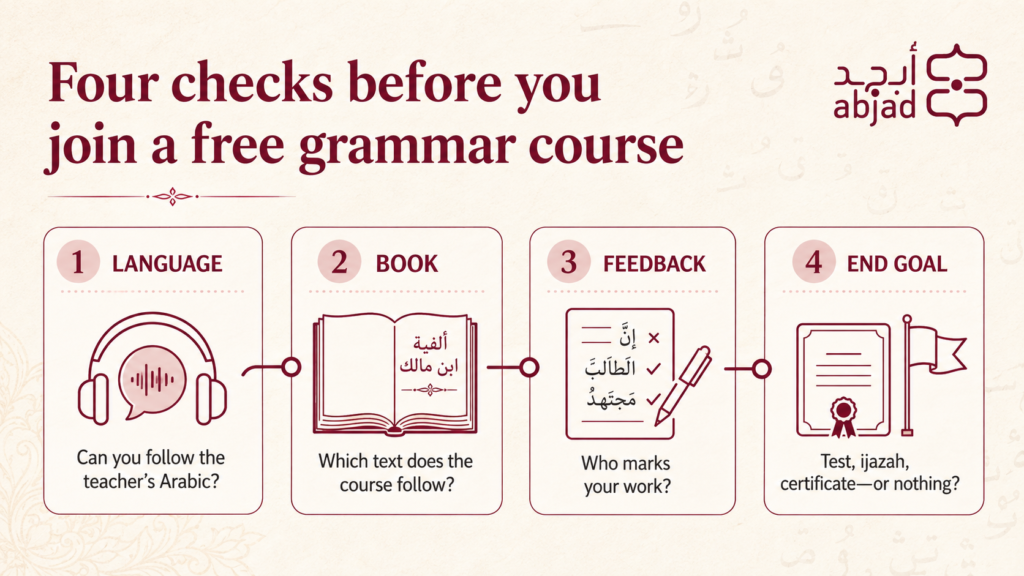
1. Is the Course Taught in Arabic or in Your Language?
Almost every free nahw course above is taught in Arabic, to Arabic speakers. If Arabic is your second language, that is not a bargain. It is a language wall on top of a grammar wall.
Watch for the trap here. You can follow an Arabic lecture on a topic you already know, because you fill the gaps from memory. Grammar gives you nothing to fill the gaps with, so a single missed sentence can cost you the whole rule.
Play the free clip first and listen to the teacher’s speed. Two minutes of listening can save you a month.
2. Which Grammar Book Does the Course Follow?
A course built on a named classical text tells you its level right away. Al-Ajurrumiyyah means beginner. Mutammimah means a step up. Qatr al-Nada means you are expected to reason, not just memorise.
When no book is named, the level is a guess. Some teachers do write their own strong material, so it is not automatically a bad course. It just means you commit first and learn the level later.
So check the book first. It is the fastest level check there is, and it costs you one glance at the course page.
3. Will Anyone Correct Your Parsing?
This question decides the whole outcome. You can pick up rules from a video. You cannot learn to use them unless someone tells you when you got a word wrong.
Live courses do this. Recorded ones do not. That is why many students pair a free video course with one live hour a week, just for feedback.
Abjad’s one-to-one Arabic lessons are built for that. You bring the lines you parsed, and your teacher shows you where the ending went wrong, and why.
4. What Will You Get At the End? A Certificate, An Ijazah, Or Nothing
Free courses end in one of four ways: a certificate, an ijazah, a final test, or nothing at all. Choose the ending that will keep you moving, and choose it before you enrol.
An ending changes how you study. It gives you a date to aim at, and a reason to open lesson six on a week when you would rather skip it. A course with no ending rests on your discipline alone, which is why those are the ones people leave unfinished.
So, be honest about your own record. If you have dropped a free course before, take one with a test or a certificate this time, and treat that ending as part of the course, not a formality at the end of it.
Read also: Arabic Grammar for Beginners – A Step-by-Step Guide
The Book Ladder: Start Your Arabic Grammar With Ajurrumiyyah, Not Alfiyyah
Classical grammar is taught through a fixed set of books, in a fixed order. Each book assumes you have finished the one before it. Read them out of order and the rules stop linking up, which is what people usually mean when they say grammar feels like fog.
Here is the ladder, from the bottom up.
| Step | Book | Level | What it adds | Free course to use |
| 1 | Al-Ajurrumiyyah | Beginner | The shortest complete map of Arabic grammar | Al-Widad on the Ajurrumiyyah |
| 2 | Mutammimah al-Ajurrumiyyah | Beginner to mid | The same map with the detail filled in, including the tawabi’ | Mutammimah class with Dr. Safwat Badawi |
| 3 | Qatr al-Nada (Ibn Hisham) | Mid | Reasoning about the rules, not just memorising them | Al-Ihsan on Qatr al-Nada |
| 4 | Al-Azhariyyah | Mid to upper | Wider coverage, plus a first look at sarf | The free university course with an ijazah |
| 5 | Alfiyyah (Ibn Malik) | Advanced | A thousand lines of grammar in verse, used as a reference | No free course listed here |
Three free courses cover steps 1 to 3, which is the whole foundation. Step 4 is the university course above, and step 5 is for later, once nahw is already in place.
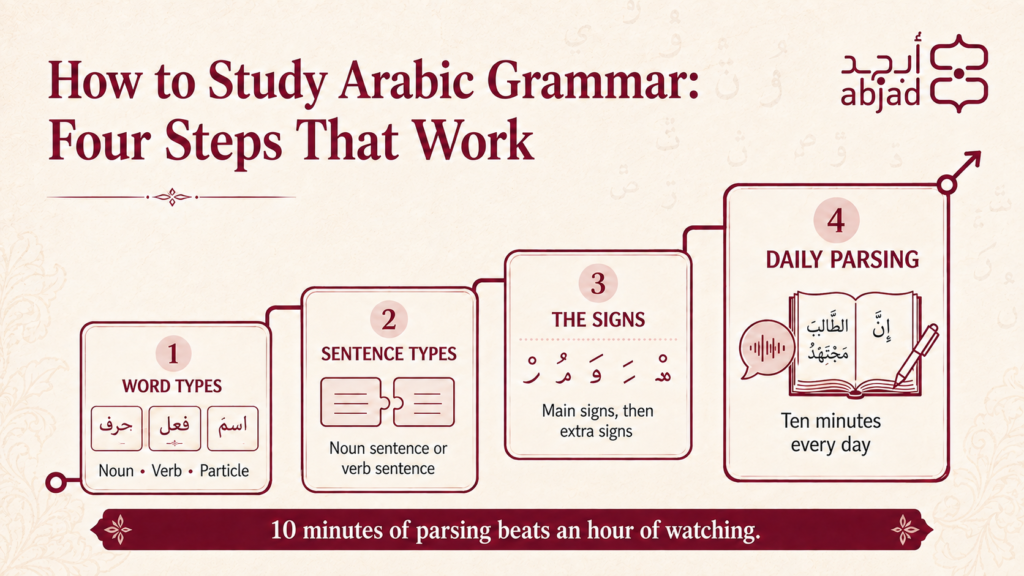
How to Study Arabic Grammar: Four Steps That Work
Grammar falls apart when you treat it as facts to store. Treat it as a skill instead. Every course above follows these four steps, even when it does not name them.
- Word types. Learn to tag any word as a noun, a verb, or a particle, on sight — no hesitating, no working it out.
- Sentence types. Decide whether a sentence is a noun sentence or a verb sentence, then name its parts.
- The signs. Learn the four main case signs first. Then, learn the extra ones, used by dual words, sound plurals, the five nouns, and the five verbs. Do not skip the extra set.
- Daily parsing. Take the shortest lines you can find and parse them out loud, every day. Short Quran verses work best, because the endings are already marked, so you can check yourself on the spot.
Most free starter courses run eight to eleven sessions. Step four is what turns those sessions into skill, and it is the one step no video can do for you. Ten minutes of parsing beats an hour of watching.
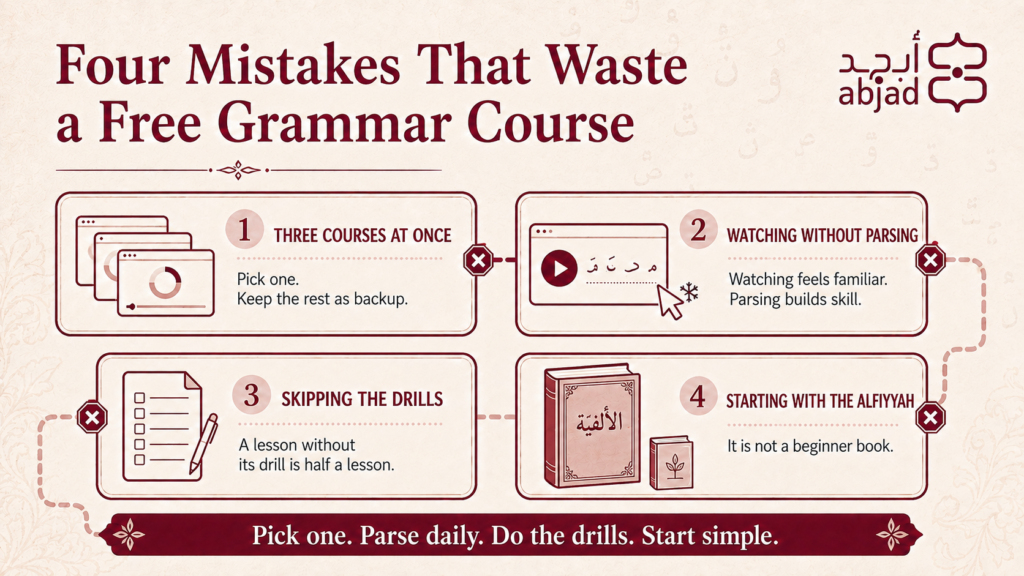
Four Common Mistakes That Waste a Free Grammar Course
A free Arabic grammar course can give you a strong foundation, but only if you study it actively and follow a clear path. Avoid these four common mistakes to turn the lessons into practical grammar skills rather than information you quickly forget.
1. Joining Multiple Grammar Courses at the Same Time
Taking three courses at once usually means covering the same material repeatedly without completing any single curriculum.
Choose one course as your main path, and use the others only when you need another explanation of a difficult topic.
2. Watching Grammar Lessons Without Practicing Parsing
Passive watching creates familiarity with grammar rules, but familiarity is not the same as being able to apply them. After each lesson, practice iʿrāb and sentence parsing so you can recognize grammatical roles even when the vowel marks are removed.
3. Skipping the Grammar Exercises and Practice Drills
Exercises reveal whether you truly understand a rule or simply recognize it when someone else explains it. Complete the drills after every lesson; otherwise, you are skipping the part that turns theoretical knowledge into practical skill.
4. Starting With Al-Alfiyyah Before Learning Basic Nahw
Ibn Malik’s Alfiyyah contains a thousand lines covering Arabic grammar, but it is designed for students who already have a foundation in nahw. Starting there too early can leave you spending more effort decoding the verses than understanding the grammar, so build the fundamentals first.
Inside Our Live Classes
Don’t just take our word for it—see for yourself! Click below to watch short clips from our live classes and meet the instructors who will guide your learning journey.
Read also: Arabic Grammar for Quran – How One Vowel Changes the Meaning of an Ayah
Start Reading Arabic the Right Way – Book Your First Lesson With Abjad
A free course gives you the rules. It cannot give you a teacher who listens to you read, hears the wrong ending, and fixes it on the spot, before the habit sets.
Abjad pairs you with a trained Arabic and Quran teacher for one-to-one lessons online. Your teacher explains at your level, works around your week, and ties every rule to the verses you want to understand. Keep the free course you are on. Your teacher will build the feedback layer around it.
Hamza Osama started with the Arabic alphabet, learned Tajweed, and has now memorised about two juz of the Quran. So, you are the next.
Read Hamza’s review of his lessons.
Check Our Arabic Courses
If you feel an online course is a load rather than a way of learning, don’t worry. A lot of learners feel the same at the start.
You just need a tutor to walk beside you. Have a look at our Arabic courses and pick the one that matches where you are now.
Arabic Courses for Adults and General Learners
- Best Arabic Course in the UAE — the main course, covering reading, writing, listening, and speaking
- Arabic Classes for Adults — built around adult schedules and adult goals
- Learn Arabic from Scratch — for anyone starting with no Arabic at all
- Best Arabic Classes for Beginners — the first steps, taken slowly
- Basic Arabic Course — everyday words and simple sentences
- Learn Arabic Alphabet Course — the 28 letters and their four shapes
- Arabic Intensive Course — more sessions each week for faster progress
- Self-Paced Arabic Course — study on your own timetable
Begin Your Arabic Journey in the UAE
Join Abjad Institute for a professional and immersive Arabic language experience tailored to your goals.
Book Your Free TrialConclusion
A free Arabic grammar course is enough to build a full base in nahw. Ma’arif and Hosoun give you clear beginner video. Asakeeb gives you real parsing through the classical texts. Baldata Tayyiba lets you study by ear. The university course ends with an ijazah and a chain back to the author of the book.
Pick one course, not three. Then run the four questions. Is it taught in Arabic or in your language? Which grammar book does it follow? Will anyone correct your parsing? And what do you get at the end? Start at the Ajurrumiyyah and climb from there, instead of taking the first course your search shows you.
Then add one small daily habit beside the course. Ten minutes of parsing beats an hour of watching, every time.
Read short verses out loud, and check each ending as you go. Keep one page for the mistakes you repeat, because the same three or four will keep coming back. Look at that page once a week, and the rules will start to feel automatic.
Frequently Asked Questions
Can I really learn Arabic grammar for free?
Yes. Ma’arif, Asakeeb, Hosoun, Bassthalk, and Baldata Tayyiba all run free Arabic grammar courses. They cover word types, sentence types, and i’rab, and some hand you a free card at the end. What they rarely give you is feedback on your own parsing.
Which free Arabic grammar course gives a certificate?
Ma’arif gives a free card once you watch every lesson and type your name. Hosoun gives a course card after you finish all its lessons. The university course on al-Azhariyyah goes further, and gives an ijazah with a chain to students who keep up.
Are free Arabic grammar courses taught in English?
Almost none of them are. They are taught in Arabic, for Arabic speakers. That is why many learners pair a free Arabic course with one-to-one lessons in English for the parts they cannot follow.
Which grammar book should a beginner start with?
Start with al-Ajurrumiyyah. It is the shortest full map of Arabic grammar, and every later book leans on it. The free al-Widad course on Asakeeb covers it, and it suits new and mid-level students.
How long does it take to learn basic nahw?
Most free starter courses run eight to eleven sessions, spread over four to eight weeks. But speed is not the point. How fast you can parse a new line depends far more on daily practice than on how quickly you clear the videos.




Leave a Reply