 Learn Arabic
Most people who quit Arabic grammar do not quit because it is too hard. They quit because they studied it in the wrong order. One rule this week. Another rule next month. Three books open at once.
Arabic grammar for beginners works in a different way. Each rule sits on top of the rule before it. So the order matters more than the effort.
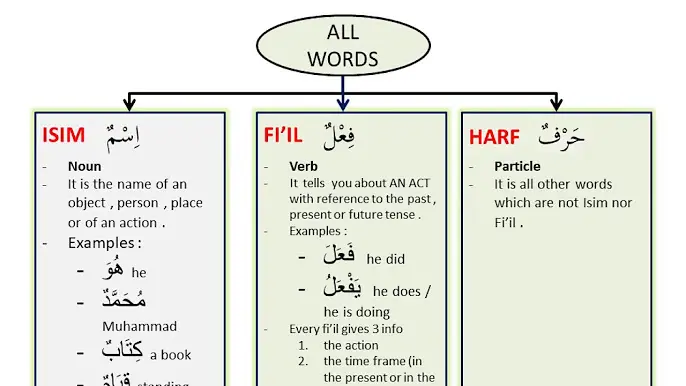
Arabic grammar is called nahw. It is the science of word endings. It tells you how the last vowel of a word changes based on where the word sits in the sentence. That change tells you the meaning.
So, let’s have a look at four things: what to learn first, the four case endings, a study method that works, and the mistakes that waste months.
What you’ll learn
- The three types of words that build every Arabic sentence.
- How the two Arabic sentence types are built.
- The four cases of i’rab and their basic endings.
- A four-pass method for studying one grammar book.
- Which book to use at your level, and which to save for later.
The Three Things To Learn First in Your Journey Of Learning Arabic Grammar
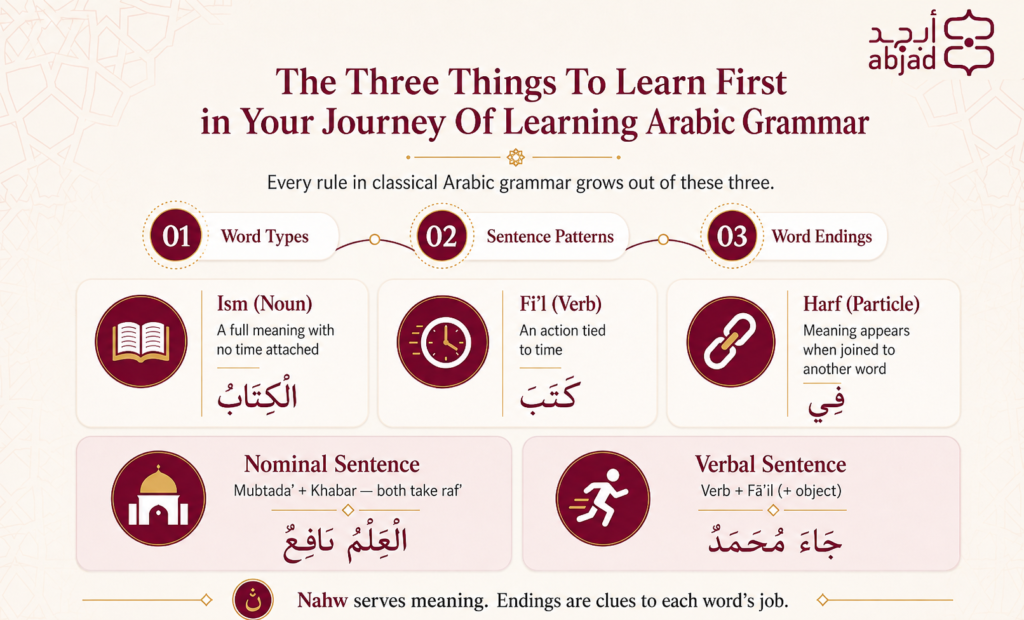
Arabic grammar for beginners means learning three things in order:
- First, the types of words.
- Second, the two sentence patterns those words make.
- Third, the endings that show each word’s job.
Every other rule in classical Arabic grammar grows out of these three.
There is a good reason to start here. Nahw serves meaning. It is not a set of empty rules to memorize. A doer takes a damma because it did the action. An object takes a fatha because the action fell on it. Once you read endings as clues to meaning, you stop forgetting them.
1- The Three Types Of Arabic Words: Noun (Ism), Verb (Fi’l), And Particle (Harf)
Every Arabic word is one of three types. There is no fourth type.
- Ism (noun): a word with a full meaning on its own, with no time attached. Examples: Muhammad, shajarah (tree), kitab (book), jamil (beautiful). Signs of a noun: it takes al- (“the”), it takes tanwin, and it can take the jarr case.
- Fi’l (verb): a word that shows an action tied to a time. There are three kinds. Past: kataba (he wrote). Present: yaktubu (he writes). Command: uktub (write).
- Harf (particle): a word with no full meaning until you join it to something else. Examples: min, ila, fi, ‘an, ‘ala.
This is not just naming. Every parsing choice you make starts here. Nouns and verbs take different endings, and particles take none at all. So you name the word type first, every time.
2- The Two Arabic Sentence Types: Nominal (Starts With A Noun) And Verbal (Starts With A Verb)
Arabic has two sentence types. What the sentence starts with decides which one it is.
- A nominal sentence (jumlah ismiyyah) starts with a noun. It consists of two parts. The mubtada’ is the noun you start with. The khabar is what you say about it. Both take the raf’ case. Example: al-‘ilmu nafi’un (knowledge is useful). Al-‘ilmu is the mubtada’. Nafi’un is the khabar.
- A verbal sentence (jumlah fi’liyyah) starts with a verb. It stands on the verb plus the fa’il, the one who did the action. The fa’il always takes raf’. Example: ja’a Muhammadun (Muhammad came). It can also take an object, the maf’ul bihi, which takes nasb. Example: qara’tu kitaban (I read a book).
Sort every sentence into one of these two shapes before you parse a single word. This one habit removes most of the guessing. It is the fastest win a beginner can get.
3- The Four Grammatical Cases In Arabic And Their Endings: Damma, Fatha, Kasra, Sukun
I’rab means the ending of a word changes with its place in the sentence. Look at ja’a Zaydun, then ra’aytu Zaydan, then marartu bi-Zaydin. The name stays. The ending moves. Bina’ is the opposite. The ending never moves, as with pronouns and words like “this” and “that.”
Learn the four cases with their basic endings first. The extra endings for duals, sound plurals, and the five verbs can wait. Trying to learn every ending at once is a common reason beginners feel lost.
| Case | Basic ending | Used with | Example |
| Raf’ (nominative) | damma | Nouns and present verbs | al-talibu mujtahidun |
| Nasb (accusative) | fatha | Nouns and present verbs | qara’tu kitaban |
| Jarr (genitive) | kasra | Nouns only | dhahabtu ila al-madrasati |
| Jazm (jussive) | sukun | Present verbs only | lam yaktub |
Look at the last two rows again. Only nouns take jarr. Only verbs take jazm. These two rules do half your work for you. If the word is a noun, jazm is out. If it is a verb, jarr is out. Beginners who hold on to this stop giving answers that are not even possible.
Sorting the basic endings from the extra ones is hard to do alone. In Abjad‘s one-to-one Arabic grammar lessons, a tutor walks you through the table and fixes your parsing while you speak. That is where most early confusion clears up.
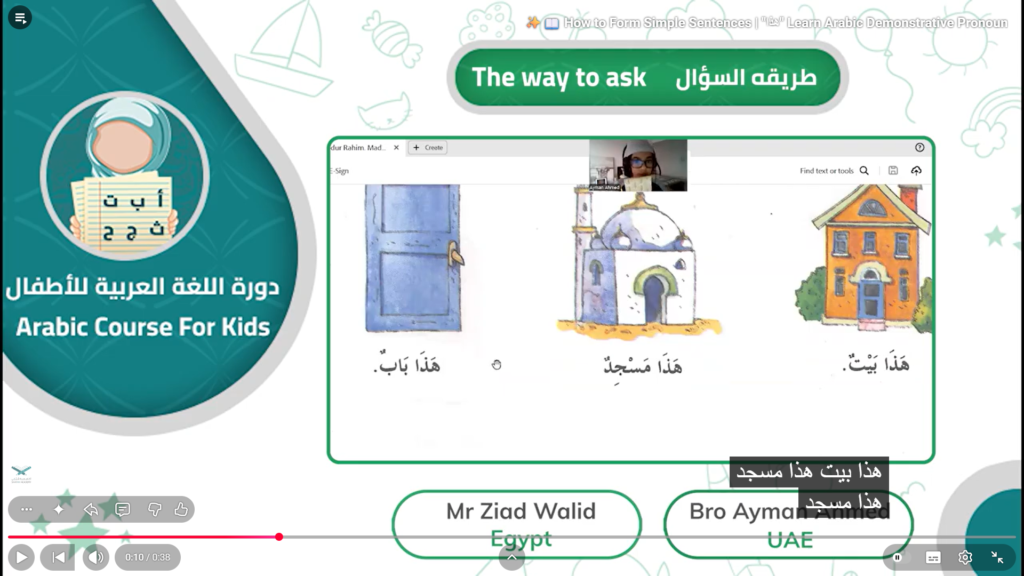
Have a look at a real-life Arabic grammar class with one of our students.
📖 How to Form the Question “ما هذا؟” in Arabic | Arabic for Kids 🎙️✨
You may also like: Learn How to Write and Read Arabic for Beginners
The Four-Steps Plan To Study One Arabic Grammar Book
As a beginner studying an Arabic book is not an easy task. However, this is a plan used by grammar teachers in teaching. This plan is built on repeating one book, not on covering many.
Here is the key idea. Nahw is one long chain. Each chapter rests on the one before it. If you do not understand chapter one, you will not understand chapter two. It will not matter how hard you work on chapter two. So the study has to run without long breaks.
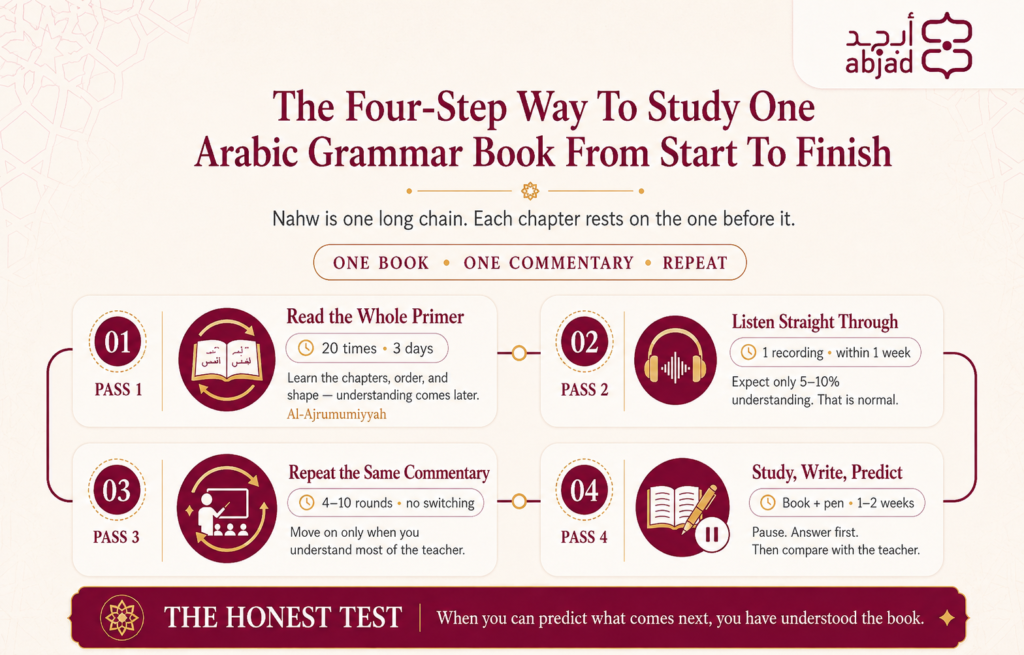
1. Read A Short Beginner Book 20 Times In Three Days, Before Trying To Understand It
Pick a short beginner book. Al-Ajurrumiyyah by Ibn Ajurrum is the normal choice, and it has been the standard first book for centuries. It is only a few pages long. You can read it three or four times in one sitting. Do not buy three books at this stage; one is all this step needs.
Keep it with you for three days and read it about twenty times. Read it out loud when you can, because hearing the words helps them stick. Read it again and again until you know it by heart, or close to it.
You are not trying to understand it yet, so do not stop at a line you cannot follow. Skip past it and keep going. You are trying to move the whole subject through your mind once.
Learn the chapter names. Learn the order. Learn the shape of it. By the end of the three days you should be able to say which chapter comes next without opening the book. That one skill makes step 2 far easier, because you will always know where the teacher is standing in the book.
2. Listen To A Full Recorded Explanation Of The Same Book Within One Week
Now pick one teacher and one recorded explanation of that same book. A short course of five to seven lessons is enough at this stage. Choose the teacher once, then stop looking. Listen to the whole thing from start to end, with no long gaps. Finish it within one week. Listening in the car is fine. Fast is fine.
Do not stop to take notes on this round, and do not rewind a part you missed. Both habits feel careful, but they break the chain and stretch one week into three.
Expect to understand about five to ten percent. That is normal. It is not failure. Your mind always runs a step behind a speaking teacher. While you are still working on point one, he has already moved to points two and three.
So the parts you miss are not the parts you are too weak to grasp; they are the parts you were still busy for.
This step exists only to close that gap. By the end of the week you will not know the rules yet, but you will know where each rule sits in the book. That map is what makes the next round much faster.
Read also: Arabic Grammar for Quran – How One Vowel Changes the Meaning of an Ayah
3. Listen To The Same Lessons Again And Again — Four To Ten Times Worked Perfectly For Most Students
Listen to the same recording again. Then again. Some students get there on the fourth round. Some need all ten.
Each round works because your mind skips what it already holds. The parts you understood last time now pass by quickly. That frees your attention for the next layer, the parts that slipped past you before. This is why the same lesson feels different every time you play it.
This is where most students break the method. They get bored, decide the teacher is not clear, and switch to a new teacher or a new book.
Do not do that. Boredom at this stage is a good sign, because it means the early chapters have settled. A new book would only send you back to chapter one with new terms and a new order.
Staying with one teacher is not stubbornness. It is what lets the layers stack. Move on only when you understand most of what the teacher says.
Watch Our Classes in Action
Curious what a real session looks like? Take a peek inside our interactive classrooms and see how our expert instructors bring the Arabic language to life. Watch a sample lesson below!
Begin Your Arabic Journey in the UAE
Join Abjad Institute for a professional and immersive Arabic language experience tailored to your goals.
Book Your Free Trial4. Take Notes As You Listen, Then Pause The Lesson And Give The Answer For Any Question Before The Teacher Does
Now listen one more time, but slowly and with care. Quiet room. Book open. Pen in hand. Write down the definitions, the conditions, and the categories as the teacher says them. Do not copy every word he says; write only the parts a rule cannot work without. Give this step one or two weeks.
Then test yourself. Play the recording. Every time the teacher starts a new point, pause it. Is he about to parse a sentence? Parse it yourself first, then compare. Is he about to list the conditions of a rule? Say them before he does.
Keep a short note of every answer you got wrong. Those are your real weak points, and there are usually fewer of them than you fear. Read those pages in the book again the same day, while the mistake is still fresh.
Once you are right more often than you are wrong, the book has done its job. That test is far more honest than saying “I finished it.” Reaching the last page only proves you turned the pages.
Read also: Quranic Grammar: A Complete Guide
Four mistakes that stop beginners from understanding Arabic grammar
Most stuck students are not lazy. They are repeating one of these four mistakes.
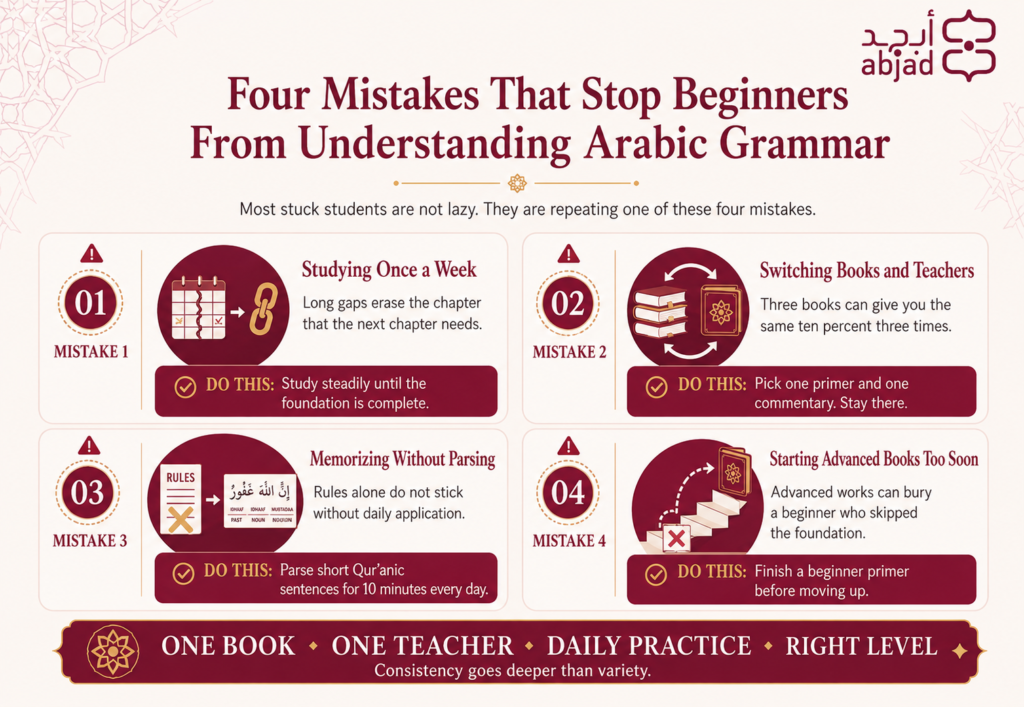
Mistake 1: Studying Grammar Once A Week Instead Of Every Day
One hour a week works for advanced students. They have already understood the basics and are just adding detail. It fails for beginners.
The week-long gap wipes out the chapter that the next chapter needs. You arrive at the new lesson having lost the old one, so you spend the hour rebuilding instead of moving forward. Grammar is not like history, where each lesson can stand on its own.
Miss the chapter on the noun, and the chapter on the doer makes no sense, because a doer is simply a noun with a job. The understanding stage needs steady study until it is done.
Twenty minutes every day beats two hours once a week. Once you understand the whole beginner book, a weekly lesson becomes useful again, but not before.
Mistake 2: Switching Between Different Grammar Books And Teachers
Reading three grammar books gets you the same ten percent three times. Each author uses different terms, a different order, and different habits. So your mind spends its energy getting used to the new book instead of going deeper.
Switching usually feels like progress. A new book looks clearer for the first few pages, because the first pages of every grammar book cover the same easy ground. Then you reach the part that stopped you last time, and it stops you again.
As the old saying goes, reading one book three times beats reading three books once. Pick one short book. Pick one teacher. Stay with both until you understand the whole thing.
Collecting books is a later stage. Once you have understood one book from start to finish, the others become useful, because by then you are comparing instead of starting over.
Read also: Free Arabic Grammar Course – The Best Options Online
Mistake 3: Memorizing Rules Without Parsing Sentences Daily
Rules alone do not stick. Parsing means naming each word in a sentence: its type, its job, and its ending. It is the only way to find out whether you have learned a rule or only read it.
Parse short, simple sentences every day. Start with three or four words, not a long sentence with clauses inside it. Say your answer out loud first, then check it against the book.
Short Quranic verses work best for this. They are brief, fully marked with vowels, and always at hand. Ten minutes a day beats one long session on the weekend. And when you cannot name a word’s job, you have just found your next lesson.
Mistake 4: Starting Advanced Books Before Finishing Beginner Books
Sharh Ibn Aqil and Mughni al-Labib are great books. They will also bury a beginner. They were written for readers who already know the rule and now want the proofs behind it, the exceptions, and the places where scholars disagree. Open one too early and every page raises three questions you have no way to answer.
Levels exist for a reason. Skipping one is what makes people say later, “I am just not good at grammar.” The truth is usually simpler: they opened the right book at the wrong time.
Here is a test before you move up. Can you parse a short sentence without help, and say why each ending is what it is? If not, stay where you are a little longer.
Which Classical Arabic Grammar Book To Study At Each Level, From Beginner To Specialist
Classical Arabic grammar has a clear order of books. Knowing your level keeps you from getting bored or getting crushed. Pick one book at your level and finish it before you look up.
- Beginner: Al-Ajurrumiyyah (Ibn Ajurrum). It is the most famous and the easiest way in. Pair it with Al-Tuhfah al-Saniyyah, its simple explanation. Or use a modern book like Al-Nahw al-Wadih, which is full of exercises.
- Intermediate: Qatr al-Nada (Ibn Hisham), Mulhat al-I’rab (al-Hariri), or Al-Azhariyyah. Each one lifts you a clear step in detail.
- Advanced: Al-Alfiyyah (Ibn Malik) in verse, or Al-Kafiyah (Ibn al-Hajib) in prose. Study one, not both. Sharh Ibn Aqil is the usual companion to the Alfiyyah.
- Specialist: Al-Tashil (Ibn Malik) and Mughni al-Labib (Ibn Hisham).
One warning about studying alone. This subject was passed down through teachers, and it still works best that way. Recordings and modern easy books are the backup plan when no teacher is around. They are not the first choice.
A tutor hears you parse a sentence and fixes the error right then. A recording cannot. That is why serious beginners pair their book with live lessons, and why Abjad teaches Arabic grammar and Quranic Arabic one-to-one.
Brand and link swapped, pointing at the grammar course since that is what the sentence is about. If the surrounding section is Quran-focused, use Quranic Arabic instead.
Have a look at our intensive Arabic course. It is built for serious students who want fast progress, with up to five one-to-one classes a week instead of one.

Inside Our Live Classes
Don’t just take our word for it—see for yourself! Click below to watch short clips from our live classes and meet the instructors who will guide your learning journey.
Read also: Arabic Grammar Exercises That Actually Make You Better
Book A Free Trial Class And Learn Arabic Grammar With A One-To-One Tutor
You do not need another PDF. You need someone to take you through Al-Ajurrumiyyah in order, fix your parsing as you go, and keep the lessons steady so the chapters stack up instead of falling apart.
Abjad teaches Arabic grammar, Quranic Arabic, and Fusha one-to-one. The tutors are native speakers, most of them Al-Azhar graduates, and several hold ijazah in Tajwid and Quran recitation. Classes come in 30 or 45 minutes, one to five times a week, so you can keep the daily rhythm that grammar needs. You also get a free trial class before you pay for anything.
Book a free trial. Tell your tutor you are a complete beginner in nahw. You will get a plan built for your level. You do not have to take our word for it. Hear it yourself from our student Yahia from Canada
Check Our Arabic Courses And Pick The One That Fits Your Level
Grammar is one part of Arabic. Here are the other Abjad courses you can start with, whether you want to read the Quran, speak Fusha, or set your child up with a strong base.
- Arabic Grammar Course — nahw from the ground up, one-to-one.
- Quranic Arabic Course — read the Quran and understand it without a translation.
- Best Arabic Course in the UAE — reading, writing, listening, and speaking together.
- Fusha Arabic Course — speak clear standard Arabic.
- Modern Standard Arabic Course — the formal Arabic of books, news, and school.
- Learn to Write Arabic Course — build a clear hand and correct spelling.
- Arabic Intensive Course — faster progress with more classes each week.
- Arabic Speaking Classes — sessions built around talking, not listening.
- Arabic for Kids Course — a simple start for young learners.
- UAE Kindergarten Arabic Classes — first letters and sounds for the youngest.
- Beginner Arabic for Kids — for a child starting from zero.
- Arabic Grammar for Kids — the rules at a child’s level.
- Teen Arabic Summer Course — keep your Arabic going through the break
Begin Your Arabic Journey in the UAE
Join Abjad Institute for a professional and immersive Arabic language experience tailored to your goals.
Book Your Free TrialConclusion
Arabic grammar for beginners rests on three things. The three word types: ism, fi’l, and harf. The two sentence types: nominal, with its mubtada’ and khabar, and verbal, with its verb and fa’il. And the four cases of i’rab with their basic endings: damma, fatha, kasra, and sukun.
Learn those three blocks in that exact order. Each one uses the block before it. You cannot judge a case ending until you know the word type and the sentence shape.
The content is not the hard part. The method is. Take one short book and one commentary, and pass through them four times. Map it, listen fast, listen again and again, then study it with a pen and test yourself by guessing what the teacher will say.
Study without long gaps. Parse short sentences every day. Do not climb to the next book before you finish the one you are on. And remember the two rules that save you the most time: only nouns take jarr, and only verbs take jazm.
Give yourself a fixed window for the first primer, not an open one. A beginner who studies daily can finish Al-Ajurrumiyyah and understand it in about one to two months. The same book, studied one hour a week, can take a year and still leave gaps.
Do that, and nahw stops being a wall. It becomes what it was meant to be. A tool that lets you read a line of Arabic and know exactly what it means.
Frequently Asked Questions
How long does it take to learn basic Arabic grammar?
A beginner book like Al-Ajurrumiyyah takes a few weeks for the first fast pass. Reaching solid understanding usually takes one to two months of steady study. Your daily time and having a teacher matter more than talent.
What is the best book for Arabic grammar for beginners?
Al-Ajurrumiyyah is the standard beginner book in classical Arabic grammar. Pair it with its simple explanation, Al-Tuhfah al-Saniyyah. If you want a modern book with lots of exercises, use Al-Nahw al-Wadih.
Can I learn Arabic grammar without a teacher?
Yes, you can make real progress with one book plus one recorded commentary. But a teacher is much faster, because grammar mistakes need to be caught as you make them. Studying alone is the backup plan, not the first choice.
What is the difference between i’rab and bina’?
I’rab is when a word’s last vowel changes with its place in the sentence, as in ja’a Zaydun and ra’aytu Zaydan. Bina’ is when the ending never changes, as with pronouns and words like “this.”
Should I learn nahw (syntax) or sarf (morphology) first?
Start with nahw, the study of word endings and sentence structure. It helps you read and understand right away. Sarf, the study of word patterns, comes alongside or just after your first primer.
How do I practice Arabic grammar every day?
Parse two or three short sentences out loud each day. Name each word’s type, its job, and its case. Short Quranic verses are best, since they are brief, fully marked with vowels, and easy to find.





Leave a Reply