 Learn Arabic
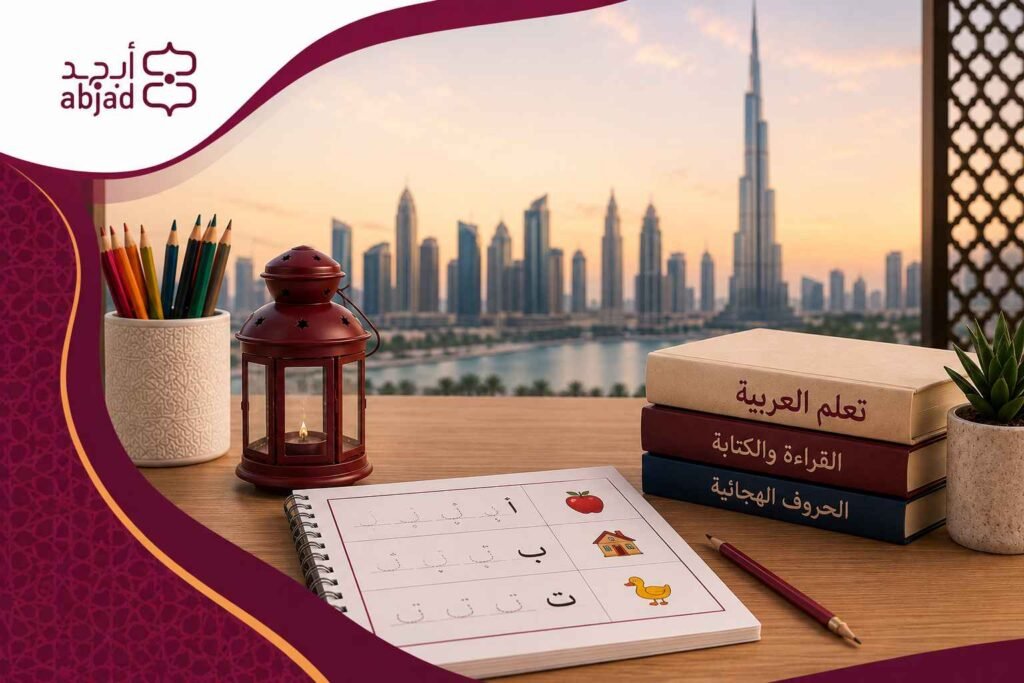
Children growing up in the UAE live at the intersection of languages. Arabic — the official language of the Emirates – shapes school curricula, government services, everyday signage, and religious practice.
Yet for many parents, whether Emirati or expat, finding the right resources to help a child build genuine Arabic literacy can feel like searching for a needle in a haystack. The internet offers hundreds of free downloads; every platform promises quick results; and most worksheets look similar at first glance.
What actually works is more grounded than the marketing suggests. Structured, well-sequenced Arabic worksheets for kids give them a consistent practice path that screens and apps rarely deliver on their own. This guide breaks down the four main worksheet types, what to look for at each age, and how to make home practice connect to what children encounter every day in the UAE.
What You’ll Learn in This Article
- The four most effective Arabic worksheet types for young learners.
- How Arabic letter forms change across word positions — and why that distinction matters.
- How diacritical marks (harakat) prepare children for real reading before they tackle full words.
- What UAE parents should know about Quranic Arabic resources.
- How to match worksheet difficulty to your child’s current stage.
Don’t Miss the Next Holiday Camp
Arabic Worksheets For Kids Cover Far More Ground Than Most Parents Expect
Arabic literacy does not follow the same path as English or French. The script is cursive by nature — letters connect and change shape depending on where they appear in a word — and the language includes sounds that don’t exist in most European languages.
A solid worksheet programme accounts for all of these layers rather than treating Arabic like a straightforward alphabet exercise.
Understanding these structural differences early helps parents choose resources with intention, rather than by trial and error.

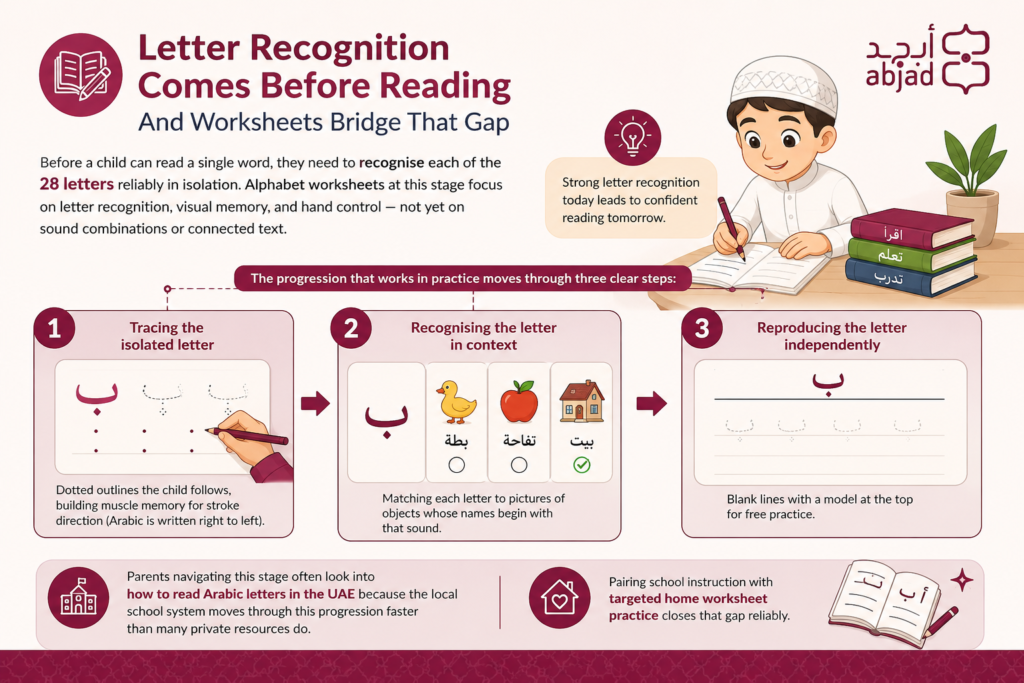
1. Letter Recognition Comes Before Reading And Worksheets Bridge That Gap
Before a child can read a single word, they need to recognise each of the 28 letters reliably in isolation. Alphabet worksheets at this stage focus on letter recognition, visual memory, and hand control — not yet on sound combinations or connected text.
The progression that works in practice moves through three clear steps:
- Tracing the isolated letter — dotted outlines the child follows, building muscle memory for stroke direction (Arabic is written right to left)
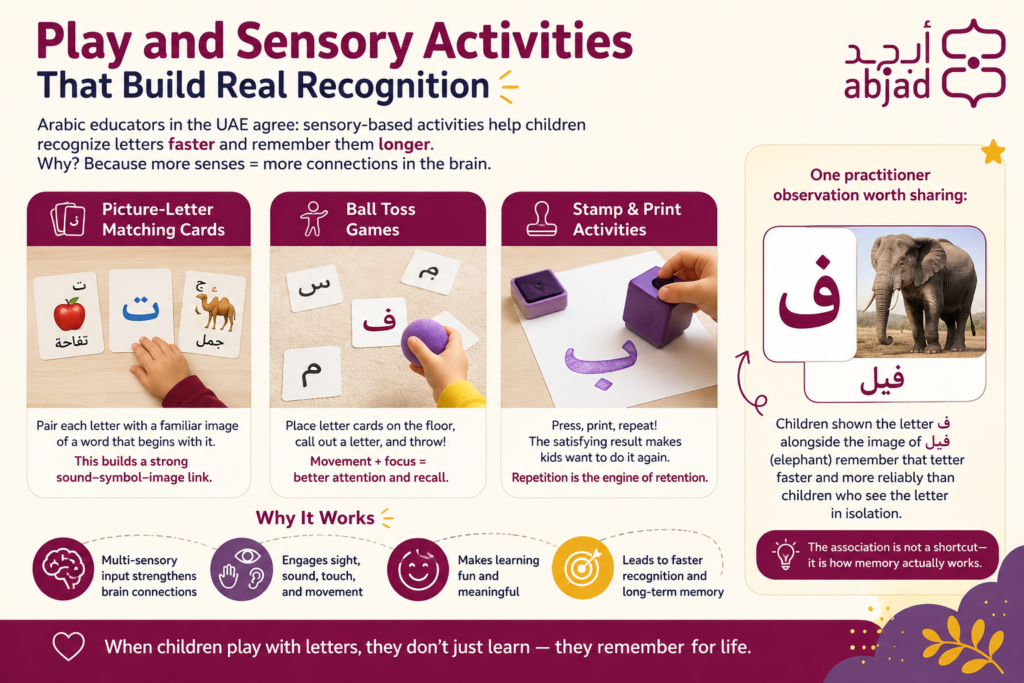
- Recognising the letter in context — matching each letter to pictures of objects whose names begin with that sound
- Reproducing the letter independently — blank lines with a model at the top for free practice
Parents navigating this stage often look into how to read Arabic letters in the UAE because the local school system moves through this progression faster than many private resources do. Pairing school instruction with targeted home worksheet practice closes that gap reliably.
2. The Four Types Of Arabic Worksheets That Build Fluency Step By Step
Not all worksheets serve the same purpose. Using the wrong type at the wrong stage wastes time and, more importantly, can frustrate a child who is not yet ready for the level of abstraction being asked of them.
Letter-and-colour worksheets are the natural entry point. The child traces, colours, and names. Fine motor skills and letter shapes develop together.
Letter-position worksheets address one of Arabic’s defining features: every letter has up to four forms — standalone, initial (beginning of a word), medial (middle), and final (end). Worksheets that show all four positions side by side, with clear examples, are the most efficient way to build this understanding.
Read also: The Best Arabic Activity For Kids In The UAE
Word-building worksheets connect letters into short words. Children practise joining letters they have already learned individually and observe how each letter’s shape shifts when it links to a neighbour.
Harakat worksheets introduce the short vowel marks — fatha (a), kasra (i), and damma (u) — placed above or below letters. Mastering these is essential before children attempt sustained reading, particularly when preparing to read the Quran.
Watch Our Classes in Action
Curious what a real session looks like? Take a peek inside our interactive classrooms and see how our expert instructors bring the Arabic language to life. Watch a sample lesson below!
Begin Your Arabic Journey in the UAE
Join Abjad Institute for a professional and immersive Arabic language experience tailored to your goals.
Book Your Free Trial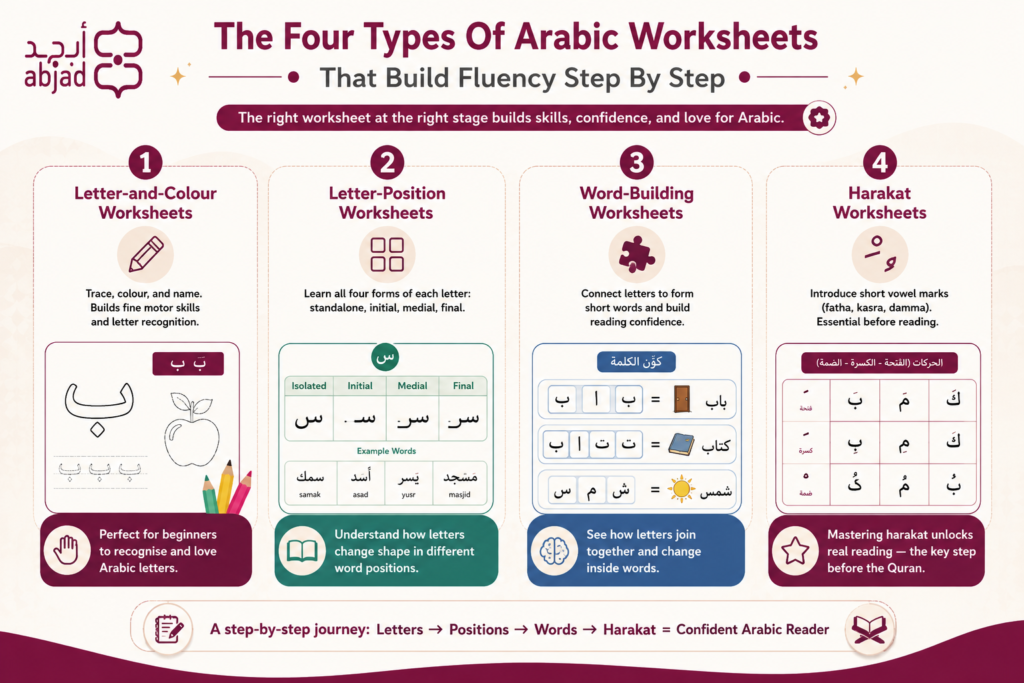
A Good Arabic Worksheet Does Half The Teacher’s Job
The design and sequencing of a worksheet determine whether a child moves forward or simply fills in boxes without learning anything durable. In UAE classrooms, teachers regularly supplement official materials because no curriculum can give every child the individual repetition they need.
A well-designed worksheet meets children at their level, gives them immediate feedback through the structure of the task itself, and allows them to self-correct.
Read also: How To Read Arabic-Indic Numbers (1 To 100) In English?
1. What Separates A Useful Arabic Worksheet From A Pretty One
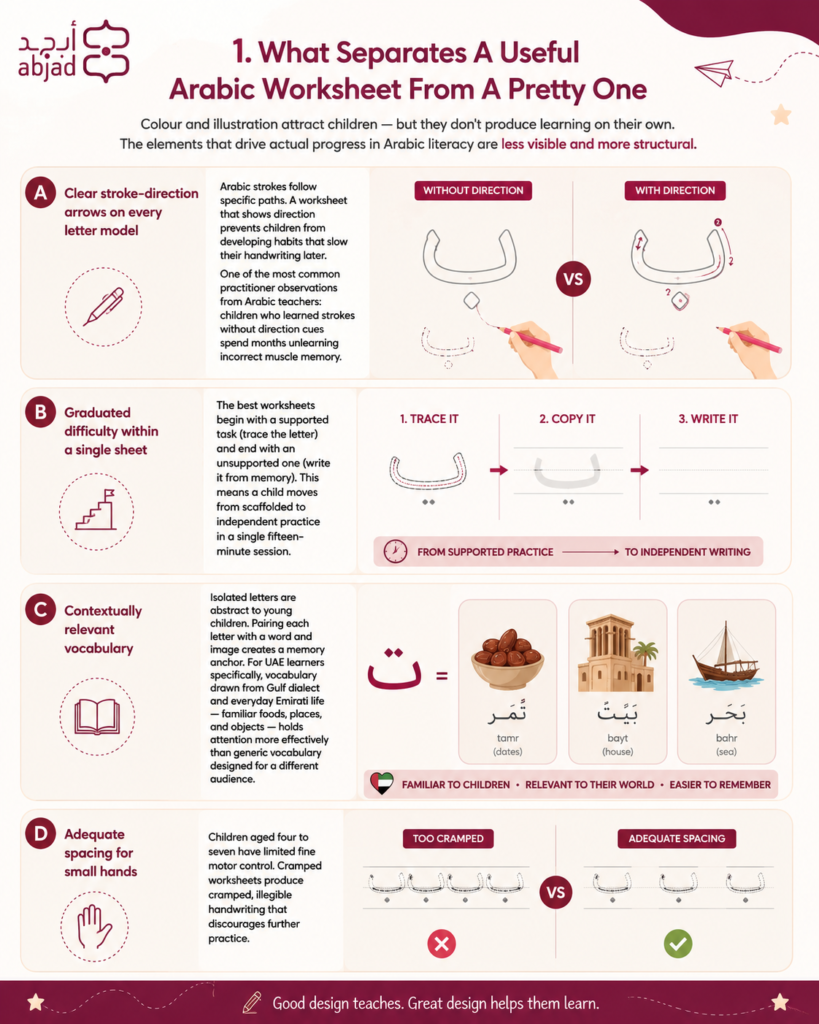
Colour and illustration attract children — but they don’t produce learning on their own. The elements that drive actual progress in Arabic literacy are less visible and more structural.
A. Clear stroke-direction arrows on every letter model
Arabic strokes follow specific paths. A worksheet that shows direction prevents children from developing habits that slow their handwriting later. One of the most common practitioner observations from Arabic teachers: children who learned strokes without direction cues spend months unlearning incorrect muscle memory.
B. Graduated difficulty within a single sheet
The best worksheets begin with a supported task (trace the letter) and end with an unsupported one (write it from memory). This means a child moves from scaffolded to independent practice in a single fifteen-minute session.
Read also: 10 Wonderful Arabic Verse Selections for Kids
C. Contextually relevant vocabulary
Isolated letters are abstract to young children. Pairing each letter with a word and image creates a memory anchor. For UAE learners specifically, vocabulary drawn from Gulf dialect and everyday Emirati life — familiar foods, places, and objects — holds attention more effectively than generic vocabulary designed for a different audience.
D. Adequate spacing for small hands
Children aged four to seven have limited fine motor control. Cramped worksheets produce cramped, illegible handwriting that discourages further practice.
For parents who want to help children understand how to write in Arabic in the UAE as they encounter it on road signs, product labels, and school materials, worksheets that anchor letter shapes to recognisable Emirati context make the learning feel relevant rather than abstract.
Enroll Your Kid Now in Arabic Qaida Course
2. Matching Worksheets To Your Child’s Stage
Ages 3–4 (pre-writing readiness): Focus on pre-writing strokes — curves, lines, and circles. Letter worksheets come later; the goal here is hand control and pencil grip.
Ages 4–5 (KG1): Introduction to the first letters, typically following the UAE Ministry of Education’s phonics-adjacent sequence. Worksheets should feature large isolated letters with generous tracing space and simple colouring activities.
Ages 5–6 (KG2): All 28 letters, with initial exposure to letter positions within words. Word-picture matching begins here, and harakat worksheets become useful as children start sounding out short vowelled words.
Ages 6–8 (Grade 1–2): Connected writing, short sentences, and supported reading aloud. Worksheets shift toward comprehension tasks and dictation support, preparing children for the unvowelled text they will encounter in real Arabic environments.
Read also: How Parents Can Teach Arabic Numbers to Children in the UAE
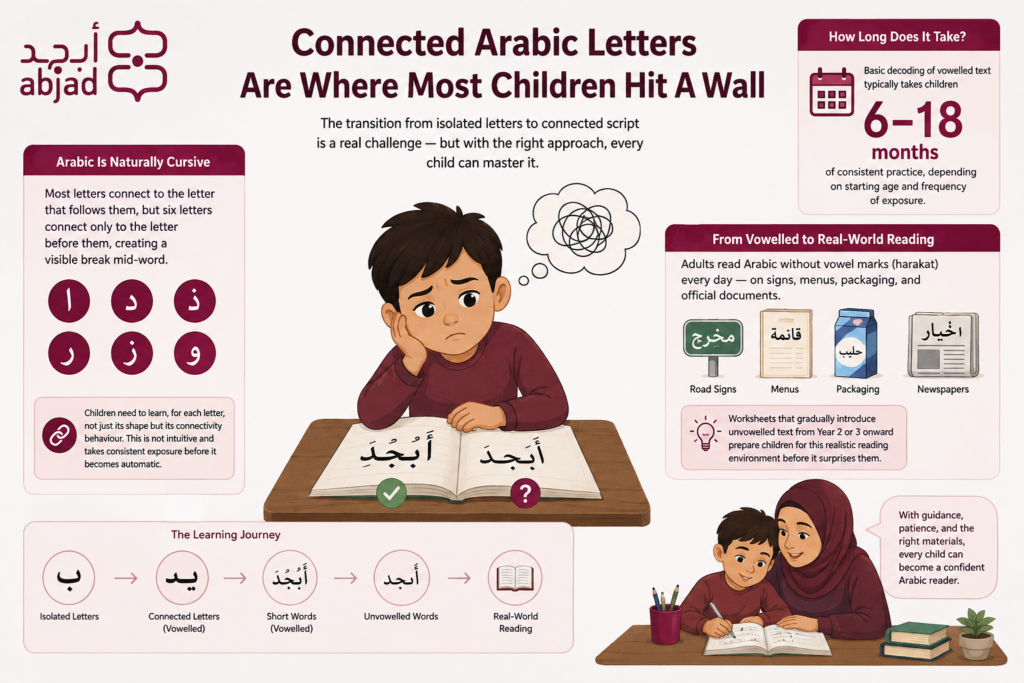
Connected Arabic Letters Are Where Most Children Hit A Wall
Reading isolated letters and reading connected Arabic script are two genuinely different skills. The transition between them is where many children and plenty of adults learning Arabic later in life get stuck. Understanding the mechanics of connected script gives parents the vocabulary to explain the challenge clearly and find the right materials.
Arabic is naturally cursive. Most letters connect to the letter that follows them, but six letters (ا، د، ذ، ر، ز، و) connect only to the letter before them, creating a visible break mid-word. Children need to learn, for each letter, not just its shape but its connectivity behaviour. This is not intuitive and takes consistent exposure before it becomes automatic.
Parents guiding children through this stage often look into how to read Arabic script in the UAE, particularly when children encounter road signs, menus, or school worksheets where vowel marks have been removed. Adult Arabic text, on packaging, newspapers, and official documents, drops harakat entirely, requiring readers to infer vowels from context.
Worksheets that gradually introduce unvowelled text from Year 2 or 3 onward prepare children for this realistic reading environment before it surprises them.
For those wondering how long does it take to learn to read Arabic, the honest answer is: basic decoding of vowelled text typically takes children six to eighteen months of consistent practice, depending on starting age and frequency of exposure.
Quranic Arabic Opens A Different Door Entirely
The Quranic Arabic alphabet is the same 28-letter alphabet used in standard written Arabic — but Quranic text always includes full harakat, which makes it easier to read aloud accurately than most unvowelled text.
The benefits of learning Quranic Arabic extend beyond religious practice. Research in bilingual education consistently shows that children who develop strong literacy in a second or classical language demonstrate improved phonological awareness and reading comprehension across all their languages.
For families building this foundation at home, parents can explore how to read Arabic Quran in the UAE through structured programmes that combine letter-by-letter worksheet practice with guided Tajweed instruction even for very young children. Options range from in-person classes in Dubai and Abu Dhabi to online courses that fit comfortably around school schedules.
Master the Language of the Quran with the first free session of our Quranic Arabic course
Putting Your Arabic Reading Skills Into Practice in Everyday Life
The UAE offers something most Arabic-learning environments cannot replicate: constant, unavoidable real-world exposure. Arabic appears on every road sign, shop front, government building, and food label in the Emirates. This environmental print is an underused resource for parents who want to reinforce what worksheets have taught.
How to read Arabic in the UAE is one of the first practical questions parents — and children — ask as soon as letter recognition begins to stick. Using that curiosity as a learning moment, pointing out letters from worksheets on actual street signs, connecting the sound of a letter to its appearance on a billboard or supermarket shelf, reinforces classroom and home practice in a way that feels like observation rather than study.
For parents who are learning alongside their children, or who want to support reading practice at home without formal Arabic instruction themselves, the option to how to learn to read Arabic online for free is widely available. Structured phonics platforms offer letter-by-letter instruction that mirrors school progression, allowing parents to stay one step ahead and reinforce the day’s lesson effectively.
For non-Arabic-speaking parents looking for learn Arabic for kids resources to use at home alongside worksheets, the most practical starting point is identifying which letters your child is currently studying at school and downloading corresponding practice sheets from UAE-aligned platforms.
Decode the mystery of Arabic Alphabet by joining our course at Abjad Institute
Inside Our Live Classes
Don’t just take our word for it—see for yourself! Click below to watch short clips from our live classes and meet the instructors who will guide your learning journey.
Begin Your Arabic Journey in the UAE
Join Abjad Institute for a professional and immersive Arabic language experience tailored to your goals.
Book Your Free Trial
Start Your Child’s Arabic Journey At Abjad Institute The Right Choice
Worksheets build habits and reinforce what has been taught — but there is a ceiling to what printed exercises can achieve on their own. Children eventually need real instruction, genuine feedback, and structured conversation to move beyond mechanical letter recognition into fluent, confident Arabic.
Abjad Institute is a UAE-based Arabic language institute with a purpose-built curriculum designed for learners of every age and background. Every course is developed by specialists who understand the UAE’s linguistic environment and the needs of children growing up in a multilingual, fast-moving city.
Discover Our Arabic Courses:
- Arabic Course in the UAE
- Arabic Intensive Course
- Learn Arabic from Scratch Course
- Madinah Arabic Course
- Arabic Classes for Adults
- Arabic Classes for Beginners
- Self-Paced Arabic Course
- Basic Arabic Course
- Arabic Speaking Classes
- Learn to Write Arabic Course
- Arabic Grammar Course
- Learn Arabic Alphabet Course

Conclusion
The most effective approach to early Arabic literacy is not complicated. Children who practise with a small number of well-chosen worksheets regularly, four to five times a week, for fifteen to twenty focused minutes, consistently outperform children who study for longer sessions scattered across the month.
Routine beats intensity at this age, and short frequent practice is how the Arabic alphabet stops feeling foreign and starts feeling familiar. The framework is straightforward: begin with letter recognition and tracing, move to letter-position awareness, introduce harakat, then transition to simple connected words.
Align worksheet content with what your child is currently learning at school, so home practice reinforces rather than confuses. Use the UAE environment, the Arabic text surrounding every child in the Emirates every single day, as a living extension of the worksheet.
And when worksheets have done their work, structured teaching takes the next step. The two are not alternatives; they are sequential stages in the same journey toward genuine Arabic literacy.
Frequently Asked Questions
What age should a child start Arabic worksheets?
Pre-writing readiness worksheets — tracing curves, lines, and simple shapes — are appropriate from age three. Letter-specific worksheets are typically introduced at KG1 (ages four to five), following the UAE Ministry of Education’s standard progression. Starting with pre-writing exercises prevents frustration and builds the hand control that makes letter tracing productive.
How many Arabic worksheets should a child complete per day?
One to two focused worksheets per session is sufficient for children under seven. Concentration and quality of engagement matter far more than volume. A child who completes one worksheet attentively learns more than a child who fills in five while distracted.
Are free printable Arabic worksheets good enough, or is a structured workbook worth the investment?
Free worksheets work well for letter-by-letter practice and targeted revision. A structured workbook adds sequencing — each page builds on the previous one — which is difficult to replicate by downloading individual sheets. Families with time to select and organise free sheets carefully can do so effectively; busy households benefit from a ready-sequenced workbook that removes the curation work.
Do Arabic worksheets help with Quran reading?
Yes, though the connection is specific. General Arabic worksheets build letter recognition and handwriting skills that directly support Quran reading. Dedicated Quranic resources then add harakat reading, Tajweed pronunciation rules, and Quranic vocabulary. For children whose primary goal is reading the Quran, using both types in parallel is more effective than relying on standard Arabic worksheets alone.
Should UAE expat children learn Arabic through worksheets or through structured classes?
Worksheets are a support tool, not a substitute for instruction. Expat children learning Arabic as an additional language benefit most from structured classes — which provide correction, immediate feedback, and genuine interaction — supplemented by consistent worksheet practice at home. The two approaches used together reliably produce faster and more durable progress than either one alone.




Leave a Reply